

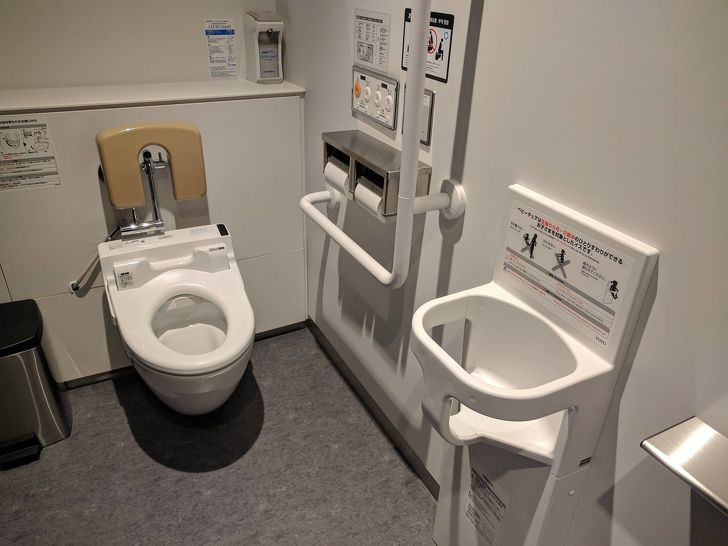
A restroom area in Japan: there are separate restrooms for the elderly, handrails along the toilet bowl for users to hold onto when standing up or sitting down, and a seat for babies aged 6 months to 2 years old while waiting for their mothers to use the restroom - Image source: Mirachan
As Tuoi Tre Online reported: The need for personal hygiene is essential, but it has become a source of frustration for passengers on highways recently.
Some readers have commented that, despite improvements, the condition of restrooms in many places, not just on highways, is still a matter of concern.
Some even argue that toilets in many places in Vietnam are off-putting to both domestic and foreign tourists.
Some suggest that we should look at how the Japanese approach tourism , starting from the restroom, and not dismiss this as a minor issue.
Nguyen Van My, a tourism expert who has led many tour groups to Japan, shared his thoughts on this matter.
The toilet has a baby seat and armrests to assist the elderly.
In recent years, the number of Vietnamese tourists visiting Japan has been steadily increasing due to the appeal of Japanese culture.
But the most impressive thing for me, and also for the members of the Japanese Famtrip group traveling by Kintetsu train, was... the restrooms!
Upon landing at Nagoya Airport, a small prefecture in central Japan, visitors are immediately struck by the unusual restroom system. Clean, spacious, elegant, and diverse in style, design, and amenities.
Most restrooms have air conditioning (in summer) and heated toilet seats (in winter). They also feature automatic hot water spraying and drying, as well as sound and music.
In addition, there are extra features such as baby seats, changing tables, support arms for the elderly and infirm, power outlets, tables or hooks for hanging bags… Many places even have remote controls.
Next to them, there are still some simple toilet stalls, equipped only with squat or flush toilets.
My Japanese friends said these toilets are for nostalgic people or tourists from other countries who aren't used to using modern restrooms. The public sinks are like a 4- or 5-star service, and you can even drink the water directly from the taps.
In smaller provinces and rural areas, toilets are always separate from bathtubs. In central areas, they are designed as a combined space. Whether shared or separate, they strictly adhere to the principles of Japanese toilets, emphasizing efficiency and making the most efficient use of every square inch of space.
Japanese people rarely use English, relying mainly on Japanese. However, the visual symbols are clear and easy to understand. Of course, first-time users should look carefully and avoid pressing buttons randomly.
Japanese hotels typically don't offer bottled water. If you're thirsty in the middle of the night, just go to the restroom and drink as much as you like. Or you can get up to boil water for coffee or buy canned water with coins from the vendors in the hallway.
In Japan, you don't have to worry about finding or being embarrassed by unpleasant smells. Japan is probably the only country with a Japan Toilet Association.
Every year, the Japan Toilet Association holds a competition to design beautiful and impressive toilets, and awards prizes for toilets.
Why is the toilet so important?
The Japanese believe that the toilet is the most private space, the most important need, and therefore should be given the highest priority.
It's worth remembering that, in preparation for the 2020 Olympic and Paralympic Games, the government even organized a national toilet design competition and formally awarded prizes to the most innovative toilet designs.
They design toilets not simply to fulfill basic needs, but also to provide convenience for users, even elevating them to an art form.
Toilets in this country have heating functions for winter, and more modern ones even include water spraying systems, dryers, deodorizers, and sound systems.
The Japanese assert that their excellent toilet system has contributed to economic development and shaped the unique cultural identity of Japan.
Throughout Japan, restrooms are always, in the truest sense of the word, restrooms.
A lack of clean and dirty toilets is the most effective way to drive away customers. Japanese toilets are one of the reasons tourists visit and return to Japan.
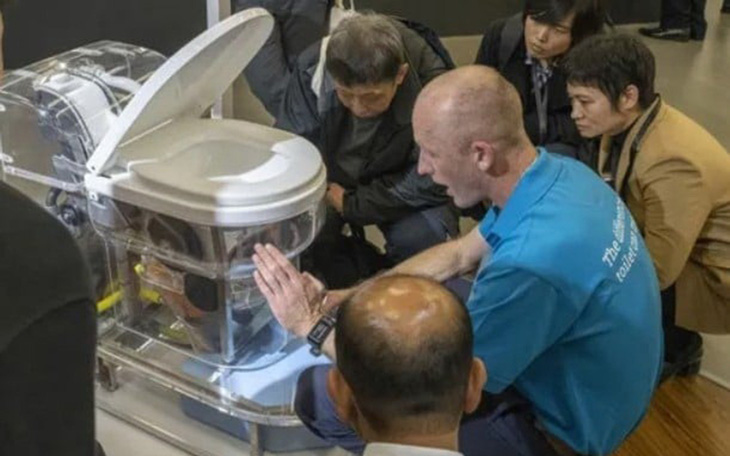 The toilet of the future: the toilet bowl will know how to... diagnose problems.
Source: https://tuoitre.vn/thu-hut-khach-du-lich-tu-nha-ve-sinh-20240701081322598.htm
![[Photo] Diary of the photojournalism contest “Vietnam on the journey of innovation”](https://vphoto.vietnam.vn/thumb/1200x675/vietnam/resource/IMAGE/2026/03/09/1773041117692_anh-man-hinh-2026-03-09-luc-14-24-45.png)
![[Image] Vietnam's diverse colors on its journey of innovation](https://vphoto.vietnam.vn/thumb/1200x675/vietnam/resource/IMAGE/2026/03/09/1773041390813_anh-man-hinh-2026-03-09-luc-14-28-17.png)
![[Image] 20 islands in the Spratly Islands special administrative region hold early elections.](https://vphoto.vietnam.vn/thumb/1200x675/vietnam/resource/IMAGE/2026/03/08/1772949669607_img-20260308-112026-90-jpg.webp)
































![[Photo] Diary of the photojournalism contest “Vietnam on the journey of innovation”](https://vphoto.vietnam.vn/thumb/402x226/vietnam/resource/IMAGE/2026/03/09/1773041117692_anh-man-hinh-2026-03-09-luc-14-24-45.png)














Comment (0)