

The "Cultural Festival for Peace " program helps many young people in Hanoi to better understand and love the city they live in, and appreciate the contributions of previous generations...
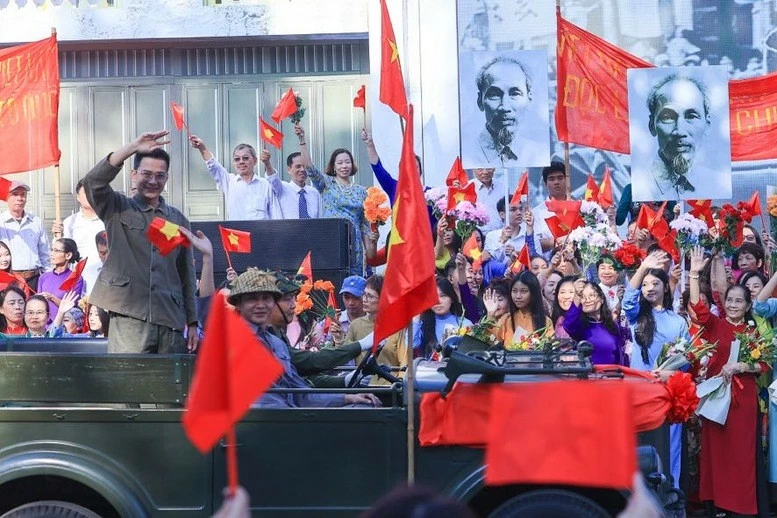 |
| The performance reenacts the scene of the army marching to take over Hanoi during the historic moment of October 10, 1954. (Source: VGP) |
The "Cultural Festival for Peace" program, celebrating the 70th anniversary of the Liberation of Hanoi, took place on October 6th. The highlight was a reenactment of the momentous historical event of October 10th, 1954, when the army marched in to take over the capital. The festival recreated familiar images such as the Long Bien Bridge, where the army entered; and the Hanoi Flagpole, where the red flag with a yellow star was first flown during the first flag-raising ceremony.
The event's main stage, elaborately designed, recreated historical landmarks and famous sites associated with the capital city, such as the five city gates, Doan Mon Gate, Long Bien Bridge, and the Hanoi Flagpole.
Walking around Hoan Kiem Lake that day, I suddenly remembered an entrance exam for the Broadcasting and Television Department of a journalism school. When asked, "Name five gates of Hanoi," a student who grew up in Hai Ba Trung district innocently listed: East Gate, West Gate, South Gate, North Gate. When the examiner asked about the remaining gate, she just smiled awkwardly. If this program had been held earlier, that student wouldn't have been in such an embarrassing situation.
Indeed, history lessons in the past were primarily taught in classrooms. While called history, the content was more like mathematics due to the abundance of numbers: dates, troop numbers, equipment, casualties, etc. The teaching and learning methods failed to help students develop their own understanding of historical events.
For a long time, young people were stereotyped as hating history and lacking knowledge about their ancestors. Videos like "Quang Trung and Nguyen Hue were brothers" further reinforced this prejudice. It wasn't until recent years that Generation Z and social media cleared up this generational misunderstanding. While history lessons were previously primarily taught in schools and through textbooks, today young people have countless ways to access history quickly and accurately.
"Historical content" is also trending, similar to songs and catchphrases popular among young people. TikTokers and YouTubers are not only storytellers but also artists, making historical events more vivid and relatable than ever before. They "understand" the language, preferences, and behaviors of their peers, thereby creating historical content that is relevant and relatable to viewers. Clever slang phrases and viral phrases tell historical stories.
It's wonderful that the Hanoi City Party Committee has caught up with the trend and understands the youth! No lengthy speeches, no outdated songs… the program helped attendees relive the atmosphere of the flag-filled days 70 years ago, admire the heroic troops returning to take over the capital, and better understand the iconic landmarks that have been immortalized in poetry. Watching the parade at Hoan Kiem Lake suddenly became a "trend," even though young people had to wake up very early to secure a good spot.
Thanks to its creative organization, the "Cultural Festival for Peace" not only successfully fulfilled its political mission but also helped participants deepen their historical memories of the capital, inspiring them to learn and explore. Joining in the joyful atmosphere of the capital, the program gave many young people in Hanoi the opportunity to better understand and love their city, appreciate the contributions of previous generations, and awaken in them a profound sense of pride in their homeland.
Source: https://baoquocte.vn/mung-ngay-giai-phong-thu-do-ke-su-sang-tao-va-song-dong-289554.html






![[Video] Hue and Quang Ninh mark strong tourism growth](https://vphoto.vietnam.vn/thumb/402x226/vietnam/resource/IMAGE/2025/12/12/1765555481742_dung00-22-16-02still007-jpg.webp)






















































Comment (0)