

DNVN - The forest carbon credit market is facing many difficulties and challenges related to a range of factors such as institutions and policies; the readiness of the domestic market and the forestry sector; the mobilization of investment resources and technical support; and the capacity of stakeholders…
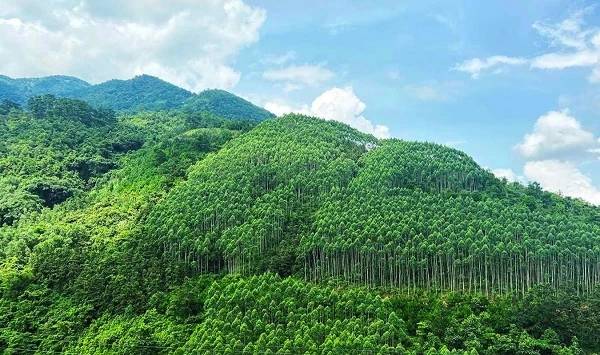
Deforestation, degradation of natural forests, and ineffective management of production forests are the causes of natural resource depletion and increased greenhouse gas emissions. Forest protection is a key task for Vietnam to realize its goal of net-zero emissions.
Vietnam aims to maintain a stable national forest cover rate of 42% to 43%; plant approximately 238,000 hectares of forest each year and seek ways to restore natural forests to combat climate change.
According to the Ministry of Natural Resources and Environment , forest carbon credits are currently receiving special attention from Vietnam's forestry sector. It is estimated that between 2021 and 2030, Vietnam will possess approximately 40-70 million forest carbon credits that can be sold on the global carbon credit market.
Developing the forest carbon market contributes to achieving the goal of "Planting one billion trees between 2021 and 2025" and Net-zero by 2050. Over the years, the expansion of forest area has helped the forestry sector meet its emission reduction commitments, opening up enormous potential to participate in domestic and global carbon markets.
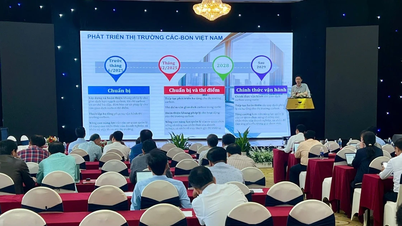
Speaking at the workshop "Promoting the Value of Forest Resources in Alignment with Net-Zero Goals and Sustainable Development" on the afternoon of September 24th, Mr. Luong Quang Huy - Head of the Climate Change Department, Ministry of Natural Resources and Environment, stated that the forest carbon credit market has advantages in terms of experience in piloting Emission Reduction Payment Agreements (ERPA). At the same time, it offers opportunities to attract support from the international community and has many investors interested in cooperating to exchange and trade forest carbon credits.
However, the forest carbon credit market is facing many difficulties and challenges related to a range of factors such as institutions and policies; the readiness of the domestic market and the forestry sector; the mobilization of investment resources and technical support; and the capacity of stakeholders…
In particular, according to Mr. Huy, the legal framework and mechanisms and policies regarding the forest carbon market are lacking or not specifically defined. Forest carbon standards and a system for measurement, reporting, assessment, and credit issuance for application to the domestic carbon market have not yet been established.
While international standards impose very high technical, environmental, and social requirements for assessing, evaluating, and granting forest carbon credits, each partner country has different regulations, resulting in variations in the content, negotiation methods, signing, and implementation of ERPA agreements.
Furthermore, the upfront funding required for project development, reporting, evaluation, and credit issuance is relatively large. Currently, there is no established valuation for forest carbon credits to serve as a basis for price negotiations with buyers.
According to Ms. Nghiem Phuong Thuy from the Forestry Department, Ministry of Agriculture and Rural Development , the difficulties of the forest carbon credit market are also related to media and public opinion regarding forest carbon credits; the domestic market's demand for carbon credits; and the Nationally Determined Contribution (NDC) of the forestry sector, as well as state investment in forest protection and development.
Therefore, it is necessary to continue implementing emission reduction programs and conducting pilot studies on high-quality carbon credits (green carbon). Promoting communication and technical training activities; researching the allocation of NDC quotas and credit potential for localities.
At the same time, it is necessary to improve the institutional and policy framework for the transfer and financial management of revenue from forest carbon credits. It is also necessary to develop Vietnamese forest carbon standards and operational mechanisms, as well as guidelines for the development and pilot implementation of several potentially promising projects.
Galaxy
Source: https://doanhnghiepvn.vn/kinh-te/thi-truong-tin-chi-carbon-rung-gap-nhieu-thach-thuc/20240924042432393

![[Image] Leaked images ahead of the 2025 Community Action Awards gala.](/_next/image?url=https%3A%2F%2Fvphoto.vietnam.vn%2Fthumb%2F1200x675%2Fvietnam%2Fresource%2FIMAGE%2F2025%2F12%2F16%2F1765882828720_ndo_br_thiet-ke-chua-co-ten-45-png.webp&w=3840&q=75)
![[Photo] Prime Minister Pham Minh Chinh receives the Governor of Tochigi Province (Japan)](/_next/image?url=https%3A%2F%2Fvphoto.vietnam.vn%2Fthumb%2F1200x675%2Fvietnam%2Fresource%2FIMAGE%2F2025%2F12%2F16%2F1765892133176_dsc-8082-6425-jpg.webp&w=3840&q=75)
![[Photo] Prime Minister Pham Minh Chinh receives Lao Minister of Education and Sports Thongsalith Mangnormek](/_next/image?url=https%3A%2F%2Fvphoto.vietnam.vn%2Fthumb%2F1200x675%2Fvietnam%2Fresource%2FIMAGE%2F2025%2F12%2F16%2F1765876834721_dsc-7519-jpg.webp&w=3840&q=75)
![[Live] 2025 Community Action Awards Gala](/_next/image?url=https%3A%2F%2Fvphoto.vietnam.vn%2Fthumb%2F1200x675%2Fvietnam%2Fresource%2FIMAGE%2F2025%2F12%2F16%2F1765899631650_ndo_tr_z7334013144784-9f9fe10a6d63584c85aff40f2957c250-jpg.webp&w=3840&q=75)























































































Comment (0)