

The "two sessions," namely the National People's Congress (NPC) and the Chinese People's Political Consultative Conference (CPPCC), are expected to provide further impetus to China's goal of continuing comprehensive and deeper reforms.
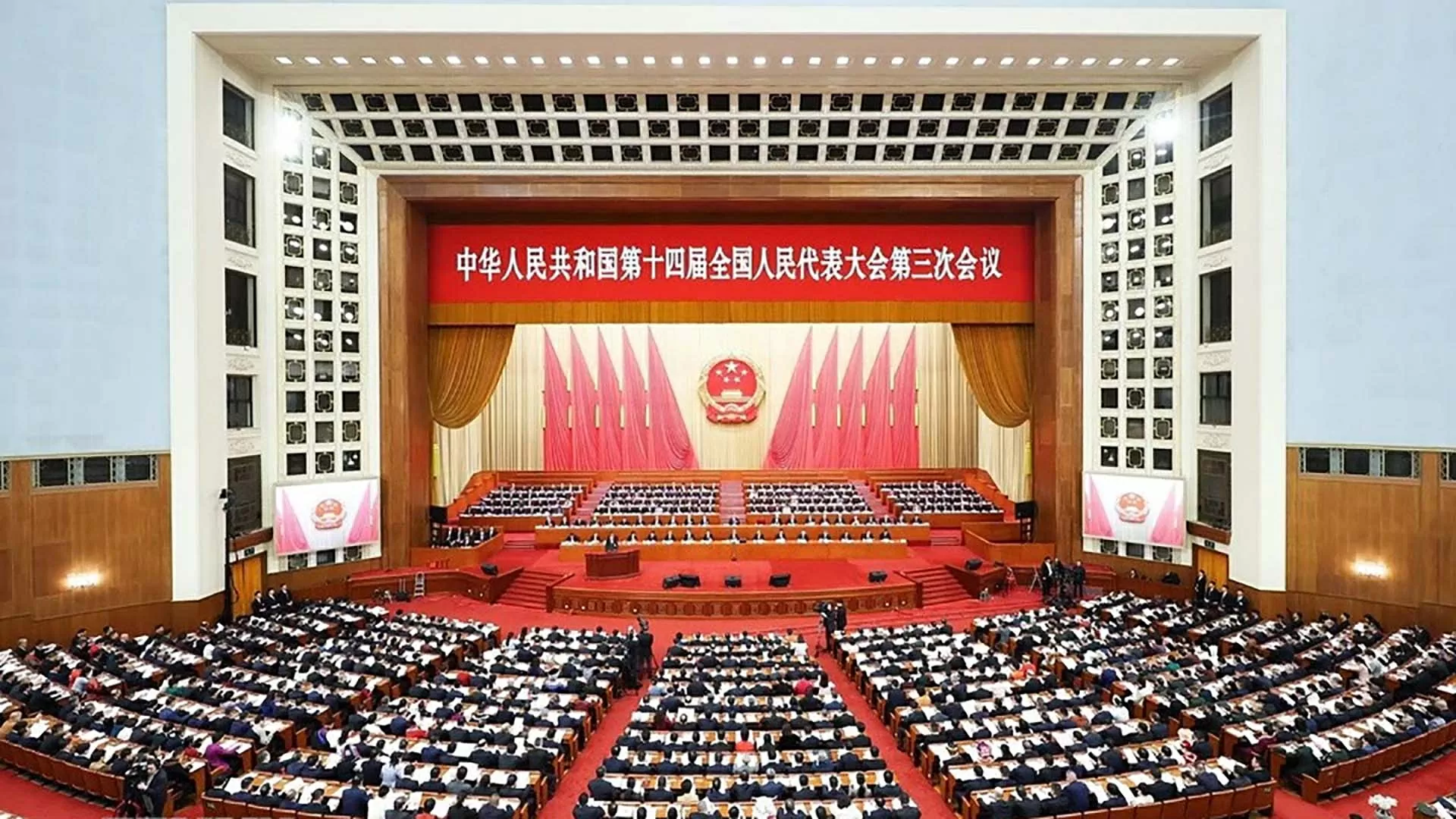 |
| Delegates attend the opening ceremony of the Third Session of the 14th National People's Congress of China in Beijing, March 5. (Source: THX) |
As one of the most important political events of the year, the "two sessions" are taking place against the backdrop of the world's second-largest economy grappling with numerous challenges, from sluggish domestic demand and a prolonged real estate crisis to high youth unemployment rates.
Externally, strategic competition remains intense. The US-China trade war is heating up with Washington doubling tariffs on Chinese goods, and Beijing immediately announced retaliatory measures.
As the leading legislative body, the NPC approves the government budget and other national development plans. Meanwhile, the CPPCC advises on key national policies related to economic, political, cultural, social, and environmental development.
2025 is the final year of the “14th Five-Year Plan” and a crucial year for continuing comprehensive and deeper reforms. In this context, many decisions will be made at the NPC session to realize that goal.
First, the GDP growth target for 2025 is projected at 5%, similar to the past two years. The fiscal deficit is forecast to increase to around 4% of GDP, higher than last year's 3%, to finance policies such as boosting household consumption.
In addition, there are policies focused on investing in innovation and high-tech fields. Achievements such as the DeepSeek AI model and solar cells need to be followed by breakthroughs in high-end chips, quantum computing, robotics, AI, etc., in order to realize the ambition of transforming the world's second-largest economy into a technological powerhouse.
Source: https://baoquocte.vn/hop-luong-hoi-trung-quoc-tao-dong-luc-tiep-tiep-ca-i-cach-306572.html

![[Photo] Prime Minister Pham Minh Chinh receives the Chinese Ambassador to Vietnam](https://vphoto.vietnam.vn/thumb/1200x675/vietnam/resource/IMAGE/2026/04/05/1775397481797_ndo_br_dsc-5512-jpg.webp)

























































Comment (0)