

Members of the National Assembly believe that adding regulations on a national database system for technical standards and regulations provides a legal basis for building, updating, and managing a unified national database system from the central to local levels, thereby facilitating better access to technical standards and regulations for organizations and individuals.
Supplementing mechanisms to promote initiatives for improving standards and regulations.
On the afternoon of November 28th, the program continued. At its 8th session, the National Assembly discussed in the plenary hall the draft Law amending and supplementing a number of articles of the Law on Standards and Technical Regulations.
Commenting on the draft law, delegate Trieu Thi Ngoc Diem ( Soc Trang ) emphasized that amending and supplementing the Law on Standards and Technical Regulations of 2006 is not only an immediate task but also a long-term strategy to improve the quality of state management and promote sustainable socio-economic development.

The draft Law amending and supplementing a number of articles of the Law on Standards and Technical Regulations of 2006 reflects a great effort in perfecting the legal framework on standardization, ensuring compliance with commitments in new generation Free Trade Agreements (FTAs), and meeting the objective requirements of practice.
Therefore, the delegates expressed strong agreement with the necessity of amending the law and generally endorsed the draft law presented at the session.
Regarding the feasibility of a national database system, delegates unanimously agreed on adding content to Article 8c concerning a national database system for technical standards and regulations, as well as several other provisions in the draft related to this content. They emphasized that building a national database system for technical standards and regulations would bring many benefits to businesses and state management agencies, such as saving costs in information searching and increasing the transparency and reliability of products on the market.
Delegates suggested that attention should be paid to clarifying the implementation roadmap, the timeframe for completing the trial operation, the specific responsibilities of each agency, the mechanism for data sharing between agencies, the ability to link with international databases, as well as the funding for building and maintaining the system.
In addition, it is necessary to clarify the support policies for businesses participating in building the system, for example, waiving, reducing, or lowering fees for businesses and organizations when accessing and using data on the system, especially for small and medium-sized enterprises or non-profit research organizations…

Highly appreciating the draft, delegate Pham Van Thinh (Bac Giang) emphasized that a country's technical standards and regulations are very important, playing a decisive role in the quality of products created by that country. In forming national competitiveness, standards and regulations are as important as infrastructure.
However, delegates also noted that, despite frequent revisions and additions to standards and regulations by regulatory agencies, the current state of standards and regulations in our country still has shortcomings.
Currently, we have approximately 13,000 national standards and 800 regulations. The application of regulations is mandatory, while standards are voluntary, but in practice, most activities, especially construction projects, are carried out with mandatory compliance by the competent authorities.
The delegates analyzed the design process. standards, regulations A potential tendency is to over-detail and over-emphasize implementation procedures, focusing primarily on execution rather than prioritizing quality control at the end of each stage. This can lead to a loss of creativity, increased compliance costs, and even obsolescence when the technology and materials used change, or when more practical and economically efficient product standards are slow to be issued and implemented.
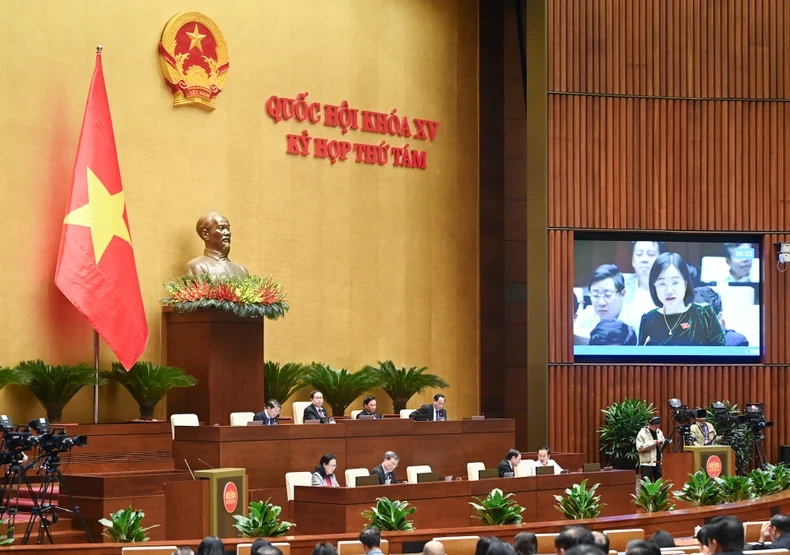
To sustainably improve this situation, Representative Thinh emphasized that the only way is to promote the role of the people and rely on the people.
Therefore, delegates proposed that the law should include a provision stipulating a mechanism to promote initiatives for improving standards and regulations, as well as a monitoring mechanism by the community and the National Assembly; and accountability of the issuing agency to ensure that national standards and regulations are always improved in a way that aligns with international integration, is easy to implement, optimizes compliance costs, and provides space for innovation to promote the application of new technologies, techniques, and materials in the implementation of standards and regulations.
The content of initiatives, monitoring, and accountability should be conducted publicly and fully documented in the digital environment, and the Government is responsible for specifying the details of this provision.
There is a need for a monitoring mechanism to reduce compliance costs for citizens and businesses.
On behalf of the drafting agency, Minister of Science and Technology Huynh Thanh Dat explained and clarified some issues raised by National Assembly deputies.
The minister affirmed that there was no overlap between Law on Technical Standards and Regulations in accordance with other specialized laws on conformity declaration procedures.

Regarding the proposal to abolish the conformity declaration procedure, the Minister argued that this would be tantamount to Vietnam abandoning technical standards. Furthermore, abolishing the conformity declaration procedure would contradict international practices and commitments; it would also create risks and compromise safety, as some products would lack any quality control measures other than technical standards.
Regarding the application of basic standards in specialized fields, the Minister stated that expanding the scope of application of basic standards by state agencies could lead to arbitrary application, vested interests, and difficulties for the production and business activities of enterprises. The Ministry of Science and Technology will continue to research and clarify this regulation further.
Responding to delegates' opinions on businesses assessing conformity based on conformity assessment results and standards, the Minister agreed with the delegates' suggestion to add a post-inspection mechanism for assessing product risk levels.
The Minister also acknowledged the delegates' suggestions regarding the addition of regulations on reporting the impact of standards to ensure their feasibility, in addition to studying the possibility of encouraging initiatives to improve standards and regulations.
Source
























































































Comment (0)