

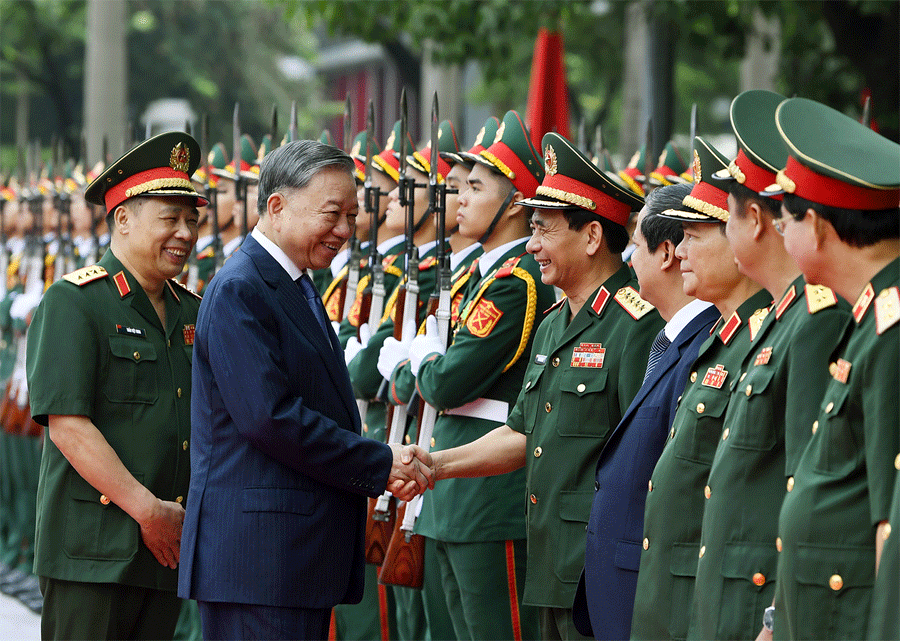
General Secretary and President To Lam attends the opening ceremony at the National Defence Academy, September 12, 2024. (Source: qdnd.vn)
Party grassroots organizations are the foundation of the Party, the political nucleus at the grassroots level, and the "bridge" between the Party and the people. When discussing Party building work, President Ho Chi Minh affirmed: "To lead the revolution, the Party must be strong. The Party is strong because of good Party branches. Good Party branches are because all Party members are good" (1), Party members are "the link to connect the Party with the masses" (2). Understanding his guiding viewpoint, during the process of leading the revolution, our Party has issued many documents aimed at building Party grassroots organizations and improving the quality of Party members; one of them is Resolution No. 21-NQ/TW, dated June 16, 2022, of the 5th Central Committee Meeting of the 13th Party Congress, "On strengthening and consolidating Party grassroots organizations and improving the quality of Party members in the new period". The resolution states: "Improving the leadership capacity and fighting strength of grassroots Party organizations and the quality of Party members has always been considered important and a crucial, ongoing task by our Party."
In the Vietnam People's Army, grassroots Party organizations are established at the local level in a wide variety of agencies and units, covering a large number and geographical area; they lead the implementation of tasks in a military operational environment with difficult and complex conditions; grassroots Party organizations in local military agencies are under the direct leadership of the local Party committee in all aspects; and at the same time, they comply with the resolutions of the higher-level military Party committee on national defense tasks and local military work.
Deeply aware of the position and role of grassroots Party organizations and the contingent of Party members, during the past term, the Central Military Commission, the General Political Department, and Party committees and political agencies at all levels have led and directed the effective implementation of the work of building grassroots Party organizations and improving the quality of Party members within the Party Committee of the Army, achieving many important results, most notably:
Firstly, we have done a good job of researching, understanding, and concretizing the resolutions, directives, regulations, and guidelines of the Central Committee on Party building.
Focus on studying and thoroughly understanding the Resolution of the 13th Party Congress, the resolutions and conclusions of the Central Committee on Party building, especially the Resolution of the 4th Central Committee Meeting of the 12th term, the Conclusion of the 4th Central Committee Meeting of the 13th term, Resolution No. 21-NQ/TW of the 5th Central Committee Meeting of the 13th term; the regulations of the Politburo on party organization in the Vietnam People's Army, on the revolutionary moral standards of cadres and party members in the new period (3); the regulations of the Secretariat on the functions, tasks, and working relationships of grassroots party committees and branches in the Vietnam People's Army (4). On that basis, concretize into leadership policies and measures in the Resolution of the 11th Party Congress of the Army, term 2020 - 2025, the resolutions and conclusions of the Central Military Commission, the Standing Committee of the Central Military Commission (5) and party committees at all levels; issue action programs and plans and implement them strictly and seriously. At the same time, the Central Military Commission directed the General Political Department to issue guidelines on improving the quality of Party branch activities; on reviewing, evaluating, and classifying the quality of Party organizations and Party members annually; on issuing and implementing regulations of Party committees and Party branches in the Army (6); directed the Party committees of military regions and the Party committees of Border Guard to proactively coordinate with provincial and city Party committees in the area to thoroughly understand and implement in local military Party committees and provincial Border Guard Party committees, ensuring the maintenance of the principle of absolute and direct Party leadership in all aspects of the Army, contributing to strengthening the building of grassroots Party organizations and improving the quality of Party members.
Secondly, we must build and strengthen Party committees and organizations at the grassroots level in accordance with the regulations and guidelines of the Central Committee, and in line with the process of adjusting the organizational structure of the Army.
Thoroughly understanding and grasping the resolutions, directives, regulations, rules, and guidelines of the Central Committee, and closely following the development of military and national defense activities, the Central Military Commission and Party committees and political agencies at all levels have promptly led and directed the consolidation and restructuring of over 3,000 grassroots Party organizations in accordance with regulations, ensuring synchronicity and uniformity with the process of adjusting the organization of the Army according to the Politburo's resolution; in particular, focusing on leading and directing the building and consolidation of grassroots Party organizations in newly established, merged, and reorganized units to meet the requirements of building a lean, efficient, and strong Army capable of leading agencies and units to complete all tasks; linking the consolidation and restructuring of Party committee members with the planning and appointment of leading cadres and the preparation of personnel for the new term of the Party committee. Ensuring sufficient numbers, appropriate structure, good quality, and continuity and development are essential for comprehensive leadership of agencies and units in all aspects of work. After consolidation and restructuring, Party committees and organizations at the grassroots level should promptly supplement tasks, issue and strictly implement working regulations and regulations on leadership in key areas of work in accordance with regulations.
Thirdly, consistently pay attention to and care for the development of the Party membership; closely combine the development of Party members with the development of the cadre.
The work of identifying, recruiting, training, and admitting new Party members is consistently emphasized, ensuring adherence to the correct principles, guidelines, and procedures, prioritizing quality over mere quantity. Party member development focuses on officer trainees, professional soldiers, squad leaders, platoon leaders, and outstanding soldiers. From 2020 to August 2024, the entire army admitted over 66,000 new Party members, with the annual Party member development rate exceeding 5% of the total number of Party members, surpassing the planned target by 2%. Party member development is linked to the training and development of cadres, contributing to an increase in the proportion of leaders in the entire army and creating a pool of cadres and Party members for local areas. The management, education, and training of Party members are consistently well-executed, creating favorable conditions to help them strive to fulfill their assigned responsibilities and duties effectively. Emphasis should be placed on reviewing, identifying, educating, assisting, and screening out Party members who are no longer qualified to be Party members; and on introducing and managing Party members who are working regularly and maintaining contact with Party organizations and the people in their places of residence in accordance with the regulations of the Politburo.
The building of the Party membership is closely integrated with the building of the cadre, especially the building of Party committee members and secretaries, along with the building of leading cadres at the grassroots level in terms of political qualities, ethics, lifestyle, qualifications, capabilities, methods, and work style. Since the beginning of the 13th Party Congress term, more than 63,000 cadres and Party members (focusing on those who have excellently completed their tasks and received awards) have been selected and sent for training and further education at training institutions inside and outside the Army, contributing to raising the level of political theory, education, expertise, and professional skills of the cadre and Party members.
Fourth, effectively carry out inspection and supervision work; protect internal political security and promote the role of mass organizations in participating in Party building.
The Central Military Commission, Party committees, and inspection committees at all levels have thoroughly understood, concretized, and seriously implemented the Central Committee's regulations and guidelines on Party inspection, supervision, and discipline, ensuring the correct viewpoints, principles, procedures, and regulations; the order and quality of inspection and supervision work of grassroots Party organizations have been maintained and improved. Grassroots Party organizations in all types of agencies and units have proactively and flexibly developed inspection and supervision plans and programs, focusing on inspecting and supervising the leadership in carrying out political tasks and Party building work; Resolution of the 4th Central Committee Meeting of the 12th Party Congress, Conclusion of the 4th Central Committee Meeting of the 13th Party Congress on Party building and rectification; studying and following Ho Chi Minh's thought, morality, and style; proactively grasping the situation and inspecting Party organizations and Party members when there are signs of violations (7). Through inspection and supervision, violations by Party organizations and members have been warned against and prevented early and from afar, enhancing the responsibility of heads of Party committees and organizations, as well as cadres and Party members. Internal political security work has been effectively implemented, especially in the assessment, verification, and conclusion of political standards for personnel recruitment, promotion, appointment of cadres, nomination to Party committees, and Party member development.
Regularly focus on leading the development of strong mass organizations (youth union, women's association, trade union) that operate according to their functions and tasks; effectively promote the role of mass organizations in training and creating a pool of candidates for Party membership; participate in contributing opinions on the leadership work of Party committees and organizations; supervise the exemplary conduct, self-cultivation, and moral and lifestyle development of cadres and Party members, especially Party committee members and leading cadres of agencies and units.
Fifth, innovate leadership methods and styles; build and effectively implement good models and innovative approaches.
Focus on innovating leadership methods and styles towards a scientific, democratic, effective, and practical approach, especially the ability to thoroughly understand and concretize resolutions and directives from higher levels, and to determine leadership policies and measures at their level that are accurate, correct, and appropriate to the nature, characteristics, and tasks of each type of grassroots Party organization. The implementation of resolutions must be rigorous and scientific; problems must be promptly identified and effectively addressed. The issuance and implementation of working regulations and leadership regulations for key areas of work must be strictly followed by 100% of grassroots Party committees and branches, adhering to the principles of democratic centralism, collective leadership, and individual responsibility. The responsibility of Party committee members and Party members, especially the secretaries and deputy secretaries of Party committees and branches, to set a good example must be emphasized. Thanks to that, the pioneering and exemplary role of Party committee members and Party members is effectively promoted according to the motto "above first, below later", "inside first, outside later"; encouraging Party members to persevere and effectively implement the spirit of "6 dares" in accordance with the spirit of the Party's XIII Congress Resolution (8).
Leading and directing the construction and effective implementation of the "four good party branch" and "four good grassroots party committee" models according to Resolution No. 5 of the 13th Central Committee Conference; at the same time, continuing to implement and promote the models in agencies and units, such as the "4 good, 3 no" party branch (9); "3 good, 3 no" party branch (10); "4 good, 4 no" party branch; "4 good, 5 exemplary"; "5 good party branch, 5 good party members"; cadres and party members "saying and doing"; "4 focus, 1 combination" (11),... to directly improve the leadership capacity and fighting strength of grassroots party organizations and the quality of party members; Through this, good, creative, and effective practices have spread and been replicated throughout the army, contributing to building exemplary, clean, and strong grassroots Party organizations, and exemplary, comprehensively strong agencies and units.
The above achievements have contributed to enhancing the leadership capacity and combat strength of grassroots Party organizations and the quality of Party members in the Army. Grassroots Party organizations have closely adhered to their functions and duties, leading their agencies and units to successfully complete all assigned tasks. Leadership in research, consultation, proposal, direction, guidance, and inspection of units by operational and strategic-level agencies has made significant progress; the quality of training, combat readiness, adherence to regulations, and discipline of grassroots units have shown positive changes; the work of consultation, proposal, management, and utilization of material, logistical, technical, and financial resources of agencies has effectively met requirements and tasks, contributing to the effective prevention of corruption, waste, and negative practices. The advisory and proposal work of local military agencies to Party committees and authorities on the implementation of military and national defense tasks, building political foundations, preventing and combating natural disasters, search and rescue operations, helping people overcome poverty, building new rural areas and civilized urban areas has achieved good results;... The team of Party committee members, especially the secretaries and deputy secretaries of Party committees and branches, have effectively played their role and responsibility as role models, matching words with actions. Annually, the results of evaluating and classifying the quality of grassroots Party organizations show that over 92% have completed their tasks well and excellently (over 17% of grassroots Party organizations have completed their tasks excellently); over 91% of Party members have completed their tasks well and excellently (over 18% of Party members have completed their tasks excellently).
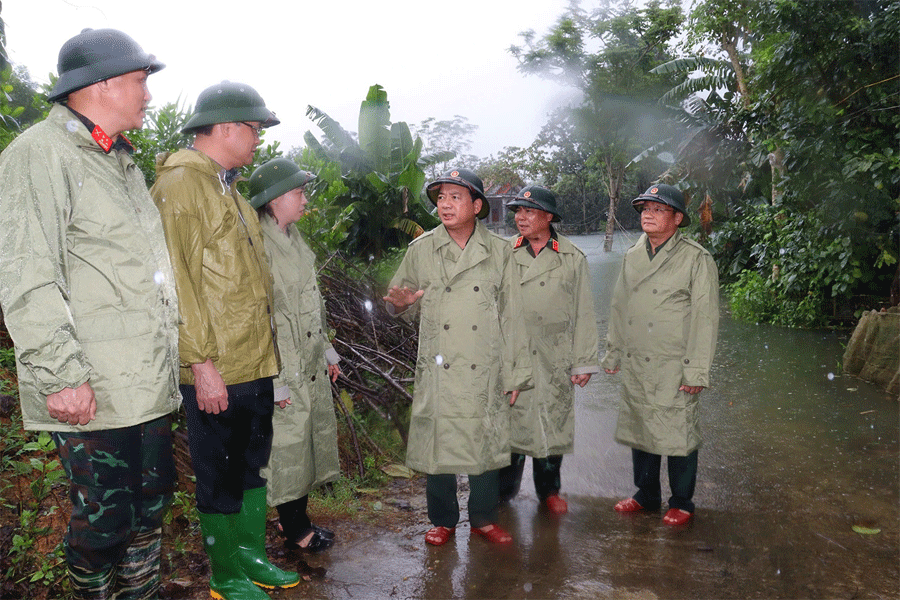
General Trinh Van Quyet, Secretary of the Central Committee of the Communist Party of Vietnam, Standing Member of the Central Military Commission, and Head of the General Political Department, inspects rescue and relief efforts in the flood-affected area of Tuyen Quang province. (Photo: VNA)
Based on the results of building grassroots Party organizations and improving the quality of Party members within the Party Committee of the Army in the past period, the following lessons can be drawn:
Firstly, consistently and effectively implement the resolutions, directives, regulations, and guidelines of the Central Committee on Party building. Focus on the comprehensive and effective implementation of resolutions of Party congresses at all levels, and resolutions and conclusions of the Central Committee on Party building and rectification, particularly Resolution No. 21-NQ/TW of the 5th Plenum of the 13th Central Committee,... creating unity in understanding and action regarding the building of grassroots Party organizations and improving the quality of Party members throughout the army; based on this, concretize and determine the policies and measures for leading and directing the building of grassroots Party organizations and improving the quality of Party members in line with the functions and tasks of each type of grassroots Party organization in the Army.
Secondly, consistently prioritize the work of developing Party members; link the building of the Party member contingent with the building of the cadre contingent, and the building of the Party committee member contingent with the building of the leading cadre contingent. Enhance the awareness and responsibility of Party committees, Party branches, and Party cells in the work of developing Party members; build and effectively implement Party member development plans; create a favorable environment for the masses to become enlightened with ideals, have pure motives, and strive to join the Party. Effectively combine the work of training and developing Party members with creating a source of cadre training from the grassroots; prioritize the training and development of cadres to improve the quality of the input of the cadre contingent. Closely integrate the evaluation of cadre quality with the evaluation of Party member quality, the evaluation of leading cadre quality with the evaluation of Party committee member quality; effectively carry out the work of protecting internal political security. Conduct all stages and steps in the cadre work process strictly and seriously. The process of reviewing, selecting, planning, managing, training, fostering, appointing, promoting, and utilizing cadres, as well as preparing personnel for grassroots Party congresses and branch committees, and consolidating Party committees at all levels, must ensure that all standards and conditions are met according to regulations, in accordance with each type of grassroots Party organization and the responsibilities and duties of cadres at all levels. The management, education, and training of Party members must be closely integrated with administrative management through the performance of cadres' responsibilities and duties.
Thirdly, we must enhance the role of organizations and forces in building grassroots Party organizations and improving the quality of Party members. First and foremost, we must leverage the role of Party committees, political organs, political commissars (political officers), and superior commanders in thoroughly understanding and grasping the resolutions, directives, and guidelines of the Central Committee, the Central Military Commission, and the General Political Department. Simultaneously, based on the functions and tasks of each type of grassroots Party organization, we must determine appropriate policies and measures for leading, directing, and guiding the building of grassroots Party organizations. Grassroots Party organizations must strictly adhere to the leadership, direction, and guidance of higher-level Party committees and political organs; they must leverage collective intelligence and proactiveness in developing policies and measures to enhance leadership capacity, combat strength, and the quality of Party members, overcoming the tendency to rely on higher levels. On the one hand, it is necessary to promote the role of mass organizations (youth unions, women's associations, trade unions) in nurturing and identifying outstanding members for Party membership; participating in contributing opinions on the leadership work of Party organizations; and supervising the exemplary conduct, self-cultivation, and moral development of cadres and Party members. On the other hand, it is necessary to promote the role of Party committees, governments, the Fatherland Front, and political and social organizations at the local level in participating in building grassroots Party organizations and improving the quality of Party members within the Party Committee of the Army.
Fourth, focus on innovating leadership methods and styles, work practices, and upholding the spirit of responsibility, awareness of law and discipline compliance, and the capacity of Party committees and secretaries at the grassroots level, ensuring the comprehensive leadership role of the Party at the grassroots level. This includes focusing on innovating the issuance of leadership resolutions to be concise, easy to understand, easy to remember, and easy to implement; assigning tasks closely and specifically, linked to the responsibilities and duties of each cadre and Party member; implementing decisively; regularly inspecting and supervising, promptly identifying and thoroughly resolving emerging issues. Actively innovate propaganda and mobilization work to create unity within Party committees and branches, and consensus within agencies and units. Effectively implement regulations on the exemplary conduct of cadres and Party members, upholding honor and self-respect, especially of the heads of Party committees, agencies, and units. Resolutely prevent and combat the decline in political ideology, morality, and lifestyle, and the manifestations of "self-evolution" and "self-transformation" within the Party. Strictly adhere to the principles of democratic centralism, self-criticism and criticism, and maintain discipline, order, and unity within the Party. Continue to effectively implement the "four-good Party branch" and "four-good grassroots Party committee" models. Strengthen administrative reform, apply information technology, and promote digital transformation in Party work and member management.
Fifth, focus on conducting preliminary and final reviews, and drawing lessons from the work of building grassroots Party organizations and improving the quality of Party members. Through these reviews, objective and comprehensive assessments of achievements, limitations, shortcomings, and their causes can be made, drawing lessons to serve as a basis for determining appropriate and feasible policies and measures. Along with these reviews, it is important to prioritize the awarding of commendations to Party organizations and members, and to promote the dissemination of best practices, effective methods, and innovative approaches to replicate successful models in building grassroots Party organizations and improving the quality of Party members.
The building of grassroots Party organizations and the improvement of the quality of Party members in the Vietnam People's Army have received serious attention, leadership, and guidance in recent years, resulting in many important achievements and valuable lessons learned. This serves as the basis for the Central Military Commission and Party committees at all levels within the Army Party organization to lead and direct the strict and effective implementation of Resolution No. 21-NQ/TW of the 5th Plenum of the 13th Central Committee./.
TRINH VAN QUYET
General, Secretary of the Central Committee of the Communist Party of Vietnam, Standing Member of the Central Military Commission, Head of the General Political Department of the Vietnam People's Army.
-------------------------------
(1) Ho Chi Minh: Complete Works, National Political Publishing House, Hanoi, 2011, vol. 15, p. 113
(2) Ho Chi Minh: Complete Works, op. cit., vol. 8, p. 288
(3) Such as: Regulation No. 49-QD/TW, dated December 22, 2021, of the Politburo, "On Party organization in the Vietnam People's Army"; Regulation No. 144-QD/TW, dated May 9, 2024, of the Politburo, "On revolutionary ethical standards of cadres and Party members in the new period"
(4) Such as: Regulation No. 110-QD/TW, dated August 20, 2004, of the Secretariat, "On the functions and tasks of grassroots party committees and branches in military agencies"; Regulation No. 117-QD/TW, dated January 25, 2018, of the Secretariat, "On the functions and tasks of grassroots party committees and branches in border guard posts in the Vietnam People's Army"...
(5) Conclusion No. 111-KL/QUTW, dated February 12, 2019, of the Standing Committee of the Central Military Commission, "On continuing to improve the leadership capacity and combat strength of grassroots party organizations and the quality of cadres and party members in the Army in the new period"
(6) Such as: Guidance No. 1677/HD-CT, dated September 28, 2018, of the General Political Department, on “Some issues on improving the quality of Party branch activities in the Party Committee of the Army”; Guidance No. 1794/HD-CT, dated September 9, 2020, of the General Political Department, “On reviewing, evaluating, and classifying the quality of Party organizations and Party members in the Party Committee of the Army annually”; Guidance No. 1224/HD-CT, dated July 27, 2022, of the General Political Department, on “Issuing and implementing regulations of Party committees at all levels in the Army”
(7) From 2020 to the present, 4,576 Party organizations and 10,836 Party members have been inspected; 3,319 Party organizations and 7,211 Party members have been supervised according to plan. Inspection committees at all levels have inspected 27 Party organizations and 301 Party members when there are signs of violations; supervised 802 Party organizations and 2,531 Party members. Party grassroots organizations have considered and disciplined 33 subordinate Party organizations and 611 Party members; the inspection committees of grassroots Party organizations have considered and disciplined 6 Party members; and resolved complaints against 3 Party organizations and 32 Party members.
(8) See: Documents of the 13th National Congress of Delegates, National Political Publishing House, Hanoi, 2021, Vol. II, p. 243
(9) The "4 good" content includes: Leaders successfully complete political tasks; good quality of life; good unity, good discipline and good cadres and party members. The "3 no" includes: No cadres or party members involved in social vices; no traffic safety violations; no use of party membership cards or documents issued by the State or the Army to secure loans, assets, or debts that cannot be repaid.
(10) Building "3 good" Party branches: Building and organizing the implementation of resolutions well; educating, managing, and training cadres and Party members well; implementing the principle of democratic centralism, self-criticism and criticism well. Building "3 no" Party branches: No weaknesses; no cadres or Party members violating discipline or failing to complete tasks; no Party members degenerating in political ideology, morality, lifestyle, "self-evolution", "self-transformation".
(11) In the Party Committees of: Military Region 2, Military Region 5, Military Region 7, Military Region 3, and the Navy.
Source: https://baotuyenquang.com.vn/tang-cuong-xay-dung-to-chuc-co-so-dang-va-nang-cao-chat-luong-doi-ngu-dang-vien-trong-quan-doi-nhan-dan-viet-nam-ket-qua-va-bai-hoc-kinh-nghiem-203276.html
![[Photo] Prime Minister Pham Minh Chinh receives the Governor of Tochigi Province (Japan)](/_next/image?url=https%3A%2F%2Fvphoto.vietnam.vn%2Fthumb%2F1200x675%2Fvietnam%2Fresource%2FIMAGE%2F2025%2F12%2F16%2F1765892133176_dsc-8082-6425-jpg.webp&w=3840&q=75)
![[Photo] Prime Minister Pham Minh Chinh receives Lao Minister of Education and Sports Thongsalith Mangnormek](/_next/image?url=https%3A%2F%2Fvphoto.vietnam.vn%2Fthumb%2F1200x675%2Fvietnam%2Fresource%2FIMAGE%2F2025%2F12%2F16%2F1765876834721_dsc-7519-jpg.webp&w=3840&q=75)
![[Image] Leaked images ahead of the 2025 Community Action Awards gala.](/_next/image?url=https%3A%2F%2Fvphoto.vietnam.vn%2Fthumb%2F1200x675%2Fvietnam%2Fresource%2FIMAGE%2F2025%2F12%2F16%2F1765882828720_ndo_br_thiet-ke-chua-co-ten-45-png.webp&w=3840&q=75)

![[Live] 2025 Community Action Awards Gala](/_next/image?url=https%3A%2F%2Fvphoto.vietnam.vn%2Fthumb%2F1200x675%2Fvietnam%2Fresource%2FIMAGE%2F2025%2F12%2F16%2F1765899631650_ndo_tr_z7334013144784-9f9fe10a6d63584c85aff40f2957c250-jpg.webp&w=3840&q=75)





































![[Live] Closing Ceremony and Award Presentation for the "Impressive Vietnam Tourism" Video/Clip Creation Contest 2025](https://vphoto.vietnam.vn/thumb/402x226/vietnam/resource/IMAGE/2025/12/17/1765974650260_z7273498850699-00d2fd6b0972cb39494cfa2559bf85ac-1765959338756946072104-627-0-1338-1138-crop-1765959347256801551121.jpeg)


















Comment (0)