

At the beginning and end of a flight, or when it gets dark outside, the cabin lights are usually turned off and passengers are asked to pull down the window shades.
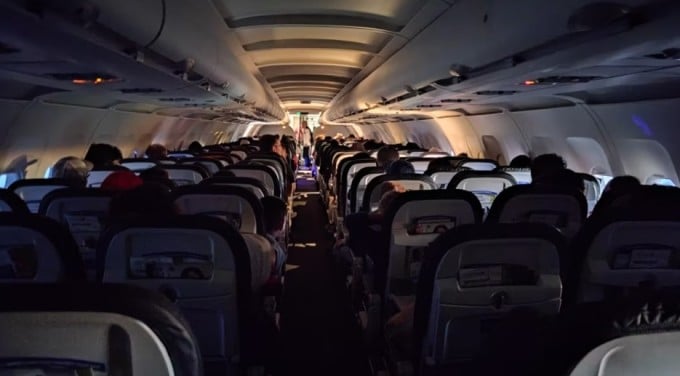
The cabin lights are switched off during critical phases of flight. Photo: Daniel Martínez Garbuno
The cabin lights turn off when the plane is taxiing on the runway preparing for takeoff, and this process is repeated at the end of the journey, signaling that landing is imminent. The fundamental reason behind this process is the safety of passengers and crew, according to Simple Flying .
The cabin lights dimmed and went out for the same reason the crew asked passengers to pull down the window shades: to ensure safety in an emergency. In such circumstances, ideal visibility can make a crucial difference to human safety. Opening the window shades also helps passengers orient themselves in an emergency because they will be more aware of their surroundings.
It takes the human eye about 10-30 minutes to fully adjust to complete darkness. Turning off the cabin lights gives passengers and crew more time to adapt to low-light conditions. This is crucial if an evacuation is needed at night. In fact, the time it takes for the human eye to adjust to low-light conditions makes a significant difference in the chances of escaping during an emergency.
Another reason to turn off cabin lights is that the darker the cabin, the easier it is to see the emergency lights and aisles. Therefore, everyone on board will be better prepared for a quick and safe evacuation. According to Colin C. Law, assistant professor of aviation business management at Stamford International University in Thailand, cabin lights are adjusted to suit external lighting conditions. For example, during an evacuation at takeoff, cabin lights should not be on at their brightest setting to avoid affecting the evacuation process.
Turning off the lights is also often associated with drawing the window shades on the plane. During the day, the latter ensures the cabin is filled with natural light, improving visibility. Of course, in most cases, emergencies do not arise. Finally, airlines turn off cabin lights during takeoff and landing to reduce the aircraft's power consumption, optimizing engine performance during critical flight phases.
An Khang (According to Simple Flying )
Source link


![[Photo] Prime Minister Pham Minh Chinh holds a phone call with the CEO of Russia's Rosatom Corporation.](/_next/image?url=https%3A%2F%2Fvphoto.vietnam.vn%2Fthumb%2F1200x675%2Fvietnam%2Fresource%2FIMAGE%2F2025%2F12%2F11%2F1765464552365_dsc-5295-jpg.webp&w=3840&q=75)





















































































Comment (0)