

The company stated that exporting frozen durian faces few technical barriers, and the product can reach any part of China.
A shipment of 24 tons of frozen durian from Dak Lak was exported to China on March 24th. This is the first frozen shipment exported after Vietnam and China signed the import-export protocol in August 2024.
Businesses see the export of frozen durian as a new opportunity for Vietnam's billion-dollar fruit, especially in the context of difficulties in exporting fresh durian.
A business leader in Dak Lak said his company has submitted an application to export frozen goods to China. With many years of experience in this field, he believes that if the first shipments are successful, the subsequent export process will be smoother.
According to the Dak Lak Durian Association, many businesses are preparing the necessary procedures to boost exports in large quantities when the peak season arrives. Mr. Nguyen Dinh Tung, CEO of Vina T&T, said this is a great opportunity. His company is currently awaiting permits from China for its packaging plant to be recognized, facilitating exports.
Mr. Tung shared that for many years, the company has exported frozen goods to the US, Canada, and South Korea. With a modern technology system and strict quality control process, the business is confident in meeting the stringent requirements of China. He emphasized that the successful export of the first batch of fresh durian is a significant milestone, opening up great growth opportunities for this industry.
The chairman of the Dak Lak Durian Association, Mr. Vu Duc Con, expects that frozen durian exports this year could contribute at least 600-700 million USD, and potentially reach one billion USD in the future.
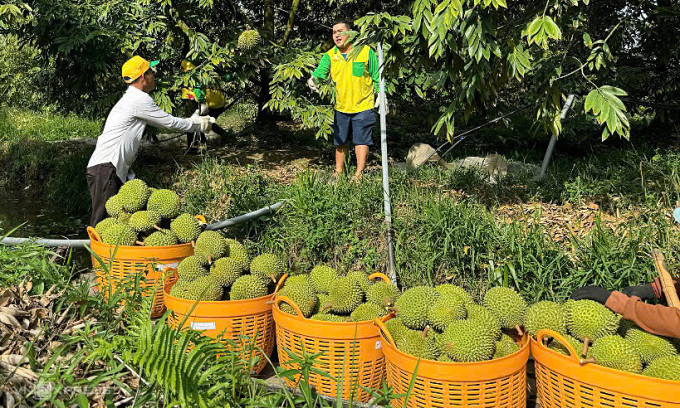
According to Mr. Con, exporting frozen durian has many advantages. Fresh durian is usually subject to strict inspections for cadmium residue and Yellow O, while frozen, separated durian segments face almost no such barriers. Several businesses in Dak Lak have conducted tests and confirmed that separated durian segments are not at risk of contamination with these substances.
Furthermore, frozen durian can utilize even small or less-than-perfect fruits while still maintaining quality, helping to resolve oversupply issues and avoid the "bumper harvest, low prices" problem. With a shelf life of up to a year, frozen durian can be exported to many inland regions of China, instead of being limited to the southern market like fresh durian.
Mr. Tung stated that freezing technology at temperatures below -45 degrees Celsius helps eliminate pests and ensures that goods meet technical regulations from China.
According to Mr. Nguyen Quang Hieu, representative of the Department of Crop Production and Plant Protection ( Ministry of Agriculture and Environment ), businesses wishing to export frozen products to China must register with the General Administration of Customs of China (GACC). After approval by the GACC, the Department of Crop Production and Plant Protection will review the application and then send a letter of introduction to the GACC.
Currently, more than 20 Vietnamese businesses have been licensed by GACC to export frozen durian to China. This is a market with huge demand, not only for fresh consumption but also for processing into confectionery, ice cream, and even as an ingredient in hot pot dishes. It is predicted that the volume of frozen durian exported to China will continue to increase rapidly in the near future.
The demand for this fruit in China reaches approximately 1.5 million tons per year, while domestic production is insufficient to meet it. Although China has started cultivating durian on Hainan Island with an area of about 2,700 hectares, the supply is still insignificant. Frozen durian, with its advantages of long-term preservation and convenient transportation, is becoming an important solution for Vietnamese products.
In 2024, China continued to maintain its position as the world's largest durian consumer market. According to statistics from Chinese Customs, the country imported approximately 1.56 million tons of durian, worth nearly $7 billion, an increase of 9.4% in volume and 4% in value compared to 2023.
Vietnam currently holds 42.1% of the country's market share with a turnover of nearly 3 billion USD, a 38% increase compared to the previous year, while Thailand still leads with over 4 billion USD but a decrease of 12.1%. Malaysia and the Philippines contribute only a small portion, with exports reaching 5.7 million USD and 32.5 million USD respectively.
Thailand and Malaysia are the two main suppliers of frozen durian to China, with a total annual export value exceeding $1 billion. However, with the rapid development of this industry, Vietnamese businesses expect frozen goods to become a key sector to boost export turnover and affirm Vietnam's position in the global market.
Source












































































Comment (0)