

BHG - Holding a copy of the Ha Giang newspaper in your hands, with its beautiful design, vibrant colors, and rich content, not everyone knows that this success is the result of the efforts of the editorial board, each reporter, editor, graphic designer, and also the contributions of the "printing house" workers.
April 13, 2025 marks the 61st anniversary of the development and growth of Ha Giang Newspaper. Throughout this journey, generations of leaders, staff, reporters, and editors of Ha Giang Newspaper have continuously overcome difficulties, innovated, and created; successfully fulfilling their assigned political tasks. Always accompanying Ha Giang Newspaper, contributing to improving the quality of the newspaper, meeting the information and entertainment needs of readers, and serving the political tasks of the locality – that is Ha Giang Printing Joint Stock Company, often affectionately called "The Printing House".
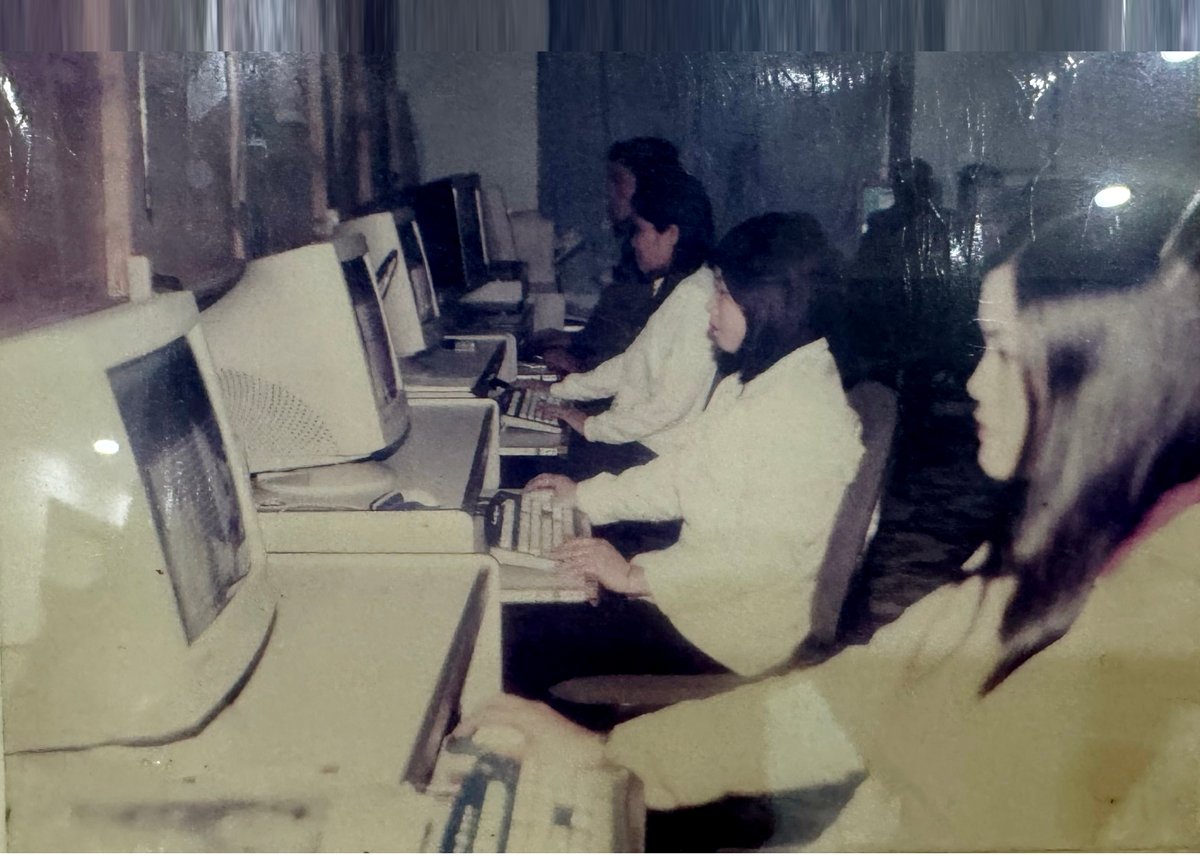 |
| Electronic typesetting technicians at the editorial office in 2003. Photo: ARCHIVE |
Newspaper printing technology has evolved with the times, but there was a time when, for a newspaper to reach readers, it had to go through the process of "lead typesetting," a task that now only remains in the memories of older generations of journalists. Before the advent of electronic typesetting technology, the first step in newspaper printing was lead typesetting. After the manuscripts of news articles and photos were edited and typed, the graphic designer would create the layout. Once approved by the editorial board, the layout would be sent to the printing house.
At the printing press back then, the typefaces, in various styles and sizes for newspaper printing, were all cast from lead metal. The types were placed in trays, each tray divided into smaller compartments holding a single type in alphabetical order (a, b, c). The typesetters, holding a small mold (the width of a newspaper column) in one hand, would pick up each type and arrange it according to the manuscript, but in reverse, reading from right to left. Besides remembering the positions of the letter compartments, the typesetters also needed the skill to read the letters in reverse. When a column was full of types, the mold was carefully wrapped with string. Then, the printer would roll ink onto the typeface and print a copy on newspaper for proofreading. If there were any errors, they had to remove the incorrect letters and replace them with the correct ones. When rearranging the typeface, they had to calculate and discuss with the newspaper's editorial board and graphic designer to adjust the size and shape of the typeface. Once the typeface is precisely adjusted according to the design, it is all secured with a sturdy iron frame (the size of the frame is the same as a single newspaper page) and then fed into the printing press.
After printing a newspaper, the typesetters had to precisely reposition the letters from the printing press into the original letter slots in the tray to prepare the letters for the next page. The process of taking letters from the printing press and placing each letter back into its original slot required absolute precision, because if the letters weren't placed in the correct slots, subsequent typesetting attempts would be flawed. Newspaper typesetting wasn't physically demanding, but it required meticulousness, patience, skill, and quick reflexes. Necessity is the mother of invention; each person had to find creative ways to count letters, calculate column divisions, and present the newspaper page. They became so proficient that sometimes they didn't even need to look at the letter slots to select the correct letters for typesetting.
To print a newspaper, it wasn't simply a matter of arranging the type according to a predetermined layout. There were frequent changes; many times, after the typesetting was complete and ready for printing, unexpected propaganda demands from the province would require changes to news articles. The typesetters would then remove the old articles and rearrange them, working through the night to meet printing deadlines. Sometimes, power outages would occur, forcing them to use flashlights to illuminate the area. Many days, they would work through lunchtime and into the night to print the newspaper on time. Two or three issues a week, not to mention other provincial publications, were hard work, but the typesetters and printing staff were always enthusiastic about their job. Like diligent bees, they meticulously and quietly worked to ensure the newspaper was error-free, published on time, and reached readers as quickly as possible.
One of the "lead typesetters" of that era is now the Deputy Manager of the Prepress Workshop at Ha Giang Printing Joint Stock Company, Ms. Vuong Thi Hong. Her mother, Ms. Mai Thi Som, retired more than 20 years ago, also worked as a "typesteater" for many years and passed on much of her experience to her colleagues and Ms. Hong. Recalling those difficult times, Ms. Vuong Thi Hong said: "During those days of diligently setting lead types, our hands and feet were always stained black, but we were still happy. Many days, waiting for news from Ha Giang Newspaper to be transferred, to ensure early publication, the printing team, along with the leaders, editors, and graphic designers of the newspaper, had to work until 3 or 4 in the morning to finish. Issues followed one another, it was hard work and difficult, but the typesetters and those working at the printing house were always passionate and dedicated to their profession." The difficult times are over; now, journalism is done electronically, everything is done on a computer, making it faster, more convenient, and more accurate.
Mr. Ha Van Trang, Chairman of the Board of Directors of Ha Giang Printing Joint Stock Company, said: "Over the years, the company has continuously invested in equipment, modernized its offset printing system, applied technology to production, and innovated in production to continuously improve the capacity and quality of publications to meet the increasingly high demands of the market. No longer requiring many steps like with the old printing machines, today's printers only need to operate on the control panel (PC) to produce colorful, high-quality products. Time is saved, and labor productivity is significantly higher than before. Compared to the old printing system which took 5 hours to complete a finished product, this system only takes 50% of the time to complete an entire issue of the newspaper. Along with printing the Ha Giang Newspaper, the printing process for other publications is also constantly innovating and improving."
The typesetting technology is no longer in use, and the workers of those days have retired, but for Ha Giang Printing Joint Stock Company and Ha Giang Newspaper, "lead typesetting" remains a vivid memory.
Dang Phuong Hoa
Source: https://baohagiang.vn/van-hoa/202504/sap-chu-chi-mot-thoi-de-nho-5ac6699/
![[Photo] General Secretary To Lam attends the Conference summarizing the work of the election of deputies to the 16th National Assembly](https://vphoto.vietnam.vn/thumb/1200x675/vietnam/resource/IMAGE/2026/03/31/1774952471746_ndo_br_bnd-2315-6970-jpg.webp)


![[Image] Creating urban areas along the Dong Nai River](https://vphoto.vietnam.vn/thumb/1200x675/vietnam/resource/IMAGE/2026/03/31/1774936857389_ndo_br_z7673258220978-0364bf985edfd080118668ad3c015934-resize-5023-jpg.webp)

![[Photo] Da Nang: Exploring the inside of Vietnam's largest "sail" symbol.](https://vphoto.vietnam.vn/thumb/1200x675/vietnam/resource/IMAGE/2026/03/31/1774964764698_ndo_br_anhcau1-jpg.webp)






































































Comment (0)