

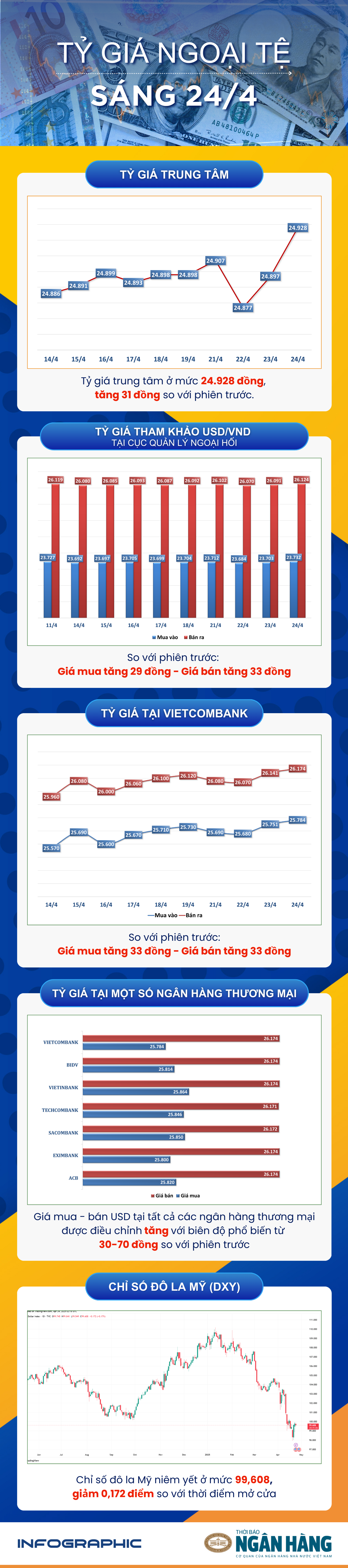
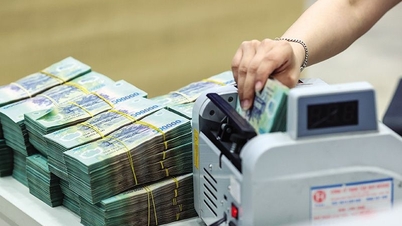
The US dollar stabilized after a sharp rise following President Donald Trump's withdrawal of his threat to fire Federal Reserve Chairman Jerome Powell and his softer signals regarding tariffs on China.
Against the Japanese yen, the US dollar fell 0.46% to 142.79 yen per dollar after US Treasury Secretary Scott Bessent confirmed the US was not targeting currencies in negotiations with Japan and called the 145% tariffs on China "not a firm deal".
The euro rose 0.28% to $1.1348, after touching a 3.5-year high of $1.1572 last week.
“No currency is as sensitive to trade news as the greenback. Downside risks remain, but a one-sided selling trend of USD is unlikely to repeat. The euro could surpass $1.15 if concerns about the Fed’s independence resurface,” commented Francesco Pesole, an expert from ING.
The British pound traded at $1.3281, up 0.2%.
The Swiss franc rose 0.31% to 0.8280 francs per US dollar after surging 8% since April 2nd.
The Australian dollar rose 0.03% to 0.6362 AUD/USD.
Joe Capurso, an expert from Commonwealth Bank, forecasts that the Australian dollar could test the 50-day moving average resistance at $0.6286 due to concerns about global growth.
The New Zealand dollar rose 0.24% to $0.5957.
The offshore yuan was trading at 7.29 yuan per US dollar after hitting a record low last week due to the 145% tariffs that US President Donald Trump announced on China.
Expert Scott Bessent believes that the US will not proactively reduce tariffs first, but negotiations with China could help de-escalate US-China trade tensions.
Source: https://thoibaonganhang.vn/sang-244-ty-gia-trung-tam-tang-31-dong-163278.html
![[Photo] General Secretary and President To Lam presides over a meeting on the implementation of Directive No. 34-CT/TW of the Party Central Committee.](https://vphoto.vietnam.vn/thumb/1200x675/vietnam/resource/IMAGE/2026/05/19/1779192417177_anh-man-hinh-2026-05-19-luc-19-06-45.png)
![[Photo] National Assembly Chairman Tran Thanh Man attends the groundbreaking ceremony for the National Highway 1A spatial axis project.](https://vphoto.vietnam.vn/thumb/1200x675/vietnam/resource/IMAGE/2026/05/19/1779161360398_ndo_br_bnd-1412-jpg.webp)
![[Photo] Capturing the moment the tide recedes at Yen Binh Son rapids - a million-year-old scenic spot in Quang Ngai.](https://vphoto.vietnam.vn/thumb/1200x675/vietnam/resource/IMAGE/2026/05/19/1779175463885_yen9-1199-jpg.webp)



















































![[Photo] General Secretary and President To Lam receives Indian Defense Minister Rajnath Singh](https://vphoto.vietnam.vn/thumb/402x226/vietnam/resource/IMAGE/2026/05/19/1779184046302_anh-man-hinh-2026-05-19-luc-16-46-58.png)



























Comment (0)