

According to the plan, there will be 23 stations along the North-South high-speed railway line. How are the local authorities planning, constructing connecting transportation infrastructure, and preparing resources, and what will they do to seize this opportunity?
Allocate land with pre-prepared site layouts.
In Thanh Hoa province, the high-speed railway line runs for approximately 95.2km with 2 stations (1 station in Dong Tan commune, Thanh Hoa city and 1 planned station in the Nghi Son Economic Zone).
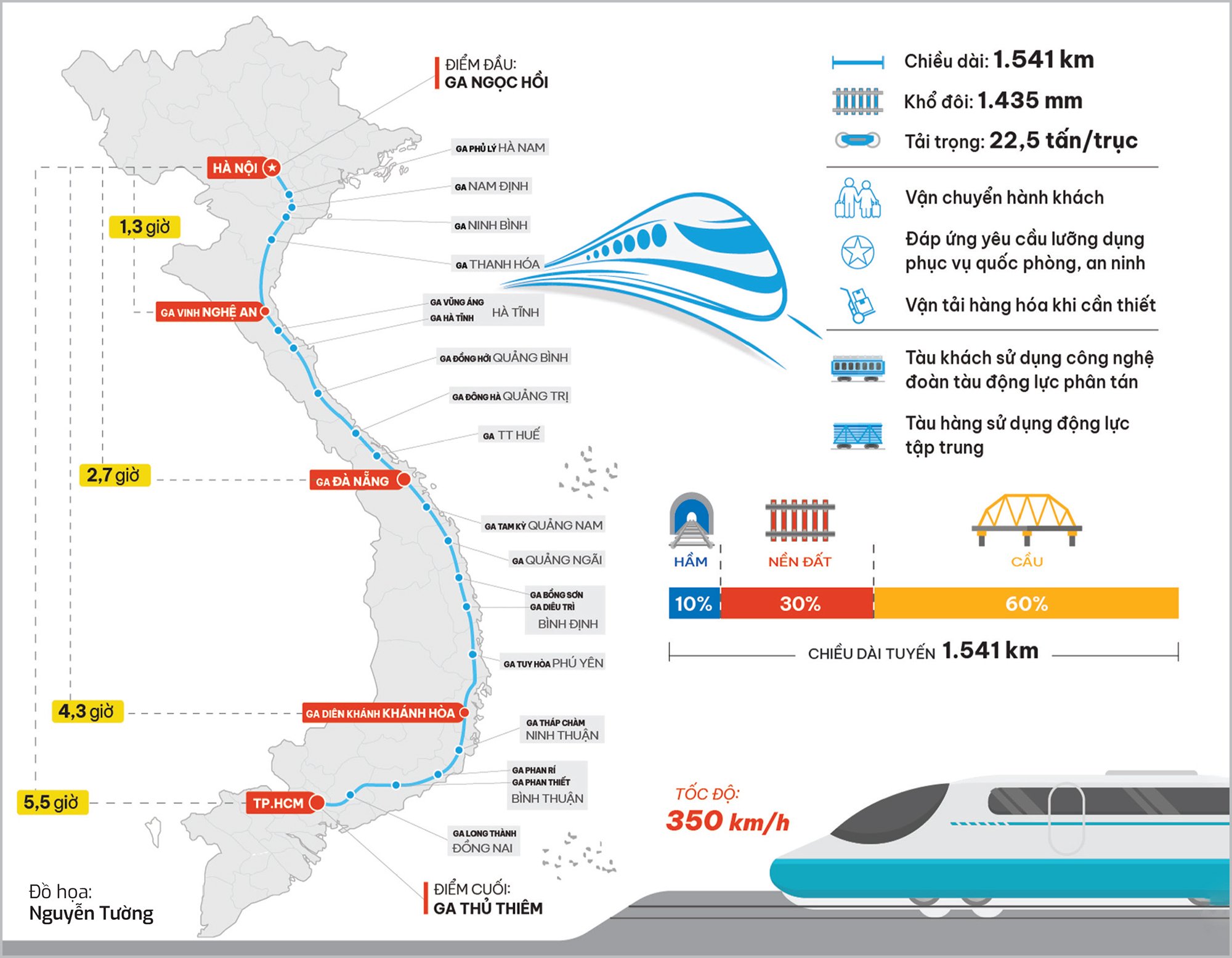
The North-South high-speed railway project is expected to start construction in 2027 and be substantially completed by 2035.
Mr. Trinh Huy Trieu, Director of the Thanh Hoa Department of Transport, said that they have advised the Provincial People's Committee to agree on the route, location, and scale of the station, as a basis for updating it into the planning to allocate land and manage it strictly.
Based on lessons learned from the implementation of the North-South Expressway project, the Thanh Hoa Department of Transport will advise the province to establish a steering committee and working group to carry out land clearance work, direct districts and towns to conduct preliminary data surveys to begin construction of resettlement areas; and coordinate with relevant departments and agencies to propose specific policies to ensure sufficient material supply for the project.
Similarly, Mr. Nguyen Dang Minh, Deputy Director of the Ninh Binh Department of Transport, said that the implementation of the North-South high-speed railway project has been included in the province's planning. The locality has prepared the necessary procedures to ensure the land for the project.
The high-speed railway line passing through Ninh Binh province is approximately 20km long. The line includes one station located in Khanh Thuong commune, Yen Mo district, 7.5km from the center of Ninh Binh city and the current Ninh Binh station.
Currently, this location is agricultural land, and the province has also constructed Route 483 to connect it.
Proactively develop connecting transportation routes.
Speaking to Giao Thong Newspaper, Mr. Vo Tan Duc, Chairman of the People's Committee of Dong Nai province, said that the high-speed railway through Dong Nai will have a freight station in Trang Bom, expected to be located in Quang Tien commune, Trang Bom district.
The station is located here to connect freight trains of the high-speed railway line with the railway network of the Ho Chi Minh City railway hub.
From here, it is possible to connect to seaports via the Bien Hoa - Vung Tau railway line, and to connect internationally with Cambodia via the Ho Chi Minh City - Loc Ninh and Ho Chi Minh City - Moc Bai routes. It also connects to the Mekong Delta via the Ho Chi Minh City - Can Tho route.
The passenger terminal is located in the center of Long Thanh Airport, in Binh Son commune, Long Thanh district. From there, the line heads south, along the Ho Chi Minh City - Long Thanh - Dau Giay expressway corridor, to Thu Thiem station.
According to Mr. Duc, the locality now has the land ready so that when the project is launched, work can begin immediately.
Of that area, the Long Thanh station is located within the airport grounds, so land clearance has already been completed. Land use for railway transportation has also been planned along the route, so implementation will proceed as soon as the plan is approved.
The province has also implemented road networks connecting to the railway. Specifically, at the Long Thanh airport site, a series of roads will be upgraded, expanded, and constructed, including routes 770B, 769, 669E, 25B, 25C, etc. The estimated capital for implementing these connecting routes is up to 20,000 billion VND.
In Trang Bom itself, transportation is currently quite convenient as Trang Bom train station is only about 1km from National Highway 1, making it easy to get to Long Thanh Airport via the Bien Hoa bypass, Highway 769, the Bien Hoa - Vung Tau expressway, National Highway 51, and many other provincial and inter-district roads.
The Phước An seaport, which has just been put into operation in Nhơn Trạch, will be an ideal location for integrating cargo transportation via rail, road, air, and sea.
Meanwhile, in Ho Chi Minh City, Thu Thiem station is the final station of the North-South high-speed railway line, covering a total area of 17 hectares.
The entire area has now been cleared and is being carefully fenced off. The planned location for this station is very prime, situated between Mai Chi Tho Boulevard and Luong Dinh Cua Street, right next to the An Phu intersection, connecting to the Ho Chi Minh City - Long Thanh - Dau Giay expressway; adjacent to the Thu Thiem new urban area, a "golden land" area of Thu Duc City.
Therefore, upon arriving at Thu Thiem station, passengers can use other means of transportation via connecting road routes.
Ho Chi Minh City has also planned to invest in an urban railway line connecting Thu Thiem station with Tan Son Nhat airport; and a Thu Thiem - Long Thanh light rail line to connect these two international airports.
According to Mr. Tran Quang Lam, Director of the Ho Chi Minh City Department of Transport, the high-speed railway line passing through Ho Chi Minh City is expected to be approximately 13km long.
Since the route follows the Ho Chi Minh City - Long Thanh - Dau Giay expressway corridor, land clearance is not a major concern.
Expectations for socio-economic development
According to Nguyen Tu Cong Hoang, Vice Chairman of the People's Committee of Binh Dinh province, after reviewing the documents, there is an overlap between the location of the Dieu Tri station of the high-speed railway project and the existing North-South expressway passing through Phuoc An commune, Tuy Phuoc district.
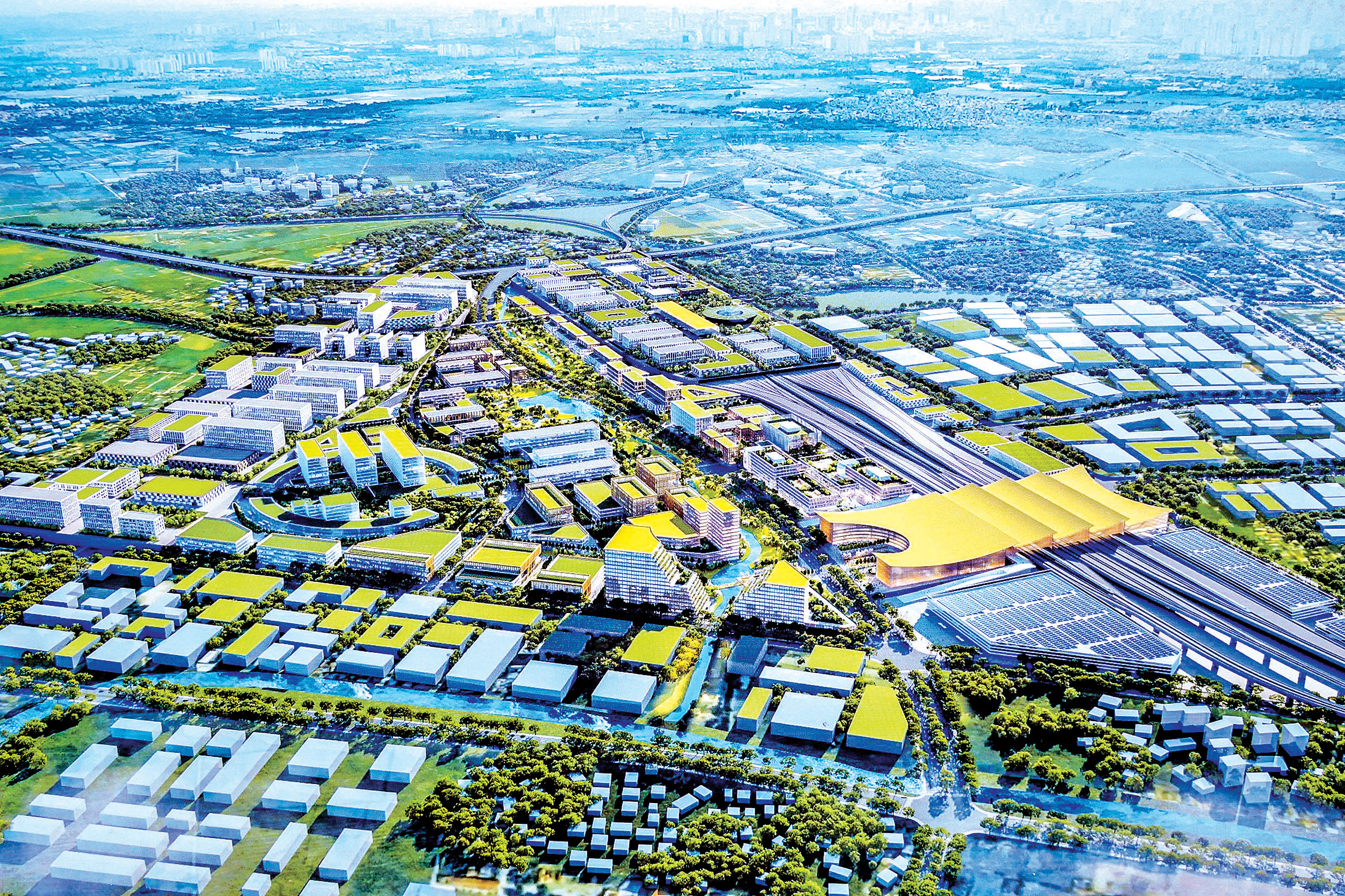
Perspective view of the Ngoc Hoi complex (Hanoi), part of the North-South high-speed railway project.
Therefore, the province recommends that when implementing the next steps, the relevant agencies work specifically with the localities on detailed design research plans, minimizing the impact of overlapping with the province's projects and works.
According to the leaders of Binh Dinh province, the placement of the two train stations at opposite ends of the province is very advantageous for the future development of the locality. After agreeing on the route and receiving the boundary markers, the locality will immediately begin land clearance.
"First, the local authorities will conduct awareness campaigns to ensure people understand and agree. Then, land clearance committees will be immediately established in each district. We have gained experience from the implementation of the North-South expressway."
"Having the train station located in Hoai Nhon town will help stimulate tourism in the northern part of the province, while the southern station will boost tourism and socio-economic development in Quy Nhon City and An Nhon City in the future," Mr. Hoang shared.
According to Mr. Hoang, along with the North-South expressway which will be put into operation at the end of next year, Binh Dinh expects the high-speed railway to be a major driving force to help the locality make breakthroughs.
The province is currently constructing connecting roads to the expressway and, later, railway stations to create a comprehensive network.
In Quang Ngai, the station's location has been identified in the Quang Phu ward of Quang Ngai city and Nghia Ky commune of Tu Nghia district.
Most of the land surrounding the train station construction site is agricultural land, with a small amount of residential land containing houses, but these are quite sparse.
In this area, Quang Ngai province has also included in its planning a bidding process to select investors for the construction of residential and urban area projects to create momentum for the development of the western part of the city.
According to Nguyen Phong, Director of the Quang Ngai Department of Transport, the province will study adjustments and additions to infrastructure projects connecting to existing projects in the Quang Ngai City planning.
"The proposed location for the train station is quite open, close to the North-South expressway and existing transportation routes, so it will open up great opportunities for the province's development," Mr. Phong said.
Hanoi allocates 250 hectares for the construction of the Ngoc Hoi complex.
The high-speed railway project on the North-South axis through Hanoi spans approximately 27.9km. The route from Ngoc Hoi station basically follows the planned corridor; at the end of Phu Xuyen district, the route branches off towards the east to bypass the Dong Van industrial zone in Duy Tien district, Ha Nam province.
Hanoi plans to allocate approximately 250 hectares for the Ngoc Hoi complex to develop a fully functional national and urban railway hub.
In terms of scale, Ngoc Hoi passenger station is intended to be a major hub in the North, with all trains stopping there.
Meanwhile, in Nguyen Trai and Van Phu communes (Thuong Tin district), the Thuong Tin freight station will be located, serving as Hanoi's southern freight hub; its scale will be determined in subsequent stages of the project.
In terms of connectivity, the Ngoc Hoi area has a fully planned and synchronized transportation system: Ring Road 3.5, Ring Road 4, National Highway 1, 3 urban railway lines, and a bus system, as well as a public square to accommodate taxis and private vehicles. It also connects to 4 national railway lines.
Mr. Do Viet Hai, Deputy Director of the Hanoi Department of Transport, said that Hanoi highly agrees with the proposal in the pre-feasibility study report because this is the optimal route for Hanoi.
Call for investment, prepare for resettlement.
Speaking with Giao Thong Newspaper, Mr. Nguyen Tan Tuan, Chairman of the People's Committee of Khanh Hoa province, informed that the high-speed railway through Khanh Hoa province will be 130km long, with a total land area of approximately 932 hectares to be cleared, at a cost of about 7,337 billion VND. It is expected to have one passenger station in Dien Khanh district and one freight station in Ninh Hoa town.
The province is currently preparing to finalize zoning plans and attract investment into industrial zones along the North-South Expressway and the Khanh Hoa-Buon Ma Thuot Expressway, as well as developing TOD (Transit-Oriented Development) urban areas connected to passenger stations in Dien Khanh district. These projects are currently in the planning and bidding process.
"Khanh Hoa has experience in land clearance for many projects. The locality is also considering planning resettlement areas to ensure project progress."
"The province also hopes to have another terminal in Cam Ranh City to capitalize on the strengths of the Cam Lam Airport Urban Area," Mr. Tuan expressed.
According to Mr. Le Huyen, Vice Chairman of the Ninh Thuan Provincial People's Committee, with the advantage of being located on the North-South high-speed railway line from Nha Trang to Ho Chi Minh City, the province will certainly be one of the localities that will soon benefit from the project.
"The province has incorporated the land use plan and route planning management into the implementation of the land clearance sub-project," said Mr. Le Huyen, Vice Chairman of the Provincial People's Committee.
In Binh Thuan province, provincial leaders conducted a field survey of the planned locations for the two train stations. Accordingly, the route and stations along the section passing through the province have a length of approximately 156km.
According to the initial plan, there will be two stations: Phan Rí (Bắc Bình district) and Phan Thiết. Phan Rí station is a passenger station with many functional areas.
According to Mr. Nguyen Hong Hai, Vice Chairman of the People's Committee of Binh Thuan province, the province has requested relevant departments and agencies and Bac Binh district to study planning options for connecting roads, and to research urban planning associated with the high-speed railway station into the regional planning of Bac Binh district, and the planning of Phan Hoa commune, Phan Ri Thanh commune, etc.
Regarding transportation connectivity, the province has proposed an investment project for a road connecting the center of Phan Thiet city to the Vinh Hao - Phan Thiet expressway.
The province is currently reviewing urban planning, infrastructure, and transportation connections to the stations so that when the high-speed railway is constructed, transportation will be seamlessly integrated.
Source: https://www.baogiaothong.vn/san-sang-lam-duong-sat-toc-do-cao-192250121094428494.htm
![[Photo] General Secretary To Lam attends the inauguration ceremony of Si Pa Phin multi-level boarding school.](/_next/image?url=https%3A%2F%2Fvphoto.vietnam.vn%2Fthumb%2F1200x675%2Fvietnam%2Fresource%2FIMAGE%2F2026%2F01%2F31%2F1769840655651_ndo_br_z7486540481209-f37c7e00a962aec2a061c64b7db569ef-jpg.webp&w=3840&q=75)


![OCOP during Tet season: [Part 3] Ultra-thin rice paper takes off.](/_next/image?url=https%3A%2F%2Fvphoto.vietnam.vn%2Fthumb%2F402x226%2Fvietnam%2Fresource%2FIMAGE%2F2026%2F01%2F28%2F1769562783429_004-194121_651-081010.jpeg&w=3840&q=75)


![OCOP during Tet season: [Part 2] Hoa Thanh incense village glows red.](/_next/image?url=https%3A%2F%2Fvphoto.vietnam.vn%2Fthumb%2F402x226%2Fvietnam%2Fresource%2FIMAGE%2F2026%2F01%2F27%2F1769480573807_505139049_683408031333867_2820052735775418136_n-180643_808-092229.jpeg&w=3840&q=75)





Comment (0)