

The Central Committee sets an example.
The resolution on the organization of the National Assembly's agencies and the number of members of the Standing Committee of the 15th National Assembly, adopted at this session, shows the National Assembly's determination to streamline the apparatus. Accordingly, the new National Assembly structure includes the Council of Ethnic Minorities and 7 committees, a reduction of 4 committees compared to the current structure. Regarding the government's structure, compared to the beginning of the term (when the government consisted of 18 ministries and 4 ministerial-level agencies), the newly approved government structure reduces 5 ministries and ministerial-level agencies, leaving 14 ministries and 3 ministerial-level agencies. This number is the result of reorganizing the apparatus, merging ministries and agencies with similar functions, demonstrating the government's strong determination.
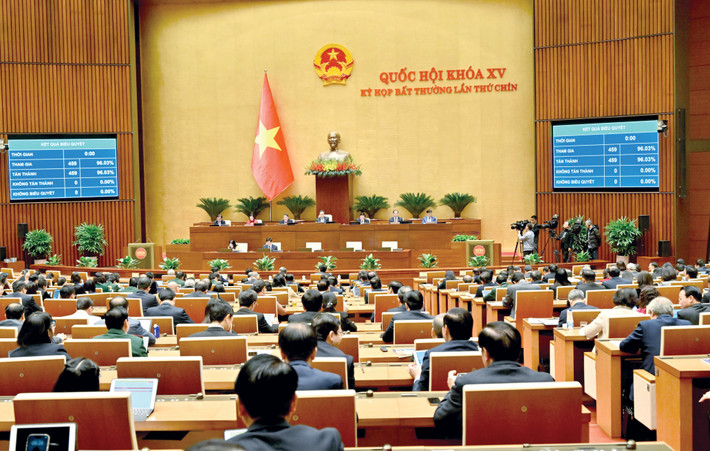 The resolution on piloting a number of specific and special mechanisms and policies to develop the urban railway network in Hanoi and Ho Chi Minh City is one of six resolutions passed by the National Assembly with 100% of the attending National Assembly deputies voting in favor. Photo: Quang Khanh
The approval of the organizational structure of the National Assembly and the Government at this National Assembly session clearly demonstrates the Central Committee's determination to set an example and take the lead in the revolution to streamline the apparatus. This aligns with the overall objective of Resolution No. 18-NQ/TW dated October 25, 2017, of the 6th Plenum of the 12th Central Committee on some issues concerning the continued reform and restructuring of the political system's organizational apparatus to be streamlined, effective, and efficient: to strengthen the Party's leadership role; to improve the effectiveness and efficiency of State management and the quality of activities of the Fatherland Front and political and social organizations. Above all, it aims to promote the people's right to self-governance.
“I believe that the Ninth Extraordinary Session, especially the session on February 18th, clearly demonstrated the Central Committee's responsibility towards the nation's destiny in this era of progress. Only by streamlining the apparatus and building a truly efficient, effective, and effective system can we have the strength to enable the nation to soar to greater heights,” observed voter Nguyen Tien Dung from Hong Linh town, Ha Tinh province.
From a practical standpoint, after observing the proceedings of the recent sessions, voter Ngo Duc Thai from Hung Nguyen district, Nghe An province, affirmed that the policy of streamlining the administrative apparatus is correct, but he also expressed concerns about its implementation in localities: “A revolution requires very high determination, broad consensus, and even sacrifices of personal interests. In my opinion, besides timely mechanisms and policies, each official and Party member needs to play a pioneering role, creating favorable conditions for the streamlining of the organizational apparatus to be completed quickly and to maximize efficiency and effectiveness. At the same time, the Party and State also need specific solutions and a roadmap to retain talented people, ensuring that after streamlining, the apparatus will be both politically sound and professionally competent,” Mr. Thai emphasized.
Improve performance, efficiency, and effectiveness of operations.
At this session, one draft law that has attracted the attention of the majority of voters and the people is the Law on Organization of Local Government (amended). The law, once passed, will provide an important legal framework for reorganizing the provincial and district-level government apparatus as part of the streamlining process in accordance with Resolution No. 18-NQ/TW.
Never before has there been such anticipation for the National Assembly's vote on a law as this session, especially for the Law on Organization of Local Government (amended), as it is a crucial legal "key" in the roadmap for streamlining and reorganizing the local government apparatus. In the morning session on February 19th, with 458 out of 459 attending National Assembly deputies voting in favor, achieving a rate of 99.78% (equivalent to 95.82% of the total number of deputies), the 15th National Assembly officially passed the Law on Organization of Local Government (amended). Voters expect the new regulations to contribute to streamlining the local government apparatus in line with the set goal of improving efficiency, effectiveness, and operational efficiency. Voter Hoang Anh Tuc from Dong Hoi City, Quang Binh Province, expressed this confidence.
The overarching theme in the laws presented at this Ninth Extraordinary Session is the issue of decentralization and delegation of power. In particular, the decentralization of power to local authorities is expected by the majority of voters to create initiative and provide a leverage for local governments to make breakthroughs. “Along with regulations on decentralization, delegation of power, and authorization, clearly defining the autonomy and accountability of local governments in the law will create initiative for localities. The law also stipulates the effective implementation of power control, coupled with inspection and supervision by higher-level state agencies, to ensure that decentralization and delegation of power are on the right track and prevent abuse of power. These are innovative contents based on carefully considered discussions among National Assembly deputies, and feedback from voters and the people,” expressed voter Vo An Ha from K'rong Nang district, Dak Lak province.
Along with regulations on decentralization and delegation of power, the National Assembly's amendment of the law grants local governments at the district level quite a few new powers. Notably, the provision clearly allowing district-level People's Councils to issue policies will be the "key" to resolving the long-standing "bottleneck" that localities have been struggling with in exercising their function of deciding on important local issues. The scientific, systematic, rigorous, and flexible approach from preparation to the conduct of the Ninth Extraordinary Session was also a highlight, affirming the National Assembly's action, its commitment to the people, and its readiness to establish a legal framework to drive national development in the new era.
Le Hong Hanh, Head of the Justice Department of Hong Linh town, Ha Tinh province
Source: https://daibieunhandan.vn/san-sang-dua-dat-nuoc-phat-trien-post405063.html


![OCOP during Tet season: [Part 1] Ba Den custard apples in their 'golden season'](/_next/image?url=https%3A%2F%2Fvphoto.vietnam.vn%2Fthumb%2F402x226%2Fvietnam%2Fresource%2FIMAGE%2F2026%2F01%2F26%2F1769417540049_03-174213_554-154843.jpeg&w=3840&q=75)




Comment (0)