

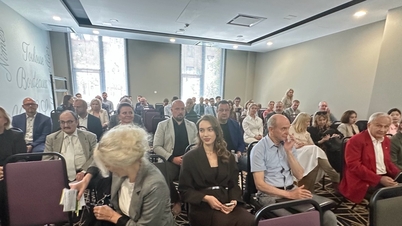
At the seminar "Nature Conservation and Buffer Zone Development of Vietnam's Special-Use Forests," organized by the Ministry of Agriculture and Rural Development in Con Cuong district at the end of July, Minister Le Minh Hoan suggested many solutions when approaching forest ecosystems and changing mindsets about income and livelihoods from forests.
Nghe An Newspaper respectfully presents the article by Comrade Le Minh Hoan - Member of the Central Committee of the Party, Minister of Agriculture and Rural Development.

“ What do forests teach us? ” – I would like to pose this question, so that each of us may have the opportunity to reflect and contemplate.
I'm sure each of us has our own answer.
- I would like to share with the delegates attending the seminar an article titled: " On the Forest: To See Our Own Smallness." I would like to quote the opening paragraph of the article verbatim: "One hundred years ago, we used computers that were the size of an entire room, yet now, a compact machine can be used to watch movies, edit photos, and chair meetings with people half a world away... Humans always think they are growing with science . But sometimes, because we prioritize material achievements, we forget what is truly great, we forget how small we are in the face of the 'giving' of nature and of everyone."
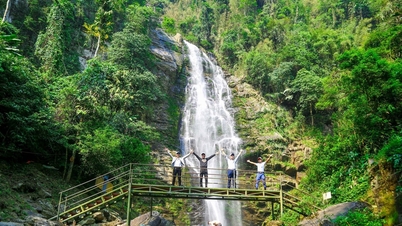
Forests teach us about compassion. Despite all the damage and destruction, forests still provide people with clean air, produce, shade, and sweet fruits...
Forests teach us about silent sacrifice. The forest rangers, experts, scientists participating in today's seminar, along with forest rangers, forest protection forces, and international nature conservation organizations across Vietnam – these "forest lovers" – silently and diligently contribute to the protection and development of forests every day. Forests teach us about learning and connecting to grow. Being aware of our own smallness means we are ready to learn and commit ourselves to becoming greater. To become great, we must learn from great things. To learn from great things, we must learn to dialogue and connect more with people and things.
Forests teach us about the preciousness and uniqueness of countless species, animals, flowers, and trees. The activity of releasing wild animals back into nature helps us understand more about the value of rescuing, caring for, and protecting each individual.
Forests teach us about the multifaceted value of what lies beneath their canopy, if we know how to strike a balance between conservation and development.

Forests teach us so much that we need to keep exploring, experiencing, learning, and growing.
Forests teach us about shelter, protection, and living in harmony with one another, regardless of our different statuses, without distinction between big and small, high and low, primary and secondary, just like the multi-layered nature of the plant life.
Forests teach us to share and to love, even in the face of adversity. With the same amount of sunlight, wind, air, and water, each living thing in the forest survives without争夺 (competing) for what it deserves.
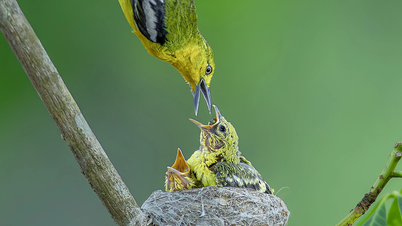
The forest teaches us a lesson about optimism, always filled with the songs of birds and the melodies of trees.
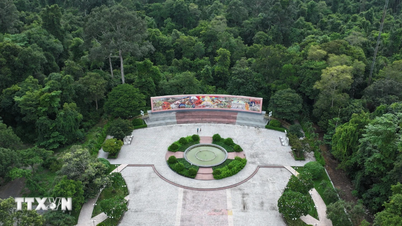
Our survey team was impressed by the portraits of children and ethnic minority people from the mountainous region when visiting the Open Nature and Culture Museum in Pu Mat National Park. People are always at the center and are the subjects of activities that connect nature conservation and livelihood development.

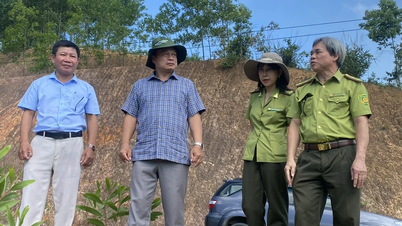
The participants in today's field survey and discussion series are very diverse, ranging from former leaders with many years of experience and close ties to forests, agricultural management units, forest rangers, specialized forest protection forces, local leaders, experts, scientists, international organizations on nature and conservation, local people whose livelihoods are closely linked to national parks and nature reserves, and even journalists and reporters from various media outlets.
This shows that the story of preserving and developing sustainable livelihoods is a laborious and diligent journey, requiring the active participation, cooperation, and perseverance of all of us.
It is necessary to distinguish between " livelihood" and " income".

While income is limited to salary, benefits, and material perks, livelihood encompasses quality of life, encompassing both material and spiritual values.
A livelihood is not just about work, responsibilities, and tasks, but also about the joy of doing that work, responsibility, and task.
Forest ecosystems not only bring economic value but also immense social value. When we sacrifice an area of forest land, it's not just a matter of sacrificing a few trees, but also the livelihoods of those involved in forest development.

In pursuit of a better life, humans have taken too much from nature, without considering the time it takes for nature to regenerate, as happened thousands or centuries ago. To accelerate economic growth, humans have inadvertently disrupted the natural balance. To get ahead, humans have impacted ecosystems at all costs. Has anyone calculated how many "positive points" for growth have been paid for by environmental degradation, ecosystem distortion, and reduced biodiversity?
The natural green color has gradually turned brown and gray; now it's time to transition from brown and gray back to green. Every change doesn't easily gain immediate societal consensus. It's all due to conflicts of interest between individuals and the community, between short-term and long-term goals. The "advantages" are easily discernible, while the "disadvantages" are harder to recognize.
There's a funny analogy: "If you're still weighing the economic and environmental pros and cons, try counting your money and holding your breath!"
Let's answer the following questions together:
Have we truly grasped the concept of "sustainable development" across its economic, environmental, and social dimensions?

Do we think that forest space is limitless, but humans themselves impose limitations on open thinking? Forests and nature are always open spaces, but humans close off their thinking space, creating divisions due to single-sector management barriers?
We often talk about "forest ecosystems" as a scientific and technical concept, but how do we understand "human ecosystems" or think about "community values" as a concept in the "social sciences and humanities"?
Are we always seeking resources from above and outside, but forgetting to develop our own internal resources, or failing to combine internal and external resources?
Price development the multipurpose value of forest ecosystems
The Forestry Department, in coordination with local authorities and relevant units, is implementing the "Development of the Multipurpose Value of Forest Ecosystems." This is not merely a purely technical proposal, but a newer approach, a broader and more far-sighted vision of the values of forest resources. Thinking about the multipurpose value of forests helps harmonize the relationship between natural and human resources, between tangible and intangible resources, towards sustainable development.
By engaging diverse stakeholders, including journalists themselves, the press plays a positive and important role: "media creates added value in the connected economy."

Diversification and integration create new economic value. Besides the value derived from timber, there are also rare ginseng and medicinal herbs, highly nutritious mushrooms, and the potential for aquaculture under the forest canopy.
Diversity does not create conflict; on the contrary, it adds synergy and richness to the forest. Today, the world is turning to foods sourced from nature, from sustainably managed forests.
The new economic value of forests also comes from services such as leasing forest land for ecotourism development and revenue from forest carbon credits.

A harmonious and integrated approach between science and technology and social sciences.

The conservation of biodiversity, including rare plant and animal genetic resources, as well as community knowledge and culture, needs to be preserved and developed within a "living museum"—the forest space.
Forest spaces are spiritual, religious, and emotional spaces in human life.
Forest spaces are always open for scientists, from science and engineering to social sciences and humanities, as well as ethnography experts, to explore and experience.
Forest spaces serve as a source of creative and innovative ideas, attracting research institutions, schools, organizations, and individuals both domestically and internationally to conduct research, training, education, knowledge transfer, and dissemination to communities.
Forest spaces also represent a synthesis of values, a blend of indigenous knowledge, age-old cultural traditions, and modern knowledge, creating new values.
Ultimately, I hope each of us will have a passport to explore the forest and discover the true value of our own lives.

Source












































![[Video] Sunset at Lap An Lagoon – Where the sun sets over the fishing nets](https://vphoto.vietnam.vn/thumb/1200x675/vietnam/resource/IMAGE/2026/05/31/1780192137701_beach-landscape-sea-water-nature-grass-745871-pxhere-com.jpeg)



























Comment (0)