

According to the U.S. Constitution, the presidential term is four years. Presidential candidates must meet mandatory criteria stipulated by the Constitution, such as being at least 35 years old, having resided in the United States continuously for more than 14 years, being born in the United States, and being a U.S. citizen.
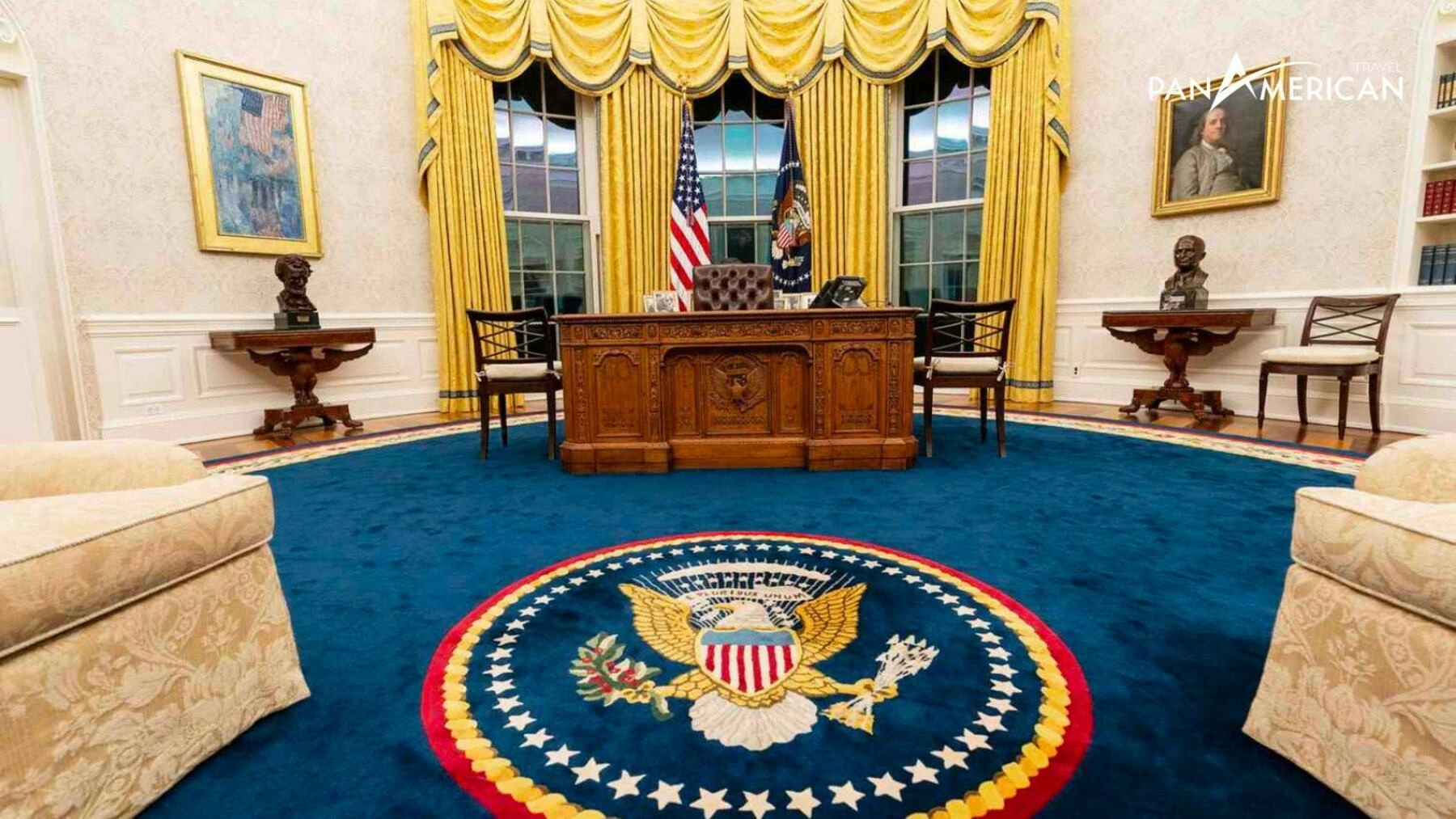 |
| The office of the U.S. President inside the White House. |
Since 1778, the US presidential election has been held every four years on the Tuesday following the first Monday of November. This year's race for the White House took place on Tuesday, November 5th, between Republican candidate, former President Donald Trump, and Democratic candidate, incumbent Vice President Kamala Harris.
According to the U.S. Constitution, the presidential term is four years, the term of a House of Representatives is two years, and the term of a Senator is six years. Candidates for the U.S. presidency must meet mandatory criteria stipulated by the U.S. Constitution, such as being at least 35 years old, having resided in the United States continuously for more than 14 years, and being born in the United States and a U.S. citizen.Term limits
Following their victory in the November election, the newly elected President, as stipulated by the U.S. Constitution, will take office at noon on January 20th of the following year. This also marks the end of the previous President's term. The presidential inauguration ceremony is held at the White House in Washington, D.C.
Each term of the U.S. President lasts four years, and according to the constitutional amendment passed on February 27, 1951, a President can only serve a maximum of two terms. If a person has served as President or Acting President for more than two years during a term in which another person has been elected President, that person may only be re-elected to the office for a maximum of one term.
In fact, prior to this regulation, only one person in American history had been elected President for three consecutive terms: Franklin Roosevelt, who served 12 consecutive years (from 1933-1945); five others had been elected for two terms: Dwight D. Eisenhower (1952-1959), Richard Nixon (1969-1975), Ronald Reagan (1980-1987), Bill Clinton (1992-2001), George W. Bush (2001-2008), and Barack Obama (2008-2016).
In the event that the President is unable to perform his duties (resigns, becomes incapacitated, or dies), Congress will transfer power to the Vice President. If both the President and the Vice President are in this situation, then according to the U.S. Constitution, Congress has the power to decide what happens next.
Most recently, the Presidential Succession Act, which took effect in 1974, stipulated that the Speaker of the House would be second in line to the succession (after the Vice President), followed by the President of the Senate (acting President), and then the cabinet members—starting with the Secretary of State.
During their term in office, presidents can be removed from office by Congress through a complex process. To remove a president, the House of Representatives must pass a resolution initiating prosecution and appoint several members of Congress as plaintiffs in a trial organized by the Senate. The Chief Justice of the Supreme Court will preside over this trial. A decision to remove a president from office requires the support of at least two-thirds of the senators.
How much power does it have?
According to the U.S. Constitution, the President must fulfill two functions: being the head of state (similar to the King or President of many other countries) and being the head of the executive branch (similar to the Prime Minister of other countries).
As the head of state, the President of the United States represents the country both domestically and internationally. In this capacity, the President must perform a range of ceremonial duties, such as receiving credentials from foreign ambassadors, presiding over celebratory banquets, and inaugurating important cultural, artistic, and sporting events. The President signs orders enacting laws passed by Congress, signs agreements with foreign countries, and appoints high-ranking officials in the federal government. The President also has the power to convene extraordinary sessions of either or both houses of Congress.
As the head of the executive branch, the President is responsible for signing treaties; appointing ambassadors, ministers, advisors, Supreme Court justices, and other high-ranking federal officials. The President also must brief both houses of Congress on the state of the federal government; propose bills, regulations, and directives that have the same effect as laws of federal agencies without requiring congressional approval.
Legislatively, the President has the power to veto any law passed by Congress, unless more than two-thirds of the members in each house override the veto.
In addition to the power to veto bills, the President also has the responsibility to propose certain bills for Congress to consider and pass. The President's proposals on bills are usually expressed in the State of the Union address at the beginning of the year, in the budget draft, and in specific recommendations.
Most of these presidential proposals are essentially demands from the executive branch to the legislative branch. Whether these proposals become law depends heavily on the president's political acumen and the relative dominance of his party in Congress.
Judicially, the President has the power to appoint federal judges, including those on the Supreme Court, but this requires Senate confirmation. The President can also overturn convictions or grant pardons to offenders who have violated federal law.
Furthermore, the US President is also considered the symbolic leader of his political party. The programs and initiatives that the President introduces often reflect the views of the party to which he belongs.
It can be said that the President is at the center of American politics. The President has immense power in foreign and military affairs, but is often less powerful in domestic policy decisions because they are still dependent on Congress. Typically, the President only achieves domestic policy goals when they convince Congress and the political parties that their interests are aligned in this matter.
To oversee the power of the President, Vice President, and other high-ranking government officials, the U.S. Constitution stipulates that the House of Representatives has the power to impeach them, while the Senate has the power to try them. Historically, three U.S. presidents have been impeached but all survived: Andrew Johnson, Bill Clinton, and Donald Trump. Meanwhile, Richard Nixon resigned before impeachment due to the Watergate scandal.
It is very difficult to be overthrown.
The President of the United States is the sole person with full executive power in the country. This concentration of power in one person allows the President to act with great freedom and effectiveness.
The President's term is four years, independent of public approval ratings or the support of a majority of members of Congress. This allows the President to make impulsive decisions that are unpopular without fear of losing office.
The relative separation of powers in the "separation of powers" system allows the President to act freely without fear of significant obstruction, especially from parliamentary interference.
The electoral college system for electing the President ensures that the President must always be the candidate of a major political party. The increased role of political parties also increases the role of the President. Therefore, the President is also considered the leader of their party.
Article 2 of the U.S. Constitution grants the President "executive power and command of the armed forces," enabling the President to make numerous important decisions. Examples include: President Jefferson's decision to purchase Louisiana; President Lincoln's numerous decisions during the Civil War; President Roosevelt's declaration of a state of emergency leading to the mobilization of national defense and deployment of troops overseas; and President Truman's decision to seize steel mills, all of which gradually increased the power of the U.S. President.
Source: https://baoquocte.vn/bau-cu-my-2024-quyen-luc-va-gioi-han-cua-tong-thong-my-292191.html


![[Photo] Ba Lang An Lighthouse - the "eye of the sea" amidst the "rock museum" of Quang Ngai province.](https://vphoto.vietnam.vn/thumb/1200x675/vietnam/resource/IMAGE/2026/05/29/1780038698840_anh-man-hinh-2026-05-29-luc-14-10-42.png)
![[Image] Pleasant weather helps students enter the 10th grade entrance exam with confidence.](https://vphoto.vietnam.vn/thumb/1200x675/vietnam/resource/IMAGE/2026/05/29/1780034401612_ngay-1-thi-lop-10-minh-duy-8-5009-jpg.webp)





























































































Comment (0)