

 |
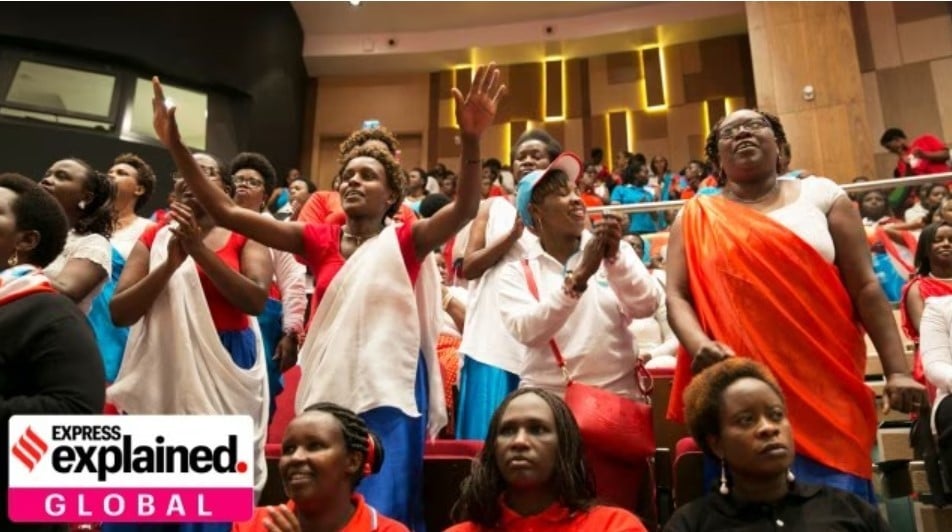
| Rwandan women at a meeting of the Rwandan Patriotic Front (RPF) political party. |
The IPU rankings reveal a reality where women are a minority in most parliaments worldwide. However, the proportion of women is increasing, now accounting for more than a quarter of all parliamentarians globally.
The IPU stated that growth in 2023 was similar to that of 2022, but slower than the previous two years.
Rwanda once again leads the world rankings with women holding 61.3% of the seats in the Lower House, followed by Cuba and Nicaragua with 55.7% and 53.9% respectively.
While Mexico also has more women than men in parliament, Andorra and the United Arab Emirates (UAE) achieve gender balance in their parliaments. Notably, the parliaments of Oman, Yemen, and the Pacific island nation of Tuvalu have no female representation.
Regionally, the Americas maintained its position as having the highest rate of female participation, at 35.1%.
The IPU report notes that a number of senior female leaders left politics in 2023, many of them citing burnout and increasing online harassment as the main reasons for their decision to "divorce" from the sport.
At the beginning of last year, Jacinda Ardern resigned as Prime Minister of New Zealand and decided not to seek re-election to Parliament. A few months later, following her defeat in the April election, Sanna Marin, the former Prime Minister of Finland, also resigned as a Member of Parliament and decided to leave politics. Several prominent female MPs in the Netherlands also resigned.
According to the IPU report, several parliaments have taken steps to enhance safety measures, such as Iceland's Althingi (National Parliament), which adopted a strategy and action plan against bullying, sexual harassment, and gender-based harassment.
| According to the latest IPU report, Vietnam ranks 63rd with women accounting for 30.6% of the seats in the National Assembly. |
Source

![[Photo] Prime Minister Pham Minh Chinh attends the Conference summarizing and implementing tasks of the judicial sector.](/_next/image?url=https%3A%2F%2Fvphoto.vietnam.vn%2Fthumb%2F1200x675%2Fvietnam%2Fresource%2FIMAGE%2F2025%2F12%2F13%2F1765616082148_dsc-5565-jpg.webp&w=3840&q=75)

































































Comment (0)