

Researchers have recreated the face of Pharaoh Tutankhamun as a young king of the 18th dynasty, who ascended the throne at age 9 and died at age 19.
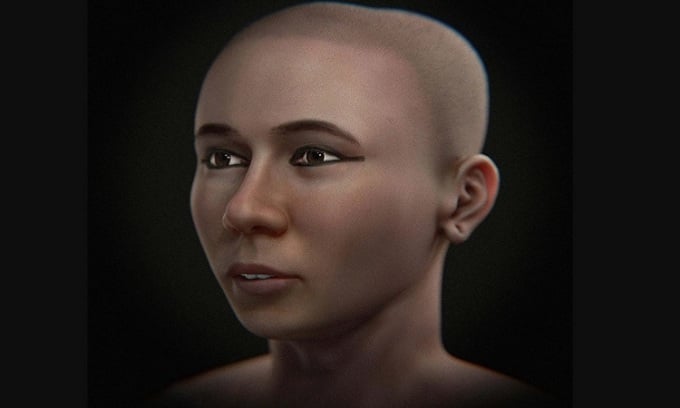
A reconstructed face of King Tut. Photo: Cicero Moraes
A team of researchers from Australia, Italy, and Brazil used modern technology to reconstruct the face of Pharaoh Tutankhamun, also known as King Tut, after 3,300 years. They will publish their findings in a new study in the Italian journal Anatomy and Embryology, The Sun reported on May 31.
Researchers used digital models and pre-existing measurements of King Tut's mummified skull to reconstruct his face. Brazilian graphic designer and co-author of the study, Cicero Moraes, described the resulting image as resembling a young student rather than a responsible king. He shared that the modeling process was difficult because the team could not directly access the skull of the late pharaoh.
"It was a process of tracing information, where we linked together every piece of data to create a 3D model of the skull. With data on proportions and some key cranial measurements, we were able to use the virtual donor's skull to create Tutankhamun's skull," Moraes explained.
Next, the research team determined the size of King Tut's lips, the position of his eyeballs, the length of his ears, and other proportions. All of these measurements were based on statistical studies conducted on CT scans of individuals with different ancestry.
Moraes believes the reconstruction results are highly consistent with the actual face in terms of overall structure. According to Michael Habicht, an Egyptologist and archaeologist at Flinders University, Australia, and co-author of the study, the reconstructed face is very close to the image created by a group of French experts a few years ago and corresponds to ancient descriptions of Tutankhamun.
Tutankhamun was an Egyptian pharaoh of the 18th dynasty, reigning from 1332 to 1323 BC. He was the son of Pharaoh Akhenaten and ascended the throne at the age of 9 or 10. He died at the age of 18, and the cause of death is unknown.
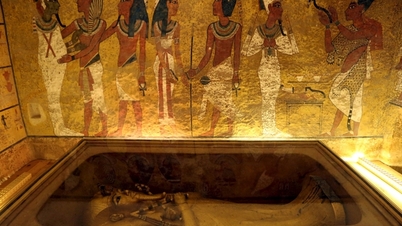
In 1907, Lord Carnarvon George Herbert appointed British archaeologist and Egyptologist Howard Carter to oversee excavations in the Valley of the Kings. On November 4, 1922, Carter's team discovered the steps leading to the tomb of King Tut. He opened the tomb and found the pharaoh's sarcophagus in February 1923. Carter and his colleagues spent 10 years collecting the treasures within. For many, King Tut represents a glorious period in Egyptian history because his tomb was filled with gold and silver, showcasing the extravagance of the 18th Dynasty, which lasted from 1569 to 1315 BC.
An Khang (According to Mail/Sun )
Source link









![[Video] Application of Biofloc technology in building an industrial-scale shrimp farming model](https://vphoto.vietnam.vn/thumb/402x226/vietnam/resource/IMAGE/2025/12/11/1765415061532_1765268925610-jpg.webp)


















![[Video] The craft of making Dong Ho folk paintings has been inscribed by UNESCO on the List of Crafts in Need of Urgent Safeguarding.](https://vphoto.vietnam.vn/thumb/402x226/vietnam/resource/IMAGE/2025/12/10/1765350246533_tranh-dong-ho-734-jpg.webp)



































































Comment (0)