

 |
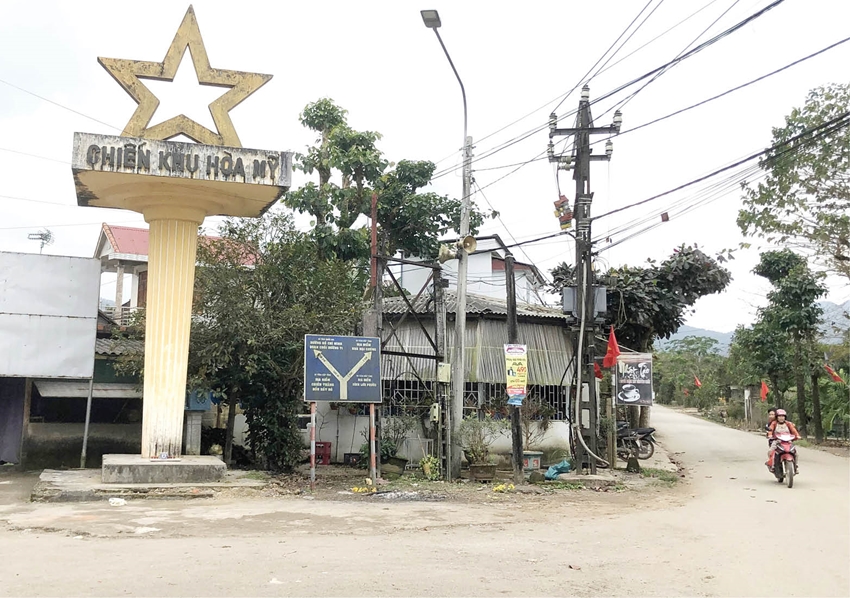
| Hoa My War Zone - the site of fierce battles fought by our army and people in the past. |
Before Liberation Day
In 1972, the war situation in the Tri Thien Hue battlefield increasingly favored us. However, the US still refused to abandon its aggression against Vietnam, continuing to implement the "Vietnamization of the war" strategy to maintain its neo-colonialism.
From March 1973, the Tri Thien Hue Regional Party Committee determined to "steadfastly maintain the violent stance, uphold the spirit of vigilance, be ready to fight, and resolutely defend the liberated areas and strategic corridors." The Phong Dien armed forces continuously attacked the enemy in many places. Dozens of internal bases were established within the Republic of Vietnam's soldiers, security forces, and militia, pushing the enemy back into a defensive position. Despite the circumstances of both rebuilding and continuously resisting enemy encroachment, the City Party Committee still focused on developing culture and education to meet the immediate and long-term needs of the revolution.
On September 30, 1973, high school students began their first school year in the liberated zone. On July 3, 1974, in the liberated zone of Phong Son, the revolutionary People's Committee of Phong Dien solemnly organized a rally to commemorate the first broadcast of the town's radio station. This was also the first radio station in the city to transmit the revolutionary voice in the liberated zone of Phong Son, boosting the morale of the soldiers and civilians in the town.
In December 1974, the Tri Thien Hue Regional Party Committee issued a key resolution: "Completely break the enemy's dividing lines and fundamentally defeat their pacification plan, win over the people, and gain control in the rural areas of the delta." The area north of Hue city was identified as the direction for mobilizing the masses to rise up, break the enemy's grip, establish strategic hamlets, and attack and destroy the enemy. At that time, Phong Dien had two types of villages and communes: one liberated and one still under dispute. At that time, the enemy's forces in the delta were quite strong, while our forces were weak. However, our side had the advantage of the people's deep hatred of the enemy, ready to rise up when the opportunity arose. Several of our secret bases behind enemy lines were capable of supporting hundreds of cadres and soldiers for a few days before the fighting began. To carry out the task of liberating the area, our side secretly moved troops through enemy checkpoints, reaching hidden areas to conceal our positions behind enemy lines.
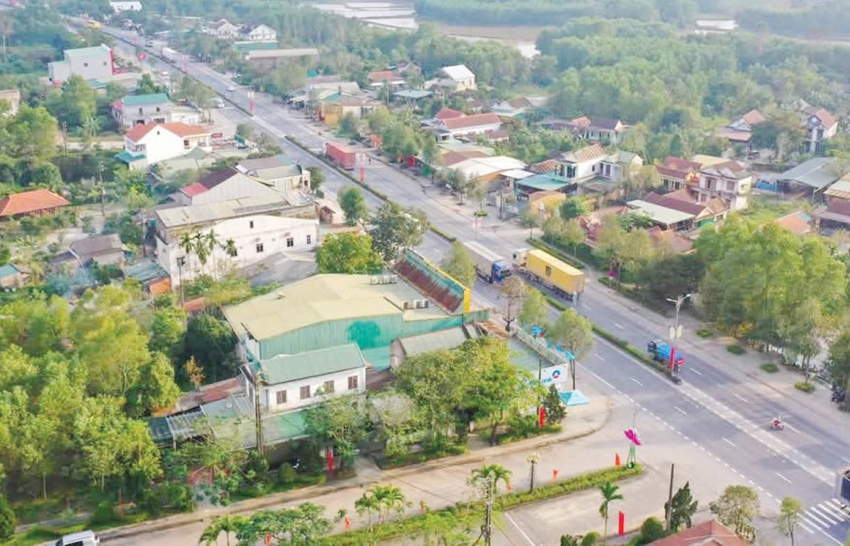 |
| Phong Dien Town Center today |
Liberation campaign
At exactly 5 PM on March 8, 1975, units of the 4th Regiment of the Tri Thien Military Region captured Pho Lai (Phong Son), including hills 57 and 37, which were held by the 130th Security Battalion under the command of the 147th Marine Brigade of the puppet regime. After more than 30 minutes of fierce artillery and infantry attacks, we quickly took control of Area A and several other targets. Along with the offensive of the 4th Regiment, on the northern front, the military region, city and town forces, along with local guerrilla units, attacked enemy military sub-districts in Phong Binh, Phong Hoa, Phong Chuong, Phong Hien, and Phong An. Simultaneously, local Party branches mobilized, supplied food and medicine, cared for the wounded, and guided troops in pursuing the enemy. Faced with our offensive momentum, the puppet regime in the communes lost its bearings. In the plains, regular and local troops, along with guerrillas, launched a swift and decisive attack on the Phong Loc Sub-district (i.e., Phong Chuong); the people and guerrillas of Phong Chuong, Phong Binh, Phong Hoa, Phong Son, Phong An, and Phong Thu communes simultaneously rose up, dismantling the militia and puppet government at the commune level. We won over the people, held them captive, and gained control of a vast area.
Despite their defeat, the enemy stubbornly continued to obstruct us at the border between villages and hamlets, intensifying mine-laying, ambushing and capturing young men and women, and constructing trenches and fortifications to guard against our surprise attacks. While they intensified their defenses externally, internally they were in disarray, regrouping, and many hamlets were left undefended; this created many advantages for us in launching our attacks.
In just two days and nights, we attacked 22 hamlets, mobilizing nearly a thousand people to hang flags, distribute leaflets in the villages, and read appeals from the revolutionary People's Committee and the City Front. We achieved great victories, especially in defeating and eliminating the oppressive forces in important remote areas.
From the early days of March, a historic month, the army and people of Phong Dien, in close coordination with the main forces of Quang Tri, Battalion 10 (K10), Company 3 (C3) of Hue city, and other units stationed in the area, simultaneously rose up and attacked with overwhelming momentum, embodying the spirit of "One day equals 20 years." Faced with this revolutionary offensive, at dawn on March 23, 1975, the Party branches, guerrilla units, and working teams of the district mobilized the masses to coordinate with the armed forces and the people of the communes to rise up in unison to hunt down the cruel oppressors, capture remaining enemy soldiers, and seize weapons. Hundreds of enemy soldiers panicked, abandoned their weapons, and deserted. On the night of March 23, 1975, we seized the opportunity, drove out the militia guarding the Pho Trach bridge, and proactively attacked and captured the Phong Dien district capital. The flag of the National Liberation Front of South Vietnam was raised atop the flagpole in the courtyard of the Phong Dien district capital. At the same time, our attacking forces continued to pursue the remaining enemy troops.
At exactly 3:00 AM on March 24, 1975, Phong Dien district (now Phong Dien town) was completely liberated, making a significant contribution to the liberation of Hue city on March 26, 1975.
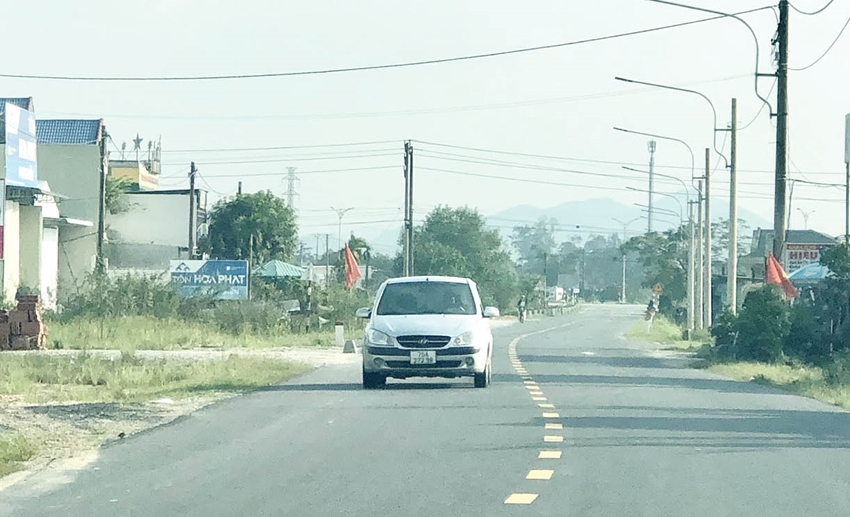 |
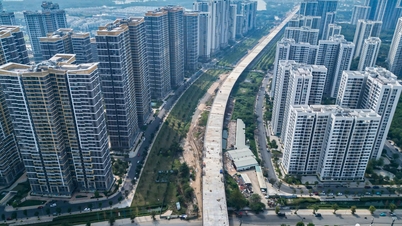
| Roads in Phong Dien town are now fully connected. |
Aspiration
The offensive to liberate Phong Dien shattered a crucial military base system, the enemy's northern shield in Hue, serving as a springboard for neighboring districts in the general uprising and creating favorable conditions for our forces to develop the offensive to liberate the entire city. It was a great and glorious victory, creating brilliant chapters in the town's history.
Following the great victory of Spring 1975, the Town Party Committee mobilized human and material resources to focus on overcoming the severe consequences left by the war. With the concerted efforts of the Party Committee, the government, and the people, for the past 50 years, since the complete liberation of the country and 35 years since the re-establishment of the district (township) in October 1990, Phong Dien has worthily continued its heroic tradition in combat, unity, and creative efforts to overcome difficulties and challenges, and develop its socio-economic aspects.
Phong Dien has now transformed with modern urban infrastructure, well-connected roads, and a clean and beautiful environment. The town's economic structure continues to shift in the right direction, focusing on increasing the proportion of industry (accounting for 60%), trade and services (accounting for 20%), and reducing the proportion of agriculture (accounting for 20%); per capita income has reached 75.7 million VND. The material and spiritual lives of the people are increasingly improving; national defense and security are constantly being strengthened. The town's Party Committee has over 4,000 members, with 51 grassroots Party organizations, and the leadership capacity and fighting strength of the Party organizations and members are constantly improving. In particular, cadres, Party members, and the people of Phong Dien are extremely happy and excited that the National Assembly issued Resolution No. 175, and the Standing Committee of the National Assembly issued Resolution No. 1314, recognizing Phong Dien as a centrally-governed city and a town. This is an important milestone and a source of pride for the Party Committee and people of Phong Dien town in their development process.
Looking back at those glorious pages of history, the Party Committee and people of Phong Dien will forever be proud of their heroic past, proud to be the first locality in the city to be liberated, worthy of the contributions and trust of our ancestors…
Source: https://huengaynay.vn/chinh-polit-xa-hoi/phong-dien-tu-hao-la-dia-phuong-dau-tien-cua-hue-duoc-giai-phong-151775.html




























































Comment (0)