

 |
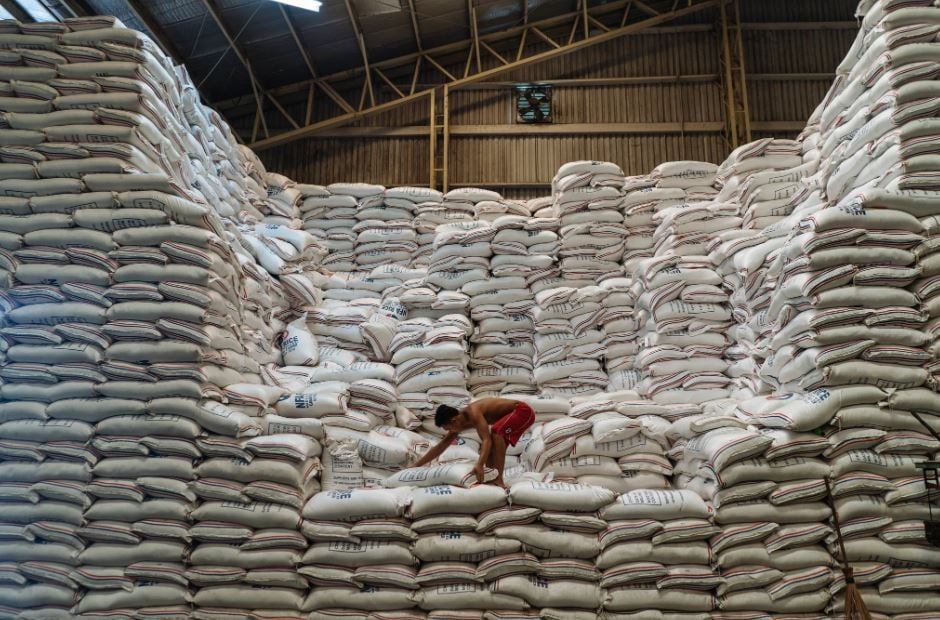
| Rice inside a warehouse of the Philippine National Food Authority in Quezon City, Philippines. Photo: NY Times |
A recent BMI report indicates that Philippine rice consumption will grow at an average annual rate of 2.5% until 2029. Meanwhile, domestic rice production is projected to grow at only 2% annually.
“The challenges facing the rice industry in the Philippines are also reflected in the growing production shortfall, from 1.4 million tons in the 2014-2015 crop year to an estimated 3.5 million tons in the 2024-25 crop year and 6.1 million tons in the 2028-2029 crop year,” the report stated.
BMI emphasizes that limited growth in domestic rice production coupled with strong consumer demand has significantly reduced the Philippines' ability to achieve rice self-sufficiency.
The Philippines' self-sufficiency in rice production is projected to fall to 69.7% of demand in the 2024-2025 crop year, a significant decrease from 91.6 percent in the 2014-2015 crop year.
The growing population in the Philippines will lead to a strong and sustained demand for rice in the medium and long term. BMI predicts that Filipino consumers' spending on rice will increase faster than their total food spending by 2029.
With domestic production failing to meet demand, the Philippines is increasingly reliant on rice imports. Philippine rice imports reached a record high of 4.8 million tons in 2024, surpassing the previous peak of 3.8 million tons in 2022. This reliance on imports leaves the Philippines vulnerable to price fluctuations and global market volatility.
BMI estimates that imported rice in the Philippines will account for approximately 30% of domestic consumption in the 2024-2025 crop year, marking a significant increase from 17% five years ago.
Limited arable land, frequent typhoons, and a growing population are persistent challenges hindering rice production in the Philippines.
According to BMI, to address this issue, the Philippines needs to improve rice productivity. Specifically for the 2025-2026 crop year, BMI forecasts that domestic rice production in the Philippines will increase due to more favorable weather conditions and the extension of the Rice Competitiveness Enhancement Fund (RCEF) until 2031.
The annual budget allocated to the RCEF will also increase from 10 billion pesos to 30 billion pesos (US$524 million) to bolster support for initiatives such as high-quality seed production, agricultural mechanization, training and extension, improved soil health, pest management, and irrigation water management. However, the RCEF cannot significantly improve the Philippines' domestic rice harvest yield.
The Philippines' rice production is projected to reach nearly 19.1 million tons in 2024, falling short of the government 's target of 19.3 million tons and 4.85% lower than the record harvest of 20.06 million tons in 2023. Despite this, the Philippine Department of Agriculture still expects rice production to reach a new record of 20.46 million tons this year.
A recent report by the U.S. Department of Agriculture estimates that the Philippines' milled rice production will reach 12.25 million tons in the crop year from July 2025 to June 2026. This figure is 2.1% higher than the previous crop year.
In February, the Philippine government declared a food security emergency to address persistently high retail rice prices, despite a global downward trend in rice prices and the previous year's decision to reduce rice import duties.
The Philippine government is also stepping up its efforts to negotiate with major rice exporting countries such as Vietnam and Thailand to secure long-term rice supply agreements. In 2024, Vietnam remained the leading rice supplier to the Philippines, accounting for three-quarters of total imports, equivalent to approximately 3.56 million tons, according to data from the Crop Production Bureau of the Philippine Department of Agriculture.
( According to thesaigontimes.vn )
Source: https://baoapbac.vn/kinh-te/202504/phillipines-ngay-cang-thieu-gao-1038558/
![[Photo] General Secretary To Lam attends the inauguration ceremony of Si Pa Phin multi-level boarding school.](/_next/image?url=https%3A%2F%2Fvphoto.vietnam.vn%2Fthumb%2F1200x675%2Fvietnam%2Fresource%2FIMAGE%2F2026%2F01%2F31%2F1769840655651_ndo_br_z7486540481209-f37c7e00a962aec2a061c64b7db569ef-jpg.webp&w=3840&q=75)


![OCOP during Tet season: [Part 3] Ultra-thin rice paper takes off.](/_next/image?url=https%3A%2F%2Fvphoto.vietnam.vn%2Fthumb%2F402x226%2Fvietnam%2Fresource%2FIMAGE%2F2026%2F01%2F28%2F1769562783429_004-194121_651-081010.jpeg&w=3840&q=75)


![OCOP during Tet season: [Part 2] Hoa Thanh incense village glows red.](/_next/image?url=https%3A%2F%2Fvphoto.vietnam.vn%2Fthumb%2F402x226%2Fvietnam%2Fresource%2FIMAGE%2F2026%2F01%2F27%2F1769480573807_505139049_683408031333867_2820052735775418136_n-180643_808-092229.jpeg&w=3840&q=75)


Comment (0)