

Lieutenant Colonel, Level 1 pilot Bui Dinh Thao successfully completed the target interception exercise with his Su-27 aircraft at the bombing and live-fire drills at the Nhu Xuan shooting range, Thanh Hoa .
Sweat trickled down his cheeks, his hair matted to his forehead after hours wearing his flight helmet, but pilot Bui Dinh Thao (Squad Leader of Squadron 2, 925th Air Regiment, 372nd Division, Air Defense - Air Force Command) smiled as he left the cockpit. A Level 1 military pilot (the highest level in the Vietnam People's Air Force) at just 33 years old, Thao was highly regarded by his instructors and comrades for his talent, courage, and flying skills.
Standing 1.85 meters tall during high school, Thao was a promising athlete on the local volleyball team, but his path to military service began when a delegation from the Air Defense and Air Force Command visited Vinh Bao district, Hai Phong, for recruitment examinations in 2003. His father told him to "go and see," but Thao was one of five young men from Hai Phong city to pass the recruitment examination, out of thousands who applied.
Thảo vividly remembers that day when, out of shyness, he didn't undress for the surgical examination. Seeing the young man enter the room and leave immediately, an officer approached him to inquire about his situation. The officer gently explained the situation, then patiently led him through the examinations of various departments before finally taking him to the surgical department. "I remember the doctor's name was Phan Thành. I will be grateful to him for the rest of my life because, thanks to him, I became a military pilot," Thảo said.
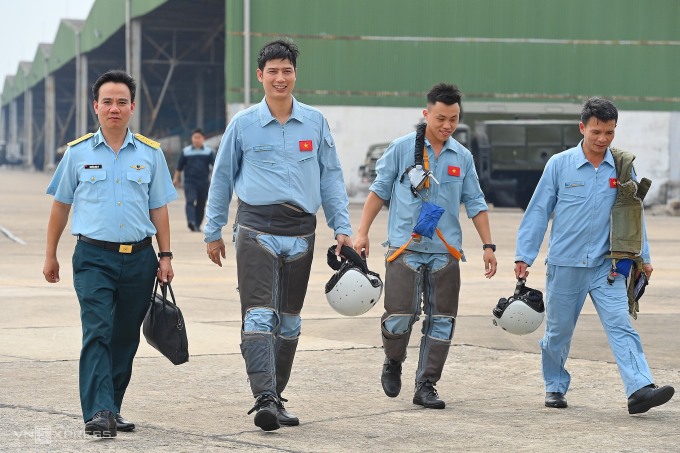
Lieutenant Colonel Bui Dinh Thao (second from the left) and his teammates chat after completing an aerial target interception test on July 17. Photo: Giang Huy
After graduating from the Air Force Officer School in 2009, Thao was assigned to the 940th Regiment, Air Force Officer School, in Phu Cat district, Binh Dinh province. Later, this unit was redesignated as the 925th Regiment, 372nd Division, responsible for protecting the central coastal region from latitude 13 to 18 and the surrounding islands. There, he became familiar with and gradually mastered the Mig-21 – the fighter jet that hero Pham Tuan used to shoot down a B-52 in 1972.
Thao said that as a pilot, anyone who flies a Mig-21 will "not be intimidated by any other jet" because it is a difficult fighter to master; it's easy to control but lacks stability. The aircraft uses delta wings with a small surface area and low lift. Air forces around the world consider the Mig-21 a flying coffin, a difficult aircraft to fly, second only to spacecraft.
In 2011, pilot Thao switched to the Su-27 multirole fighter. The aircraft can perform many roles in combat, including air combat and attacking ground targets with bombs and rockets. Thanks to his proficiency in flying the Mig-21, he progressed quickly.
To become a Level 1 pilot, he had to accumulate enough flight hours and pass all flight exercises, from easy to difficult. The biggest challenge for Thao remained the complex meteorological night flight. This flight was tricky because of the darkness, heavy clouds, the difficulty in determining the aircraft's state in space, and limited visibility.
"At this moment, the pilot is like a bird flying in a storm. The mission is to leave the nest, but when returning, they must find their own way and get back to the parking area safely. If their skills aren't sufficient, they'll fly up and then not be able to find their way back to the airport to land," he said.
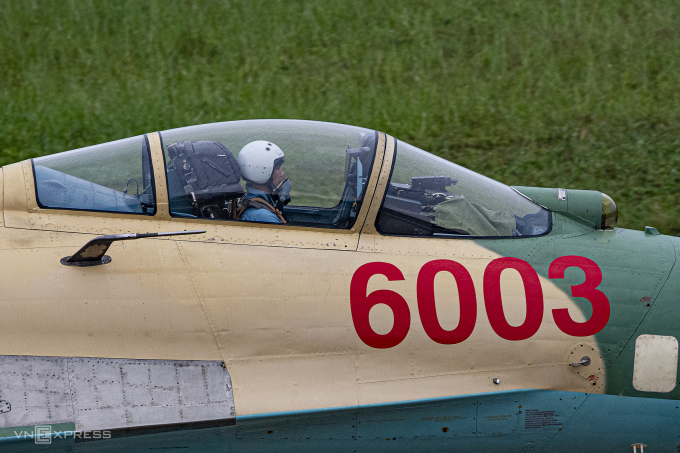
Lieutenant Colonel Bui Dinh Thao pilots the aircraft back to the parking area after completing the bombing exercise, July 20. Photo: Giang Huy
In his early days of flying, to overcome the limitations of visibility during difficult flight exercises, pilot Bui Dinh Thao determined his azimuth and distance using the instruments in the cockpit, visualizing his current location to find his way. Based on distance and speed, he could mentally calculate the flight time to his destination. As he became more proficient, he no longer relied so heavily on navigation. Fighter pilots are all experts at mental arithmetic and quick calculations. All calculations in their heads yield results in just 3 to 5 seconds with very high accuracy.
For pilots, theory is always closely linked to practice during training. However, even after learning 10 parts of the theory, only 6-7 parts can be applied in the air due to lack of oxygen. Therefore, many excellent trainees are unable to fly during training.
According to Lieutenant Colonel Bui Dinh Thao, for fighter pilots, the flight maneuvers that require the most experience, courage, and demonstrate ability are those involving attacking airborne targets. To master these maneuvers, pilots must perform complex high-altitude and low-altitude aerobatics, combine various weapon handling techniques, and skillfully control the aircraft.
"Pilots have to practice tracking aircraft visually from distances up to 30 km, meaning the target aircraft is only the size of a pen tip, but the pilot still maintains a precise position, pointing the radar beam," he said.
A typical day of flight training for Thao and his teammates usually begins at 4 a.m. This is when pilots have breakfast, have their blood pressure checked, and inspect their flight equipment. An hour later, when all procedures and equipment conditions are complete, he begins his mission. For patrol flights, the aircraft often carry missiles with the aim of detecting and intercepting the enemy from a distance, preventing them from penetrating deep into the mainland to attack important targets.
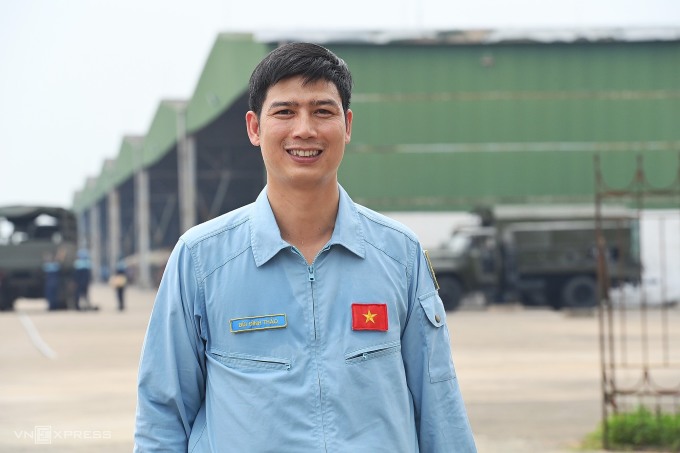
Lieutenant Colonel Bui Dinh Thao, Squadron Commander of Squadron 2, 925th Air Regiment, 372nd Division. Photo: Giang Huy
To ensure their health and fitness for duty, Thao and his teammates must adhere to a strict diet and physical and mental training regimen, under the supervision of a sports assistant officer. Each week, pilots undergo at least three days of rigorous training with a 10km run and aviation sports exercises such as pivoting and ladder climbing to train their vestibular system and acclimatize to being in space. After completing all of these exercises, pilots are free to engage in other sports.
With over 15 years as a pilot and 1,200 flight hours, Lieutenant Colonel Bui Dinh Thao has completed hundreds of missions and exercises of all sizes. In 2019, he and his teammates were assigned to conduct a bombing test at the Hon Ty Island-based shooting range in Binh Thuan province (TB-5), flying a Su-27 carrying bombs and missiles to hit the target. He successfully completed the mission, earning high praise from his superiors.
From July 16th to 20th, the Air Defense - Air Force Command organized a navigation and bombing/live-fire training exercise at the Nhu Xuan shooting range (Thanh Hoa). The competitions aimed to assess the skill level of the crew and radar navigation station; the ability of pilots to detect and intercept targets visually and with equipment; and the ability of helicopter crews to calculate and maintain long-distance flight data.
This is the highest level of training aimed at enhancing the command, coordination, and flight control capabilities of regimental-level officers throughout the entire Air Force. It also serves as an opportunity to assess the quality of weapons and equipment, technical support, combat capabilities, and combat maneuvers of each officer and pilot, especially in nighttime conditions and complex situations. From this, the Air Force will draw lessons learned and organize training that is closely aligned with practical realities and the evolving trends of modern warfare.
Source link

![[Photo] General Secretary and President visit the China-ASEAN AI Application Cooperation Center](https://vphoto.vietnam.vn/thumb/1200x675/vietnam/resource/IMAGE/2026/04/17/1776404277677_vna-potal-tong-bi-thu-chu-tich-nuoc-tham-trung-tam-hop-tac-ung-dung-ai-trung-quoc-asean-8706616-2286-jpg.webp)

![[Photo] Capturing each moment at the "People We Meet" photography exhibition.](https://vphoto.vietnam.vn/thumb/402x226/vietnam/resource/IMAGE/2026/04/15/1776245695648_1-8944-jpg.webp)






















![[Photo] National Assembly Chairman Tran Thanh Man attends the policy seminar to promote Vietnam-Türkiye cooperation.](https://vphoto.vietnam.vn/thumb/1200x675/vietnam/resource/IMAGE/2026/04/16/1776351415367_vna-potal-chu-tich-quoc-hoi-tran-thanh-man-du-toa-dam-chinh-sach-thuc-day-hop-tac-viet-nam-tho-nhi-ky-8705791-jpg.webp)























































Comment (0)