

Along with the development of fishing, aquaculture, and seafood processing, the development of seafood processing is becoming one of the important factors promoting the strong development of the fisheries economy , creating a solid foundation for fishermen to stay at sea, providing jobs, and generating stable income for thousands of workers in coastal localities.
 Seafood production for export at Song Viet Thanh Hoa Joint Stock Company.
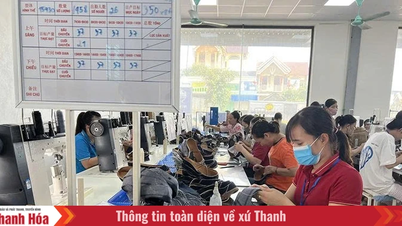
In recent times, seafood processing businesses and facilities have gradually expanded their scale and applied automated production technology to some stages, aiming to improve product quality. Visiting Song Viet Thanh Hoa Joint Stock Company (Nghi Son town), we witnessed hundreds of workers busy with their tasks: some transporting raw materials and sorting, others processing and filleting fish. In the freezing and storage area, a group of workers carefully inspected each surimi fish cake product before transferring it to the packaging department.
According to company director Nguyen Nhu Long: "In the first six months of 2024, the company's seafood export orders remained stable and increased slightly compared to 2023. We have fulfilled orders for nearly 4,000 tons of surimi fish paste and nearly 6,000 tons of fishmeal for partners in Japan, Malaysia, Indonesia, Thailand, and several European countries. The company is also focusing on purchasing and preserving raw materials to ensure proactive production. Along with that, we continue to seek markets linked to diversification and enhancing the value of our products."
In recent years, the seafood processing sector in Thanh Hoa province has seen a rapid increase in the number of businesses and a diversification of products. Many of these are high-quality, deeply processed seafood products that meet the stringent requirements of major markets such as the EU, Japan, and South Korea. Currently, the province has 80 businesses involved in seafood processing. These include 18 businesses processing fish sauce and fermented fish paste, 2 businesses processing fish meal, 1 business processing surimi fish cakes, 1 business processing steamed and frozen clams, and over 60 businesses involved in preliminary processing and freezing of seafood. The province currently has 6 businesses exporting seafood through official channels, with an export value of approximately US$134 million per year. In addition, coastal localities have more than 1,300 small-scale establishments involved in preliminary processing and processing of seafood products.
Through its businesses and processing facilities, Thanh Hoa annually supplies the market with over 13 million liters of fish sauce, more than 22,000 tons of fish meal, 2,500 tons of surimi fish paste, 10,500 tons of steamed and frozen clams, and 22,440 tons of frozen seafood... The proportion of products processed accounts for approximately 43.7% of the total harvested and farmed output, with the remainder consumed in raw form.
The province's seafood products are widely consumed domestically and also participate in exports. Typical examples include frozen clams, steamed clams, and frozen seafood exported to Spain, Portugal, France, the USA, and Italy; surimi fish cakes exported to South Korea, Japan, and Thailand; fish meal exported to China; and Le Gia fish sauce exported to Japan. In addition, some businesses export fresh and iced seafood through unofficial channels to the Chinese market or export on consignment to factories inside and outside the province.
Despite positive results, the seafood processing sector in the province still faces shortcomings and limitations that need to be addressed. Most processing facilities operate on a small, scattered scale, lacking strong linkages from production and processing to product consumption. Production technology is outdated, primarily focusing on preliminary processing, freezing, and raw material processing, resulting in low product value. Furthermore, the supply of raw materials to processing facilities is unstable. The province has yet to establish concentrated raw material areas to serve processing, nor has it formed major seafood processing centers.
To ensure the sustainable development of the seafood processing industry, commensurate with its potential, in addition to support mechanisms and policies from the province and relevant agencies, businesses and production facilities need to continue investing in improving management capacity, innovating technology and equipment to continuously improve product quality, and further developing local raw materials towards product diversification, focusing on export products. They should also promote joint ventures and linkages with large domestic and foreign enterprises to expand markets. Emphasis should be placed on ensuring food safety and hygiene in production and consumption, while protecting the environment and developing sustainable production and business practices.
Text and photos: Luong Khanh
Source: https://baothanhhoa.vn/phat-develop-nghe-che-bien-thuy-hai-san-217695.htm

![[Photo] General Secretary To Lam attends the Conference summarizing the work of the election of deputies to the 16th National Assembly](https://vphoto.vietnam.vn/thumb/1200x675/vietnam/resource/IMAGE/2026/03/31/1774952471746_ndo_br_bnd-2315-6970-jpg.webp)

![[Photo] Da Nang: Exploring the inside of Vietnam's largest "sail" symbol.](https://vphoto.vietnam.vn/thumb/1200x675/vietnam/resource/IMAGE/2026/03/31/1774964764698_ndo_br_anhcau1-jpg.webp)
![[Image] Creating urban areas along the Dong Nai River](https://vphoto.vietnam.vn/thumb/1200x675/vietnam/resource/IMAGE/2026/03/31/1774936857389_ndo_br_z7673258220978-0364bf985edfd080118668ad3c015934-resize-5023-jpg.webp)









































































Comment (0)