

Lesson 2: Experiences in Planning Policies to Attract Talent
To support their further development upon their return, comprehensive and long-term incentive mechanisms and policies are needed. Learning from the experiences of countries that have successfully attracted talent will contribute to improving the effectiveness of this policy.
THE APPEAL OF A NEW RESEARCH ENVIRONMENT
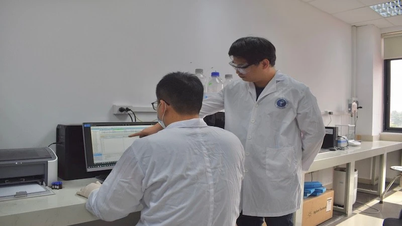
In a small room at the Vietnam-Korea Institute of Science and Technology (VKIST), several young researchers shared their experiences studying and researching abroad and their reasons for deciding to return to Vietnam. While each had their own reasons, they shared a common passion for science and a desire to quickly use their knowledge to create technological products that would serve the country's strategic industries.
The research environment at the Vietnam-Korea Institute of Science and Technology, which closely adheres to international standards, is considered a "magnet" attracting them back and enabling them to maximize their research capabilities. Dr. Dang Van Cu, a new researcher at the Vietnam-Korea Institute of Science and Technology, had the opportunity to secure a stable job and engage in extensive international collaborations after completing his postdoctoral research program in Korea.
At the end of 2024, he returned and chose the Vietnam-Korea Institute of Science and Technology to continue his research. Dr. Dang Van Cu shared that, in the process of carrying out scientific and technological tasks there, researchers only need to focus on their research and dedicate maximum time to their projects, without having to worry about administrative procedures such as bidding, procurement, and settlement... because there is a specialized department to support them.
Dr. Hoang Anh Viet, Deputy Head of the Energy Technology Department of the Institute, was also one of those who decided to return after completing their doctoral research in Japan. He highly appreciated the Institute's compensation policy, where researchers receive double salary, and the bonus system is transparent and fair.
All labor costs for research projects will be concentrated in a salary fund and redistributed according to the competence, level of contribution, and completion results of each individual assigned tasks annually. The evaluation process is clearly quantified according to KPIs, helping scientists confidently dedicate their full time and effort to creating high-quality research products.
Dr. Hoang Anh Viet assessed that the Vietnam-Korea Institute of Science and Technology is a new research institution but is constantly improving its modern management model to create a professional working environment where scientists have a certain degree of autonomy in their research. Phenikaa University is also a "common home" for many returning postgraduate students from abroad thanks to its advanced management model and competitive remuneration policies. The university prioritizes recruiting scientists with international publications, especially those with doctoral degrees who have been trained abroad or are currently studying abroad.
Associate Professor, Dr. Truong Thanh Tung, Head of the "New Drug Design and Synthesis" research group at Phenikaa University, shared that research groups are free to form their own research teams and receive financial support from the university to purchase equipment and chemicals. Students and trainees participating in the research are exempt from tuition fees, while postgraduate students are also exempt from tuition fees and receive a monthly salary, creating favorable conditions for them to pursue scientific research.
Thanks to this attractive mechanism, Phenikaa University has established more than 20 strong and promising research groups, all consisting of returning postgraduate students from abroad. The research group led by Associate Professor, Dr. Truong Thanh Tung alone has attracted four PhDs and two Master's degree holders from overseas, maintaining approximately 20-30 students participating in research each year. Besides research institutes and universities, the business sector is also an important "launching pad" for overseas Vietnamese talent, notably Vingroup, which has implemented many strategies to attract overseas Vietnamese to return and contribute, resulting in the return of many experts and scientists.
The reason these organizations attract such talent is that they have strong financial resources and a favorable scientific research environment, comparable to that of advanced countries.
THE LACK OF SYNCHRONIZATION NEEDS TO BE ADDRESSED
In contrast to the aforementioned institutions, the majority of public research institutes and universities still face difficulties in attracting human resources. The main reasons stem from barriers related to the research environment, financial regulations, or a lack of specific guidance on applying remuneration schemes using public funds. Professor Chu Hoang Ha, Vice President of the Vietnam Academy of Science and Technology, stated that the need for research collaboration with scientists abroad is significant, but most public institutions are unable to do so due to a lack of guidance on remuneration.
Attracting talented overseas Vietnamese is also difficult due to staffing limitations, while the Academy has seen a 20% reduction in its workforce over the past 10 years as part of a downsizing policy. As evidence of this, Professor Trinh Van Tuyen, former Director of the Institute of Environmental Technology, stated that the Institute has attracted many PhDs who studied in Russia, Canada, and Japan, but some PhDs have not been granted permanent positions for the past 10 years and have had to work under contract.
"I once sent a letter and had direct discussions requesting the Academy to appoint them as heads and deputy heads of departments, because they are truly talented and deserve recognition and titles to facilitate better cooperation with partners. For many years, they have been disadvantaged, especially by not being allowed to lead research projects," said Professor Trinh Van Tuyen.
The lack of synchronization in infrastructure and the failure of science and technology management mechanisms to keep pace with practical needs are also major obstacles in attracting talented scientists and technology experts from abroad to return. Professor Phan Tuan Nghia, Chairman of the Council of Professors in Biology, shared that he has a student who is currently an Associate Professor at the Hong Kong University of Science and Technology, and was once honored for a modern RNA invention.
He repeatedly expressed his intention to invite his students to take charge of the Key Laboratory, but without success. “I understand that our working conditions are not yet adequate, so even if they work abroad, it's good if they still have a connection to their homeland. Those working in research fields that don't depend on equipment are more likely to return, while fields like biotechnology, which require synchronized, modern equipment, are not yet as attractive.” Upon returning to Vietnam, many are not only concerned about income or working conditions, but also about the science and technology promotion policies of relevant ministries and agencies.
Dr. Do Tien Phat, from the Institute of Biotechnology (Vietnam Academy of Science and Technology), participated in the research and development of the CRISPR/Cas system for plant gene editing at a prestigious laboratory specializing in gene technology and molecular biology in the United States. Upon returning to Vietnam, he continued to work with his research team to successfully develop and apply this technology to various crops such as soybeans, rice, tomatoes, tobacco, cucumbers, etc.
However, to date, Vietnam still lacks specific policy guidelines to ensure that promising research products from gene editing technology can be applied in production and serve daily life. This hinders and reduces the motivation for research among scientists. Associate Professor, Dr. Truong Thanh Tung, Head of the "New Drug Design and Synthesis" research group at Phenikaa University, stated that in the US, there is a "venture capital" mechanism for research from the State, accepting a certain percentage of risk in the research, development, and commercialization of new drugs. However, in Vietnam, there are no clear regulations to protect scientists, thus hindering new, risky research in this field.
The 30-50 age range is the peak period of a scientist's research career, but if they are attracted back to the country without mechanisms to support their development, they will leave or miss their golden age. Therefore, there is a need for mechanisms to protect them, as well as socialized research funds with better allocation and supervision to support these talents after they are recruited. A representative from M-Service Joint Stock Company stated that when expanding and aiming for the global market, human resources become crucial. For innovative and groundbreaking models, domestic human resources are insufficient, forcing businesses to seek international experts or invite Vietnamese people from abroad to return.
Therefore, the government needs practical support policies such as granting long-term visas, reducing personal income tax, and providing housing assistance... to create favorable conditions and show appreciation so that they can confidently return to contribute. Professor Chu Hoang Ha emphasized that for science and technology to truly develop and integrate, it must also integrate in terms of policy, meaning that in science management, human resource management, and talent attraction, it must be closer to international practices. The resolutions aimed at removing obstacles for science and technology need to be institutionalized soon, with specific guidelines to create a real breakthrough in attracting talent.
The practices of many countries in attracting overseas talent show that successful nations consider this a valuable asset and constantly seek ways to utilize this resource. Basically, there are two main policy groups:
Firstly, attract outstanding individuals through repatriation programs with high remuneration, appeal to patriotism, honor achievements, and invest heavily in research institutes, universities, and high-tech zones (China, South Korea, India, Israel, Russia).
Secondly, attract investment through a systemic approach by improving the institutional environment, reducing external "temptations," and simultaneously developing an innovation system, promoting linkages between businesses, research institutes, and universities, and building internationally standardized educational and research facilities (South Korea, Taiwan (China), India).
Many believe that the current favorable situation is that Resolution 57-NQ/TW has demonstrated the political will and goodwill at the highest level regarding the importance of the community of talented overseas Vietnamese scientists and experts. Based on the experience of other countries and the reality of Vietnam, it is necessary to build a comprehensive, reliable, long-term policy environment with special incentives to attract them, such as policies on citizenship, visas, housing, travel, salaries, remuneration, and recognition; a complete, interconnected, and updated database on overseas Vietnamese scientists and experts is needed; strong investment policies for science and technology infrastructure are required; and large-scale national programs and projects with the aspiration to reach the world... These are the "magnets" that attract talented overseas Vietnamese scientists and experts to return and contribute to the sustainable development of the country.

![[Image] Nearly 125,000 Hanoi students completed the Literature exam for the 10th grade entrance exam.](https://vphoto.vietnam.vn/thumb/1200x675/vietnam/resource/IMAGE/2026/05/30/1780117233041_ndo_br_thiet-ke-chua-co-ten-2-png.webp)







![[INFOGRAPHIC] Canon EOS R6: A new breakthrough in 7K Open Gate video recording.](https://vphoto.vietnam.vn/thumb/402x226/vietnam/resource/IMAGE/2026/05/30/1780114528841_info-mayanh-a-thumb-jpg.webp)








![[Photo] The General Secretary, President and Prime Minister of Singapore attend the tree planting ceremony at the Singapore Botanic Gardens.](https://vphoto.vietnam.vn/thumb/402x226/vietnam/resource/IMAGE/2026/05/30/1780122934945_vna-potal-tong-bi-thu-chu-tich-nuoc-va-thu-tuong-singapore-du-le-trong-cay-8794687-jpg.webp)

![[Photo] Admire the coral "masterpiece" amidst the million-year-old heritage of Dak Lak province.](https://vphoto.vietnam.vn/thumb/1200x675/vietnam/resource/IMAGE/2026/05/30/1780107638639_y25-jpg.webp)





























































Comment (0)