

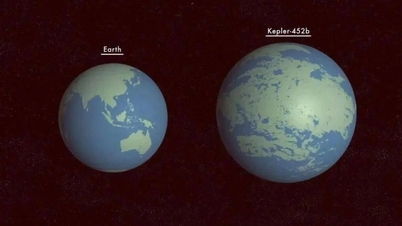
Scientists have discovered a planet, dubbed a 'super-Earth'—a group of planets capable of supporting life—orbiting a sun-like star about 20 light-years from our solar system.
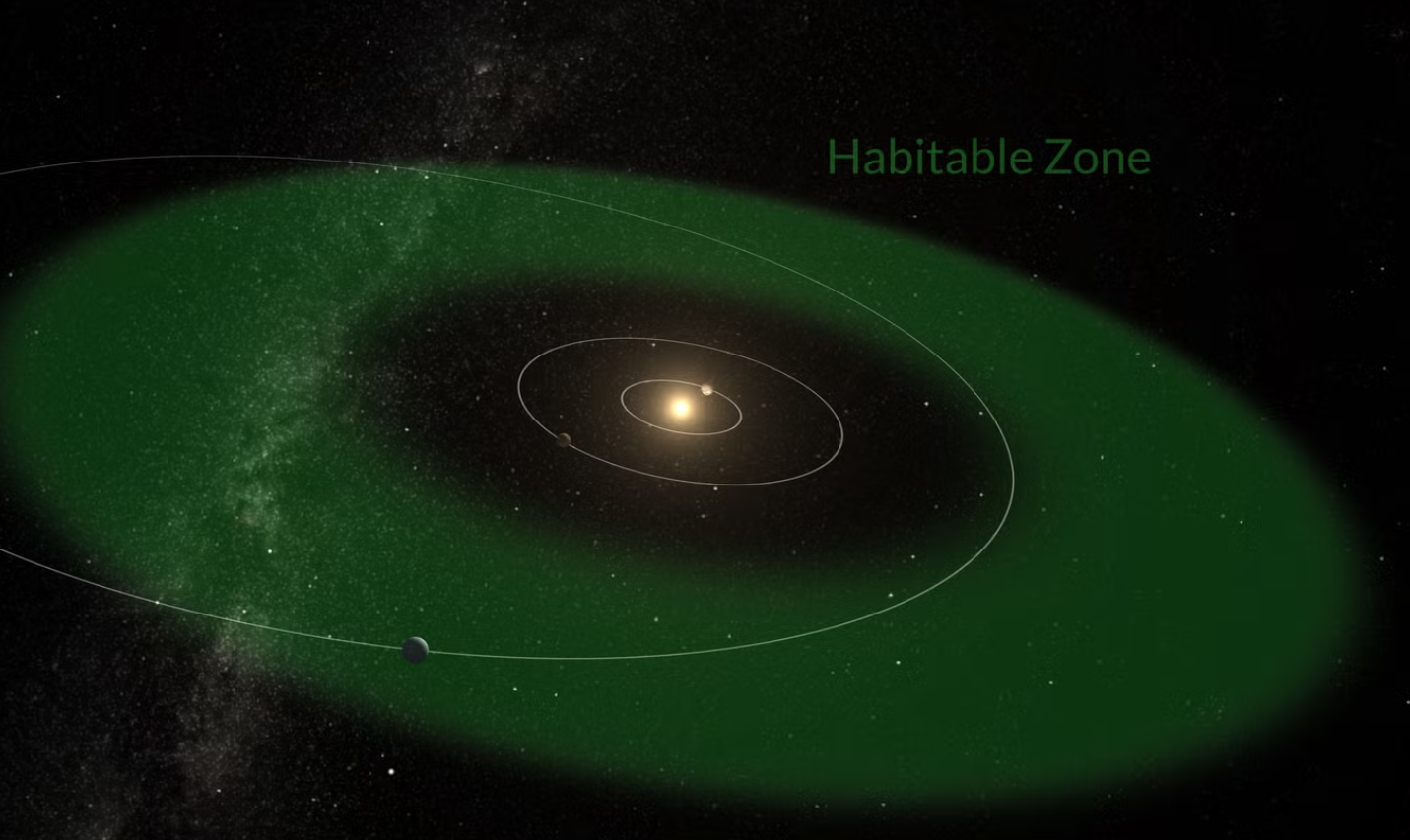
The blue halo is the region of the planet where life may be possible.
According to a report published in the journal Astronomy & Astrophysics , the newly discovered super-Earth, named HD 20794 d, has a mass six times that of Earth and lies within what is commonly known as the "habitable zone".
This is the region at a distance from the central star that could allow liquid water to form on the planet's surface, thereby creating conditions for life to flourish.
However, HD 20794 d orbits in an elliptical rather than a circular orbit, meaning the distance between the planet and its central star varies depending on its orbital position. Therefore, scientists are currently having difficulty determining whether life exists on the planet.
Clues to the existence of the super-Earth HD 20794 d began in 2022, when Dr. Michael Cretignier of Oxford University (UK) detected a signal while examining stored data from the La Silla Observatory in Chile.
Based on this information, an international team of researchers got involved. They analyzed data collected from two decades of observations before confirming the existence of the planet.
"The exciting thing is that the planet's proximity to Earth (20 light-years) offers hope for future space missions to capture more detailed images of this super-Earth," according to Dr. Cretignier.
Researchers call HD 20794 d an invaluable case study for projects searching for signs of extraterrestrial life.
"With its location within the habitable zone and close to Earth, the planet could play a crucial role in future missions to determine the atmospheric characteristics of exoplanets in the search for signs of biological activity indicating potential for life," according to the researcher.
Source: https://thanhnien.vn/phat-hien-sieu-trai-dat-co-the-dung-duong-su-song-185250129204156658.htm


![[Photo] Prime Minister Pham Minh Chinh attends the Conference summarizing and implementing tasks of the judicial sector.](/_next/image?url=https%3A%2F%2Fvphoto.vietnam.vn%2Fthumb%2F1200x675%2Fvietnam%2Fresource%2FIMAGE%2F2025%2F12%2F13%2F1765616082148_dsc-5565-jpg.webp&w=3840&q=75)




















































































Comment (0)