

(NLĐO) - Around two distant dwarf stars, a European spacecraft has discovered a giant planet and a bizarre half-star, half-planet phenomenon.
Analyzing data from the European Space Agency's (ESA) Gaia spacecraft, scientists have discovered a planet named Gaia-4b and a brown dwarf named Gaia-5b orbiting two dwarf stars.
They are all incredibly strange and magnificent worlds .
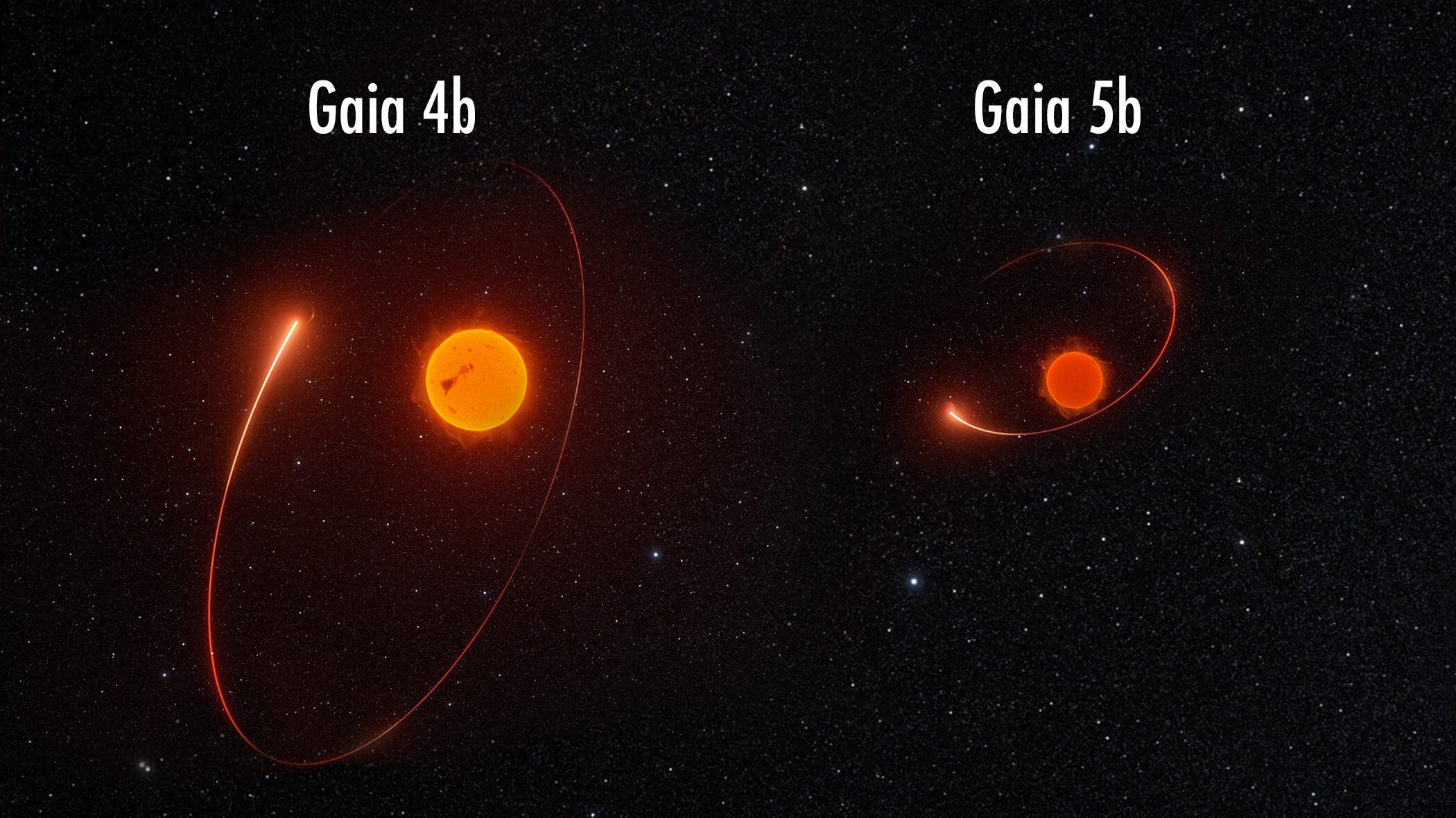
Graphic illustration depicting the planet Gaia-4b and the brown dwarf Gaia-5b orbiting two orange and red dwarf stars - Image: ESA
According to an article published in the scientific journal Astronomical Journal, Gaia-4b is a "super-Jupiter" planet, meaning it's a gas planet similar to Jupiter but much larger. Measurements show its mass is 11.8 times that of Jupiter, or more than 3,752 times that of Earth.
It orbits a red dwarf or orange dwarf star called Gaia-4 and is located about 244 light-years from Earth.
According to Sci-News, citing Dr. Guðmundur Stefánsson from the University of Amsterdam (Netherlands), a member of the research team, the planet has an orbital period of 571 days, meaning it orbits quite far from its parent star and is relatively cold.
Gaia-4b is also one of the first exoplanets discovered through astrophotometric techniques and one of the largest known planets orbiting a low-mass star.
Another interesting discovery is the brown dwarf Gaia-5b, orbiting the red dwarf Gaia-5, located about 134 light-years from our planet.
Brown dwarfs are among the most peculiar objects in the universe. They typically have masses exceeding 13 times that of Jupiter, far too large to be considered planets, and usually do not originate from the protoplanetary disk of any star.
However, Gaia-5b—like other brown dwarfs—is still too small to sustain nuclear fusion in its core, which would allow it to be considered a star.
Therefore, it is considered a "failed star" or "higher planet" and likely has a companion relationship with Gaia-5, rather than being a "child" of this red dwarf star.
In this case, scientists calculated the mass of this half-star, half-planet object to be about 21 times that of Jupiter, or 6,678 times that of Earth.
Source: https://nld.com.vn/phat-hien-sieu-hanh-tinh-nang-gap-3752-lan-trai-dat-196250207092154918.htm

![[Photo] Prime Minister Pham Minh Chinh receives Lao Minister of Education and Sports Thongsalith Mangnormek](/_next/image?url=https%3A%2F%2Fvphoto.vietnam.vn%2Fthumb%2F1200x675%2Fvietnam%2Fresource%2FIMAGE%2F2025%2F12%2F16%2F1765876834721_dsc-7519-jpg.webp&w=3840&q=75)
![[Live] 2025 Community Action Awards Gala](/_next/image?url=https%3A%2F%2Fvphoto.vietnam.vn%2Fthumb%2F1200x675%2Fvietnam%2Fresource%2FIMAGE%2F2025%2F12%2F16%2F1765899631650_ndo_tr_z7334013144784-9f9fe10a6d63584c85aff40f2957c250-jpg.webp&w=3840&q=75)
![[Photo] Prime Minister Pham Minh Chinh receives the Governor of Tochigi Province (Japan)](/_next/image?url=https%3A%2F%2Fvphoto.vietnam.vn%2Fthumb%2F1200x675%2Fvietnam%2Fresource%2FIMAGE%2F2025%2F12%2F16%2F1765892133176_dsc-8082-6425-jpg.webp&w=3840&q=75)
![[Image] The tenacious fighting spirit of Vietnamese women's football](/_next/image?url=https%3A%2F%2Fvphoto.vietnam.vn%2Fthumb%2F1200x675%2Fvietnam%2Fresource%2FIMAGE%2F2025%2F12%2F17%2F1765990260956_ndo_br_4224760955870434771-copy-jpg.webp&w=3840&q=75)
![[Image] Leaked images ahead of the 2025 Community Action Awards gala.](/_next/image?url=https%3A%2F%2Fvphoto.vietnam.vn%2Fthumb%2F1200x675%2Fvietnam%2Fresource%2FIMAGE%2F2025%2F12%2F16%2F1765882828720_ndo_br_thiet-ke-chua-co-ten-45-png.webp&w=3840&q=75)





































































![[Live] Closing Ceremony and Award Presentation for the "Impressive Vietnam Tourism" Video/Clip Creation Contest 2025](https://vphoto.vietnam.vn/thumb/402x226/vietnam/resource/IMAGE/2025/12/17/1765974650260_z7273498850699-00d2fd6b0972cb39494cfa2559bf85ac-1765959338756946072104-627-0-1338-1138-crop-1765959347256801551121.jpeg)























Comment (0)