

SGGP
The US National Aeronautics and Space Administration (NASA) has just announced that the Juno spacecraft has for the first time detected mineral salts and organic compounds on the surface of Jupiter's moon Ganymede.
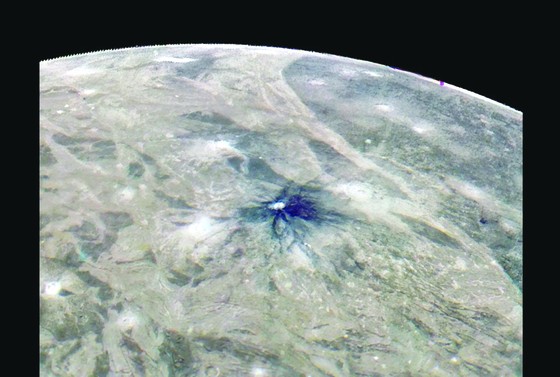 |
| The Juno spacecraft has for the first time detected mineral salts and organic compounds on the surface of Jupiter's moon Ganymede. |
According to NASA, these findings could help scientists better understand the origins of Ganymede and its deep-sea composition by analyzing the characteristics of its hydration salts, ammonium chloride, sodium bicarbonate, and possibly fatty aldehydes. Scientists have long been interested in Ganymede because it hides a vast ocean beneath its icy crust.
Previously, Europa, a moon believed to contain an ocean beneath its icy crust, was also first observed by Juno in October 2021, then again in September 2022, and a further approach is planned for December 30th, when the spacecraft will come within approximately 932 miles (1,500 km) of its surface.
Source




![[Photo] General Secretary and President To Lam presides over a meeting on preparations for the review of one year of operation of the three-tiered government system.](https://vphoto.vietnam.vn/thumb/1200x675/vietnam/resource/IMAGE/2026/06/02/1780391821195_a1-bnd-4595-9717-jpg.webp)
































































































Comment (0)