

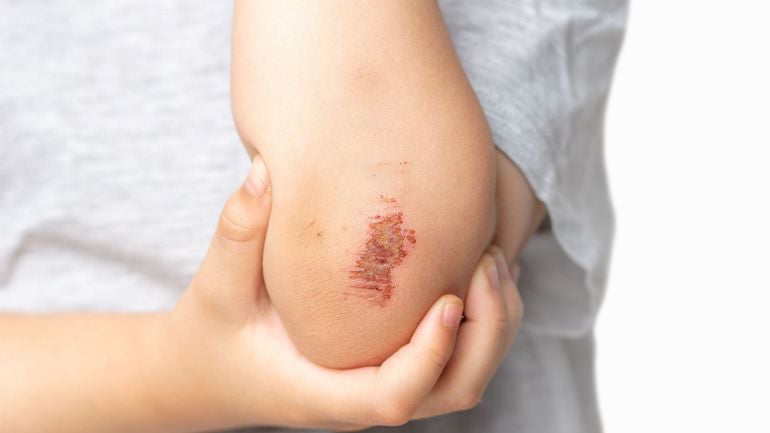
Scientists have discovered that skin cells have the ability to switch between solid and liquid states to promote the healing process - Illustration: GETTY IMAGES
Have you ever wondered what happens when a small cut heals? A research team led by Professor Cédric Blanpain at the Free University of Brussels (ULB) delved into this issue and made a surprising discovery.
By directly observing the wound healing process in mice under a microscope, they discovered that skin cells not only simply move to fill the wound, but also undergo a highly specific transformation of their state.
According to research published in the journal Cell , skin cells are initially in a solid state. However, when there is a wound, they "melt" into a liquid form, allowing them to move easily and quickly to the site needing repair.
After completing their task, these cells will "freeze" to form new skin tissue.
This transition between solid and liquid states is likened to a kind of biological "gel." Scientists have identified genetic factors that play a crucial role in controlling this transition. They may even be able to use drugs to temporarily block this process and keep the cells in a liquid state.
This discovery opens up new prospects for treating chronic wounds such as diabetic ulcers, pressure ulcers, and diseases related to tissue regeneration. By understanding the mechanisms of wound healing, scientists can develop more effective treatments that help wounds heal faster and minimize scarring.
Furthermore, this research also has significant implications for the field of regenerative medicine. Scientists are seeking ways to stimulate tissue regeneration in other organs such as the heart, liver, and lungs. Understanding the mechanisms of skin wound healing could provide crucial insights for research into regenerating these tissues.
Many questions remain unanswered. For example, how can we accelerate wound healing in large injuries? Does the process of cell transformation occur in other tissue types? And how can we control this process more precisely?
Nevertheless, the research team's findings have provided a completely new perspective on the wound healing process. This is a significant step forward in understanding the body's self-healing mechanisms and opens up new avenues for treating wound-related diseases.
Source: https://tuoitre.vn/phat-hien-dot-pha-ve-qua-trinh-lien-seo-20240816142942721.htm


![[Photo] Standing Committee member of the Party Central Committee Tran Cam Tu presents the Decision appointing the Secretary of the Party Committee of the Ho Chi Minh National Academy of Politics.](/_next/image?url=https%3A%2F%2Fvphoto.vietnam.vn%2Fthumb%2F1200x675%2Fvietnam%2Fresource%2FIMAGE%2F2026%2F02%2F02%2F1770039902160_le-cong-bo-bt-hvctqg-11-7880-jpg.webp&w=3840&q=75)


![OCOP during Tet season: [Part 3] Ultra-thin rice paper takes off.](/_next/image?url=https%3A%2F%2Fvphoto.vietnam.vn%2Fthumb%2F402x226%2Fvietnam%2Fresource%2FIMAGE%2F2026%2F01%2F28%2F1769562783429_004-194121_651-081010.jpeg&w=3840&q=75)





Comment (0)