

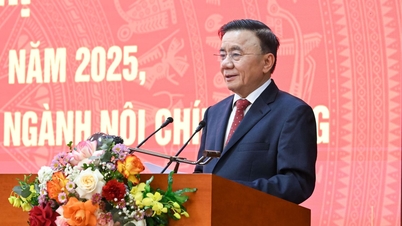
On December 1st, in Hanoi, the Politburo and the Secretariat of the Central Committee of the Communist Party of Vietnam held a national conference to thoroughly understand and implement the summary of Resolution No. 18-NQ/TW of the 12th Central Committee of the Communist Party of Vietnam; the socio-economic situation in 2024, solutions to accelerate socio-economic development in 2025, and to remove institutional bottlenecks and obstacles. General Secretary To Lam presided over and delivered a keynote address at the conference. Thai Nguyen Newspaper respectfully presents the full text of the speech.
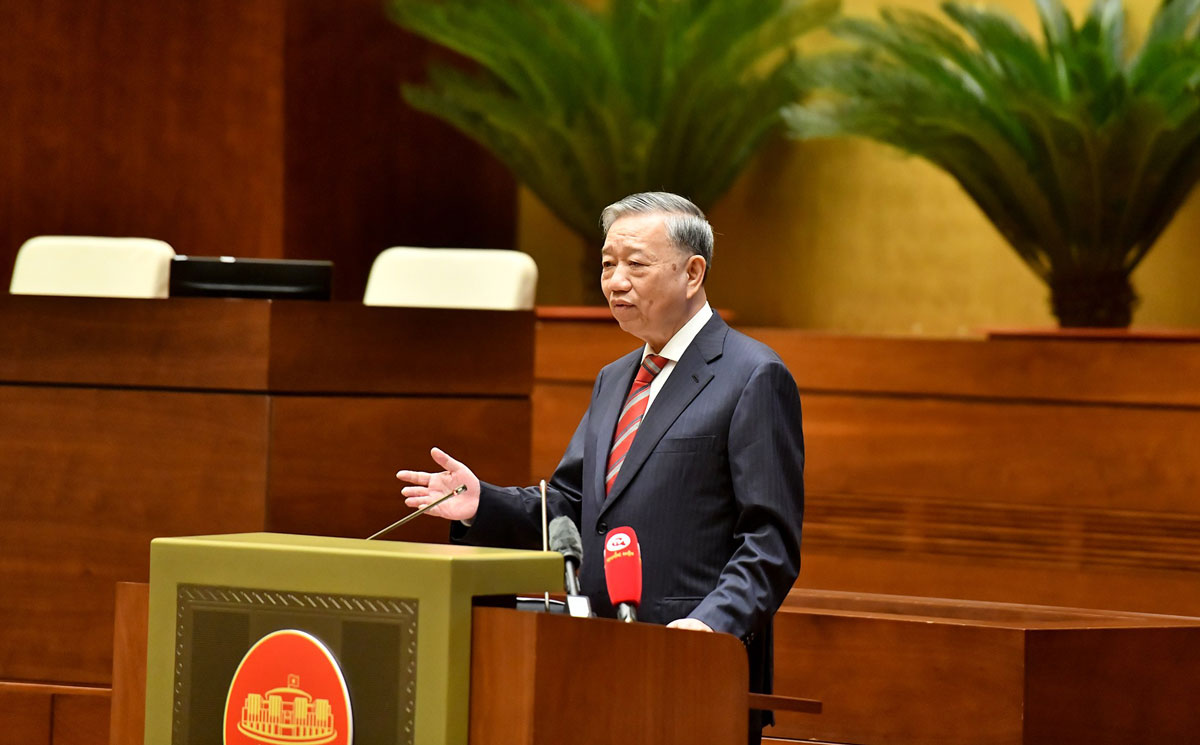 |
| General Secretary To Lam delivers a speech at the conference. Photo: nhandan.vn |
Dear members of the Politburo , members of the Secretariat, and members of the Central Committee of the Party,
Dear comrades attending the Conference at various locations nationwide,
Today, although it is Sunday, the Politburo and the Secretariat still decided to convene a national conference to: (1) Thoroughly understand and implement the summary of the implementation of Resolution No. 18-NQ/TW, dated October 25, 2017, of the Central Committee of the 12th Party Congress. (2) Report on the socio-economic situation of the first 11 months of 2024, and solutions to accelerate socio-economic development in 2025. (3) Solutions to remove institutional bottlenecks and obstacles for development, which shows the urgency, urgency and importance of the above issues.
The comrades heard Comrade Pham Minh Chinh, Member of the Political Bureau and Prime Minister, report on the socio-economic situation in the first 11 months of 2024 and solutions to accelerate socio-economic development in 2025; Comrade Tran Thanh Man, Member of the Political Bureau and Chairman of the National Assembly, report on the results of the 8th Session of the 15th National Assembly, especially the results of lawmaking and removing institutional bottlenecks for national development; and Comrade Le Minh Hung, Member of the Political Bureau, Secretary of the Central Committee of the Party, and Head of the Central Organization Department, disseminate and implement the contents of the summary of the implementation of Resolution 18 of the 12th Central Committee of the Party "on some issues of continuing to innovate and reorganize the organizational structure of the political system to be streamlined, effective and efficient".
The reports of the three Politburo members addressed each issue relatively specifically, and I believe they have envisioned what needs to be done in the coming period in their respective sectors, localities, and units.
Comrades,
Since the 10th Central Committee Conference on September 20, 2024, the entire political system has undergone significant changes, operating with a new spirit and new speed to create new impetus and efficiency for socio-economic development and improve the material and spiritual lives of the people.
During that period, the Politburo and the Secretariat worked very urgently, holding more than 10 meetings to discuss and resolve nearly 100 major issues within their authority, focusing on fundamentally addressing outstanding issues and resolving many newly arising problems.
The National Assembly, the Government, and the Central Committee of the Vietnam Fatherland Front have coordinated very decisively and smoothly to remove bottlenecks, obstacles, and barriers that hinder socio-economic development and the lives and livelihoods of the people...
These initial actions have energized the task of protecting, building, and developing the country, with the immediate goal of striving to complete the targets and plans for 2024 and 2025, creating leverage to break through and achieve all the objectives set forth in the Resolution of the 13th National Congress of the Party.
The big question now is: Do we have the strength and power; the will and determination to enter a new era, an era of national development and prosperity? The answer is: Yes, we do.
Is now the time, the opportunity; the urgency, the objective necessity for a revolution in streamlining the organizational structure of the political system to ensure its effective and efficient operation? The answer is: There can be no further delay.
I believe the statements of the Prime Minister, the Chairman of the National Assembly, and the Head of the Central Organization Department have clarified these issues. I would like to emphasize three more points for you to study and understand:
1. Regarding socio-economic development: To achieve the socio-economic development goals set forth in the Resolution of the 13th National Congress, we must innovate our thinking, "break free," be decisive, make breakthroughs, and surpass ourselves.
To achieve the goal of a high-middle income for its people by 2030 and a high income by 2045, Vietnam's economic growth rate must consistently reach double digits in the following years. This is a very difficult problem that we must solve. Only a simplified solution will provide a timely answer.
The Central Committee of the Party, the Government, and the National Assembly are focusing on addressing bottlenecks and creating the foundational elements for the country to "take off," especially issues related to infrastructure such as transportation systems, energy infrastructure, human resources, physical facilities, institutional development reforms, and administrative procedures.
First and foremost, we need to implement a comprehensive set of solutions to strive to achieve and surpass the GDP growth targets for 2024 and 2025, including aiming for double-digit growth starting now. This is something we have a solid foundation to achieve.
To achieve this goal, it is necessary to continue making further breakthroughs in development institutions, removing all difficulties, obstacles, and bottlenecks to unlock all resources, and strongly reforming the administrative system to create a favorable environment for development.
I acknowledge that the recent 8th Session of the 15th National Assembly has shown a profound shift in thinking regarding lawmaking, with 7 laws and 4 resolutions passed, including one law amending 4 laws and another amending 9 laws to promptly address difficulties and obstacles in practice. However, this is only an initial result; much work remains to be done to untangle this "bottleneck within a bottleneck."
It is crucial to recognize that institutional reform for development is not only the responsibility of law-making agencies, but also the shared responsibility of the entire political system and of every official and Party member involved in lawmaking and enforcement. A sufficiently strong remedy is needed to cure the disease of bureaucratic, mechanical work; corruption, harassment, and abuse of power against citizens and businesses; prioritizing personal gain over substance; deliberately delaying work; seeking opinions in a roundabout way; and blaming the system or fear of responsibility…
The socio-economic development policies and guidelines are quite comprehensive. Now is the time for us to act. Based on the general policies and guidelines of the Party and State, and the central government's direction, localities must reflect and think "on their own land," fostering a spirit of initiative and creativity for development; each agency, unit, and locality must set specific goals to strive for in order to contribute to achieving the country's overall goals.
More than ever, cadres and Party members must uphold a high sense of responsibility and set a good example in performing their duties, prioritizing the common good above all else, boldly innovating, creating breakthroughs, and courageously making sacrifices for the country's development.
I believe that in addition to the efforts of the Party, the Government, and the State, the participation and involvement of the people are crucial. We must liberate the labor force and productive capacity, mobilize material and spiritual capital from the people, and ensure that the people can enjoy and experience these achievements. Only then will everyone work together in unity to implement them.
Economic development must be linked to addressing social issues, protecting the environment, better meeting the material and spiritual needs of the people, effectively implementing social welfare policies, eradicating hunger and poverty, eliminating temporary and dilapidated housing... clearly demonstrating the positive nature of our system.
2. Regarding Party Congresses at all levels leading up to the 14th National Congress: Party congresses at all levels, from grassroots branches to communes, districts, provinces, and central agencies, must be a broad and profound political activity throughout the Party, discussing the vision, goals, and tasks for national development to become prosperous and strong in the new era.
The documents submitted to the 14th National Congress of the Party were meticulously and scientifically prepared by the Central Committee. The draft Political Report, the Socio-Economic Report, the Party Building Report, and the Report summarizing 40 years of reform have been edited multiple times and are now ready to be sent to party congresses at all levels for their input.
The draft summaries of these four documents will be sent to the grassroots level before December 15, 2024; the full drafts will be sent to the district, provincial, and central agencies before March 31, 2025. The task of Party committees at all levels is to promptly organize for cadres and Party members to study and contribute their opinions on these documents.
It is important that Party committees at all levels use the content of the Draft Documents of the 14th National Congress as a basis for developing the content of their political reports and work directions for their respective documents; specifically defining the goals and tasks of their agencies, units, and localities, contributing to the overall goals of the country in the coming period.
The Central Committee of the Party continues to incorporate feedback from Party organizations, scientists, intellectuals, and all sectors of the population to supplement and refine the documents to be presented at the 14th National Congress. The documents must closely reflect the realities of life, be concise, easy to remember, and easy to implement. They should become like "textbooks" or "dictionaries," providing immediate guidance when needed. The need for further resolutions and directives to implement the resolutions of the 14th National Congress should be minimized.
Party committees at all levels need to focus on preparing personnel for the new term in accordance with the guidelines, ensuring a well-prepared team of cadres with sufficient qualities and capabilities to meet the requirements of new development. Every cadre and party member must constantly learn and improve themselves to meet the requirements and tasks of the country's new stage; if they cannot meet the requirements, they should voluntarily step aside to let others do the job.
It is crucial to address the "ailments" of personnel work before the Congress, such as: those not seeking re-election playing it safe, being defensive, and hesitant to implement new ideas; prospective members of the new Party committee being cautious, avoiding conflict, and fearing losing votes; calculating for relatives, acquaintances, and close associates to secure leadership positions; or using "organizational maneuvers" to sideline those they dislike...
Personnel management is a task of the Party; therefore, Party committees at all levels must strictly implement the Party Charter as well as the Party's regulations and the law on personnel work.
3. Regarding streamlining the organizational structure of the political system: As I have mentioned in several articles and speeches, this is a very urgent issue that must be addressed. The sooner it is done, the more beneficial it will be for the people and the country. Many Party Congresses from previous terms have raised this issue, especially from the 12th Congress to the present. This shows that the Party has recognized the need to implement it, but the implementation process has not yet achieved the set goals. This is truly a difficult issue, even very difficult, because streamlining the apparatus will involve the thoughts, feelings, aspirations, and interests of some individuals and organizations. Therefore, despite thorough and systematic preparation, as presented in Comrade Le Minh Hung's report and the numerous guidelines for implementing this work sent to comrades, implementation in many units will certainly face difficulties, and even resistance. However, we still have to go through with it because, to have a healthy body, sometimes we have to "take bitter medicine," endure pain to "surge on a tumor."
I propose that all levels and sectors, from the central government to the grassroots, must demonstrate the highest level of political determination in implementing this policy. This is an especially important task, a revolution in streamlining the organizational structure of the political system. This is not just a matter of scale or quantity, but more fundamentally, it must create a qualitative change in the operation of the political system.
Leading officials and heads of Party committees and agencies need to be exemplary, proactive, and decisive in carrying out assigned tasks in the spirit of "running while queuing"; "The Central Committee does not wait for the provincial level, the provincial level does not wait for the district level, and the district level does not wait for the grassroots"; "The Central Committee sets the example, and the localities respond." Each level and sector must closely follow the plan to summarize and propose models for their respective agencies and units, ensuring timely progress (ministries and sectors must complete this by December 2024); aiming towards the common goal of completing and reporting to the Central Committee the Plan for arranging and consolidating the organizational structure of the political system in the first quarter of 2025.
The implementation must be carried out urgently but cautiously and surely, upholding principles, incorporating feedback from practical experiences, experts, scientists, and even foreign experiences... to propose the most optimal streamlined organizational structure. Strictly adhere to the principle of one agency performing multiple tasks, with one task assigned to only one agency responsible for it; thoroughly address overlapping functions and responsibilities, and fragmentation of geographical areas and sectors; agencies and organizations that have undergone initial restructuring must also be reviewed and proposed for internal reorganization; resolutely eliminate intermediary organizations; organizational reform must be linked to the effective implementation of the Party's policies on reforming leadership methods, strong decentralization to localities, promoting administrative reform, combating waste, national digital transformation, and socializing public services... The general requirement is that the new apparatus must be better than the old one and become operational immediately; There should be no interruptions to work, no gaps in time, no vacant areas or fields; and no impact on the normal activities of society and the people...
Streamlining the organizational structure goes hand in hand with reducing the workforce and restructuring the staff to ensure they possess the necessary qualities and capabilities to meet the demands of their tasks. Streamlining doesn't mean mechanically cutting positions, but rather eliminating unnecessary roles and reducing inefficient work, thereby concentrating resources on key areas and truly deserving and suitable personnel. State agencies must not become "safe havens" for incompetent officials. With higher demands placed on the new organizational structure, plans for training and retraining personnel must be in place before and after the reorganization. Each agency and unit must effectively implement political and ideological work and provide appropriate policies and benefits for officials, Party members, civil servants, and employees affected by the reorganization; ensuring fairness, transparency, objectivity, and preventing complications. The Politburo has decided to temporarily suspend appointments and nominations for higher positions in agencies and units slated for restructuring and streamlining (except in truly necessary cases); and to temporarily suspend civil servant recruitment from December 1, 2024, until the completion of organizational restructuring in accordance with the Central Committee's guidelines. Party committees at all levels are requested to thoroughly understand and implement this directive.
Party committees at all levels, from the Central Committee to the grassroots, are directing efforts to strengthen propaganda and guide public opinion, creating high unity within the Party and the entire political system, and consensus among the people regarding the policies, requirements, and tasks of streamlining the organizational structure in the new situation. They are also effectively combating erroneous, hostile, and distorted views on the implementation of this policy; and strictly handling cases of exploiting organizational restructuring to cause internal disunity and damage the prestige of the Party and its agencies and organizations.
Dear comrades,
The work ahead is immense and urgent. Time waits for no one. The country is standing at the threshold of history, entering an era of progress. The work we do today will determine the future. Delay would be a disservice to the people. I urge all comrades, from the Central Committee to the grassroots, present at today's conference, to demonstrate a high level of responsibility to the Party, the State, and the people, focusing on leadership and guidance with the highest determination to complete the streamlining of the political system's organization and apparatus as soon as possible; contributing to accelerating and surpassing the goals and tasks of 2024, 2025, and the entire term of the 13th National Congress; and making thorough preparations for the Party congresses at all levels leading up to the 14th National Congress of the Party.
Wishing you all good health and success.
Thank you very much.
Source: https://baothainguyen.vn/chinh-polit/202412/phat-bieu-cua-dong-chi-tong-bi-thu-to-lam-tai-hoi-nghi-toan-quoc-quan-triet-trien-khai-tong-ket-viec-thuc-hien-nghi-quyet-18-867133b/

































































Comment (0)