


Developed by a team of Scottish artificial intelligence (AI) experts from Heriot-Watt University in Edinburgh, these social support robots perform daily tasks in place of hospital staff. They help reduce physical contact between clinicians and patients, as well as reduce the risk of infectious disease transmission, while increasing the productivity of nurses, doctors, and hospital staff.
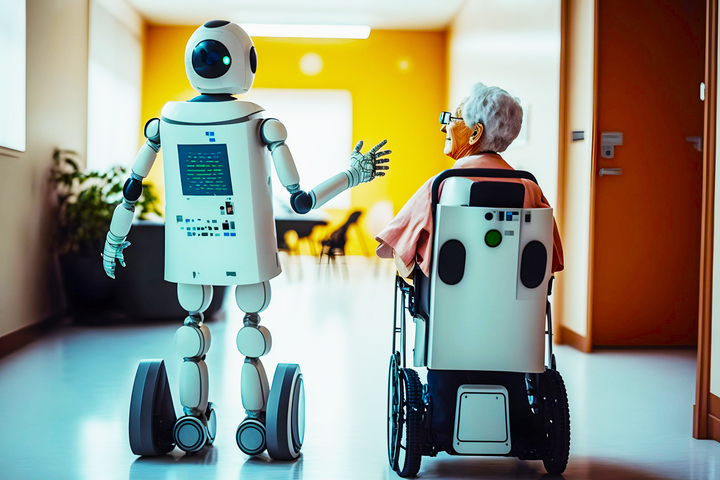
The Hôpitaux de Paris public support hospital in France is testing "social support" robots to help reduce the workload for its staff. (Illustrative image: Wazoku)
In fact, these robots are part of the national Robotarium social assistance robot trial at Heriot-Watt University in the field of geriatric healthcare. The experiments are made possible by the development of large-scale language modeling technology, allowing the robots to engage in natural and fluent conversations when interacting with elderly patients at the Hôpitaux de Paris Public Assistance Hospital.
Test results show that robots can participate in social interactions by greeting patients, answering questions, and giving instructions, thus easing the workload for hospital staff. Furthermore, they can simultaneously understand conversations between multiple parties.
“The prospect of robots seamlessly collaborating with hospital staff to enhance the patient experience is now closer to reality. Promising initial trials at the Hôpitaux de Paris Public Assistance Hospital have demonstrated the robots’ ability to effectively converse with patients,” explains Oliver Lemon, professor of AI and co-academic leader at the national Robotarium Social Assistance Robotics Project.
He added: “We believe this pilot project marks a significant milestone in the development of interactive robots, and we are proud of these achievements while recognizing the exciting challenges ahead.”
According to Professor Anne-Sophie Rigaud, Head of Department at the Hôpitaux de Paris Public Support Hospital, their patients are increasingly showing interest in robots and advancements in hospital services. They believe that these robots have the potential to become an essential component of patient care in hospitals, thanks to their extremely intelligent and flexible social interaction capabilities.
She said, "Older people also expressed satisfaction with the robot's design and thought it would be useful in providing information and accompanying patients with cognitive disorders."
Experts believe that the trial at the Hôpitaux de Paris Public Support Hospital has provided valuable insights into how emerging AI robotics technology can improve healthcare delivery and safety, while also driving further innovations in computer vision, audio processing, and human-robot interaction, with significant global application potential.
HUYNH DUNG (Source: Interestingengineering)
Source



![[Photo] Prime Minister Pham Minh Chinh receives the Minister of Emergency Situations of the Russian Federation.](https://vphoto.vietnam.vn/thumb/1200x675/vietnam/resource/IMAGE/2026/03/05/1772712011395_ndo_br_thiet-ke-chua-co-ten-76-png.webp)
![[Photo] General Secretary To Lam working with the Central Inspection Committee](https://vphoto.vietnam.vn/thumb/1200x675/vietnam/resource/IMAGE/2026/03/05/1772718314670_a1-bnd-8682-5192-jpg.webp)
































































































Comment (0)