

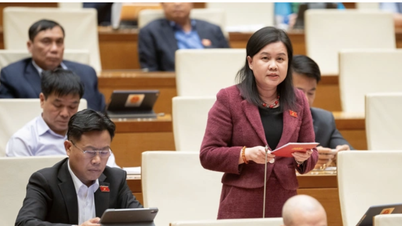
At the 5th session of the 15th National Assembly , the Law on Real Estate Business (amended) was discussed in the plenary hall. Regarding the contents of the draft law, Nguoi Dua Tin (The Informer) had an interview with National Assembly Deputy Quan Minh Cuong - Head of the National Assembly Delegation of Dong Nai province.
Interviewer: Sir, the 15th National Assembly discussed the amended Law on Real Estate Business, which clearly stipulates the rights and obligations of individuals and organizations building housing and participating in the real estate market. So, what are your remaining concerns regarding this draft law?
National Assembly Deputy Quan Minh Cuong: It can be said that the amended Law on Real Estate Business has now clearly stipulated the rights and obligations of individuals and organizations building housing and participating in the real estate market, harmonizing the relationship between the State, the people, and businesses.
Due to the overlap between the amended Real Estate Business Law, the Housing Law, the Investment Law, and especially the draft amended Land Law... I would like to propose some points as well.
Regarding capital requirements for organizations participating in the real estate market, Point c, Clause 1, Article 10 of the Law stipulates that in addition to the conditions on equity capital as a percentage of total investment capital, there is also the condition that "the ability to mobilize capital to implement the investment project must be ensured" .
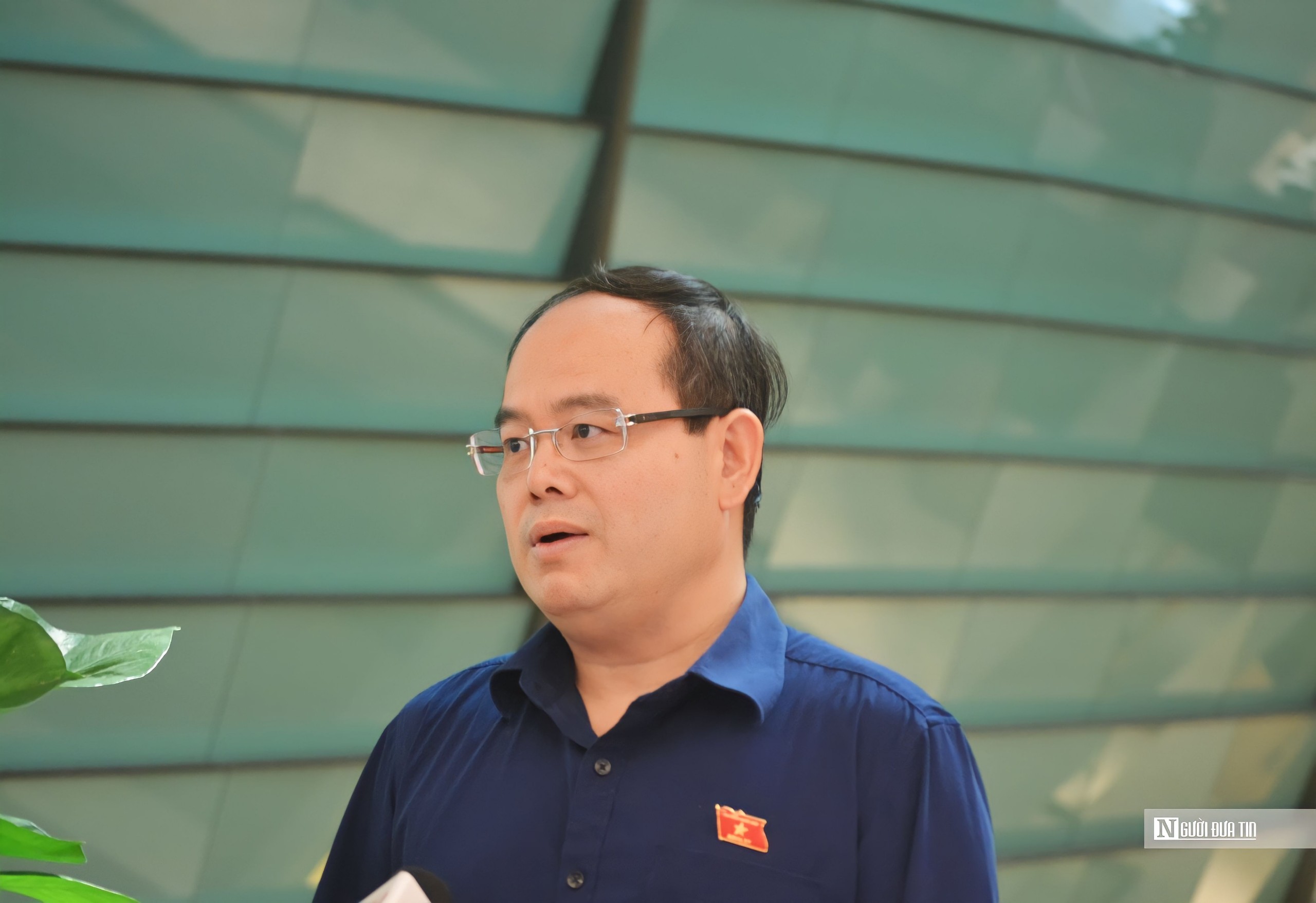
National Assembly Deputy Quan Minh Cuong speaks with Nguoi Dua Tin (Photo: Hoang Bich).
However, the Investment Law and the Bidding Law already clearly stipulate that investors must ensure their financial capacity. During the appraisal of investment project dossiers, bidding documents, and the approval of investment policies, the investor's proof of financial capacity has already been reviewed. Therefore, adding this provision to the Law is unnecessary and may create additional administrative procedures.
Furthermore, Clause 1, Article 10 adds point d, stipulating that "The investor of a real estate project must ensure the ratio of outstanding credit and corporate bond debt to their own capital as prescribed by the Government ."
Currently, the government has not issued specific regulations on the ratio of outstanding credit and corporate bond debt to the equity of enterprises (currently, there are only regulations related to the banking sector) .
Therefore, I suggest that the drafting agency consider not including this content in the draft or include it in the draft Government decree on this matter, so that delegates can participate and provide feedback.
Investor: In your opinion, how should the developer's responsibility in building social infrastructure within a real estate project be addressed to resolve these issues?
National Assembly Deputy Quan Minh Cuong: Regarding the responsibility of the investor in building social infrastructure in real estate business projects, Clause 7 of Article 18 stipulates that the investor "is only allowed to hand over housing to customers when the construction of housing and technical infrastructure and social infrastructure works have been completed according to the progress stated in the approved project."
In my opinion, social infrastructure is a very broad concept, encompassing all facilities and amenities related to commerce, services, public works, education, healthcare, and so on.
In reality, depending on the developer's purpose and business plan, projects may be launched in multiple phases, so the number of residents moving into the project will follow the sales schedule. Therefore, developers often build essential infrastructure to meet residents' needs in advance (such as parks, green spaces, common areas, parking lots, and recreational areas).
The remaining social infrastructure, such as schools and supermarkets/shopping malls, will usually be developed by secondary investors once the project has a large number of residents.
Requiring the developer to construct all the social infrastructure systems for a project when the population density is still low would be wasteful.
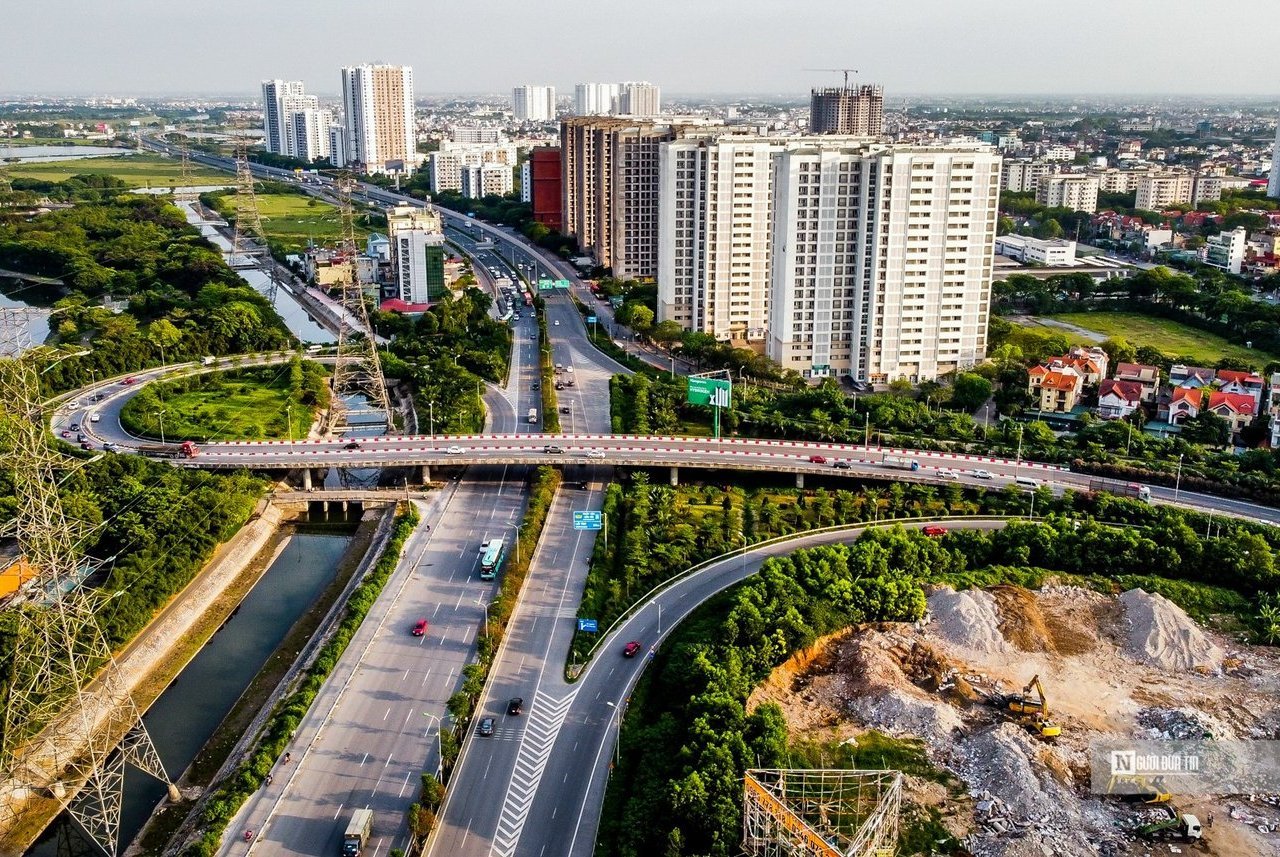
Specific regulations are needed regarding essential social infrastructure (Photo: Pham Tung).
On the other hand, in reality, service providers in education, commerce, and supermarkets only proceed with development when there is a certain population density within each project (except in cases where investors have an ecosystem encompassing real estate and healthcare, education, and commerce services, which they will independently carry out investment and business development... However, practice shows that some investors, when investing in multiple sectors, have led to financial imbalances or inefficient business operations).
The regulation "completion of construction..." is understood to mean that the construction projects must be officially certified. For example, in the case of a project comprising multiple components, including a separate school building that has been completed and is undergoing certification procedures but has not yet been confirmed, according to the draft regulations, the investor is not allowed to hand over the houses to customers.
In fact, the handover of houses between the developer and the customer is carried out according to the house/apartment purchase contract, and the draft also includes specific regulations on the handover deadline and payment upon handover.
At the same time, point b, clause 1, Article 31 also requires that real estate projects with land use rights that have invested in the construction of technical infrastructure must meet the requirement of: "Having completed the investment and construction of essential service facilities and technical infrastructure facilities in accordance with the approved design, detailed construction plan 1/500 or overall site plan and project content," but it does not specify which facilities constitute essential service facilities.
Therefore, I believe there should be specific regulations regarding essential social infrastructure, and only requiring investors to complete "essential technical and social infrastructure projects according to the schedule stated in the approved project" would be sufficient to hand over housing or transfer land use rights to customers. This would resolve the issues and be more in line with practical realities.
Investor: Thank you very much !
Source


![[Image] Central Party Office summarizes work in 2025](/_next/image?url=https%3A%2F%2Fvphoto.vietnam.vn%2Fthumb%2F1200x675%2Fvietnam%2Fresource%2FIMAGE%2F2025%2F12%2F18%2F1766065572073_vptw-hoi-nghi-tong-ket-89-1204-jpg.webp&w=3840&q=75)




























































































Comment (0)