


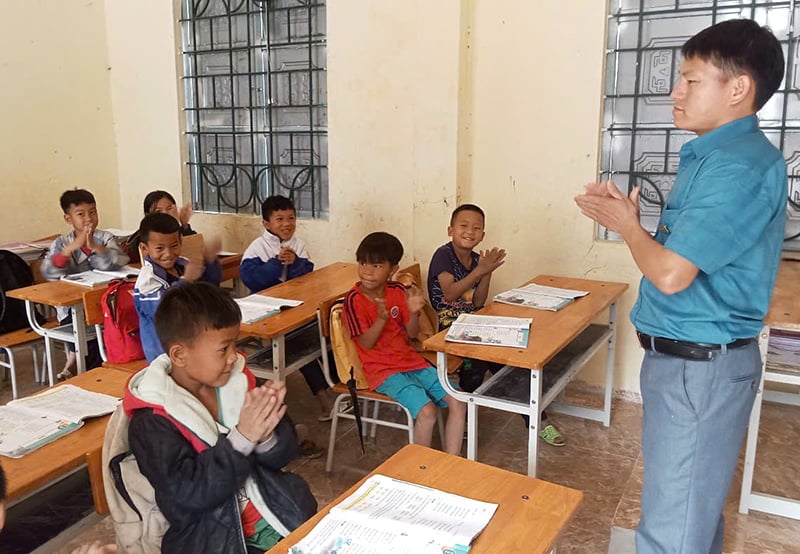
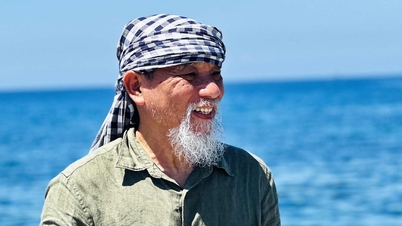
Teacher Sung A Chai during a class session. Photo: Dinh Giang
Getting to Ta Com village in Trung Ly commune is not easy. Following National Highway 16, crossing the Chieng Nua bridge to Mau village in Muong Ly commune, then taking a ferry across the Ma River is the only way to reach Ta Com.
The Ta Com school I visited belongs to Trung Ly 2 Primary School and has 89 students divided into 5 classes, taught by 5 male teachers. Due to the challenging terrain and geographical location, all the teachers stationed here are men. During the day, they teach classes, and on weekends, they take turns crossing the Ma River to the Trung Ly commune center to buy food. The biggest challenge for the teachers is the unreliable phone signal and weak internet connection, making online meetings with the school administration and accessing information online very difficult. Taking advantage of the students' break time, I met Mr. Sung A Chai, a Hmong man assigned to teach third-grade students. Mr. Chai shared: "Despite many difficulties, hardships, and shortages, being able to teach and bring literacy to the Hmong children is a heartfelt wish not only for me, but for all the teachers at Ta Com school. Because it's a remote village, parents haven't prioritized their children's education, so at the beginning of the school year or after the Lunar New Year, the teachers have to go to each household to persuade them. Being a Hmong person, I find it easier to talk to the villagers and get along with them. Mostly, after persuading the parents, they send their children to school."
In the late afternoon, I arrived at Pa Bua school – another branch of Trung Ly 2 Primary School. Here, four young teachers are dedicated to nearly 100 students. All the teachers are from Muong Lat district. Among them, I was particularly impressed by Mr. Va Van Tuan, a Mong ethnic minority from Ca Noi village, Pu Nhi commune. He is the ninth child in a family of ten siblings. Mr. Tuan's story showed me his relentless efforts to achieve his dream of becoming a teacher. His family was poor, yet his parents always encouraged him to study hard. As a result, he was the only one from Ca Noi village to attend university. According to Mr. Tuan, "Nurturing knowledge for oneself is difficult, but passing it on to the next generation is even more challenging. The students here truly cherish education, but they could drop out at any time due to poverty, natural disasters, or lack of transportation."
In a conversation with us, Sung Thi Dua, a fourth-grade student, shyly shared: “I like going to school because I get to learn to read, sing, and tell stories. Mr. Tuan teaches very well. When I grow up, I also want to be a teacher to teach little children like him.”
Meeting and talking with the teachers gave me a deeper understanding of the hardships and difficulties they face on their journey of "spreading literacy" in the border region. They not only "spread knowledge," but also sow seeds of hope and ignite dreams for the children in the mountain villages of Muong Lat district.
According to Le Trung Kien, Deputy Head of the Education and Training Department of Muong Lat District: Through a review, the preschool and primary education levels in Muong Lat District currently have 124 school locations, including both main and satellite schools. The large number of satellite schools creates considerable difficulties in arranging and assigning staff and teachers. The number of teachers from the lowlands coming to work here is decreasing, while many teachers are transferring back to the lowlands. Therefore, local teachers are the preferred choice in recruitment in Muong Lat District. This also demonstrates the significant changes and improvements in education in the border region of Muong Lat.
Dinh Giang
Source: https://baothanhhoa.vn/nuoi-chu-de-gieo-chu-246674.htm















![[Photo] Prime Minister Pham Minh Chinh presides over a meeting of the Steering Committee for the construction of the nuclear power plant.](https://vphoto.vietnam.vn/thumb/1200x675/vietnam/resource/IMAGE/2026/02/13/1770947038316_dsc-1534-jpg.webp)
























































Comment (0)