

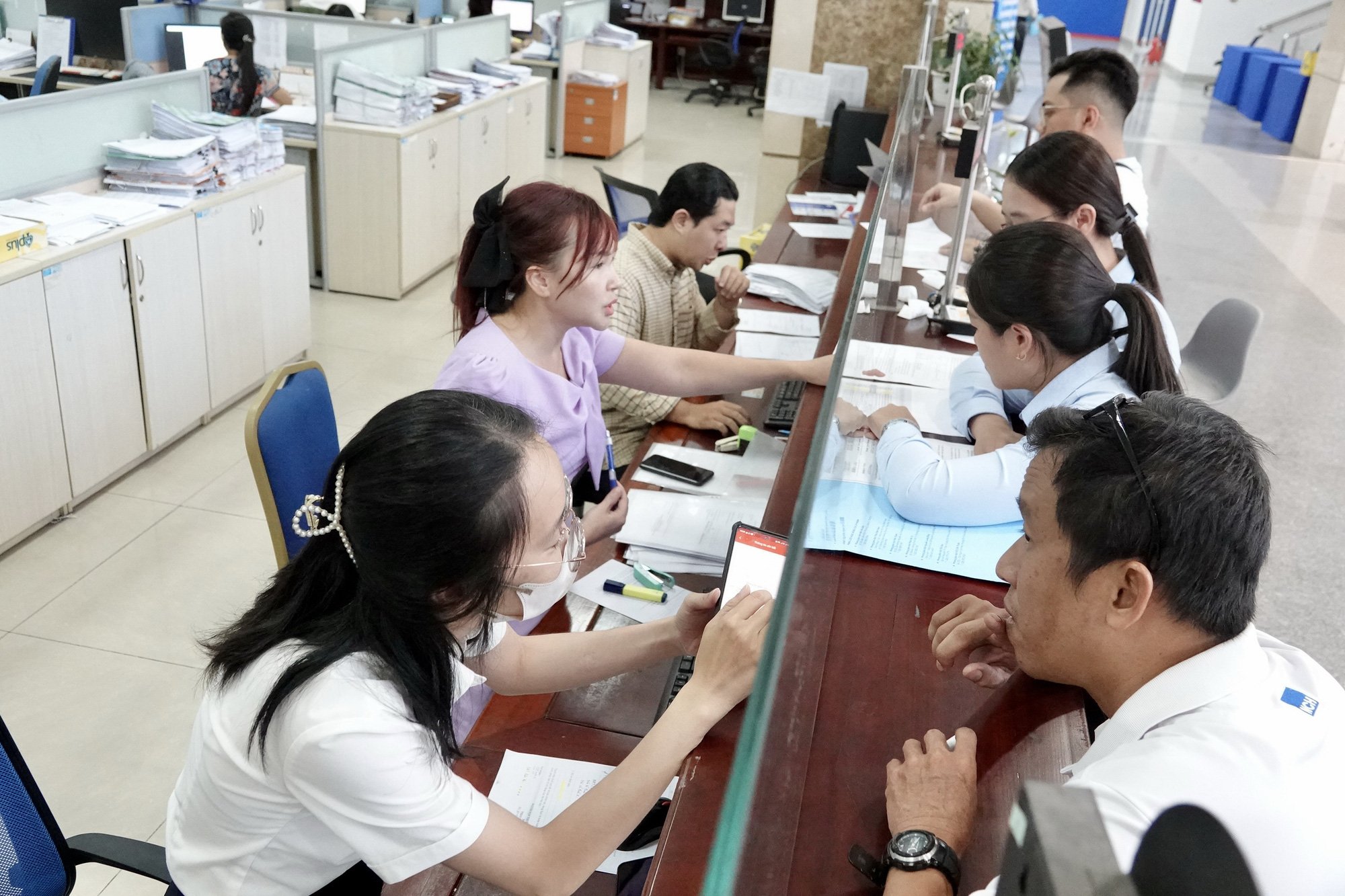
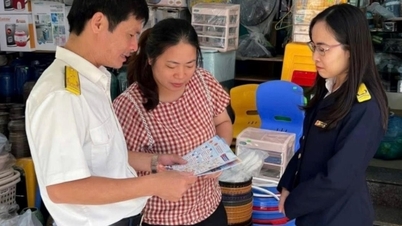
Citizens and businesses complete tax procedures at the Ho Chi Minh City Tax Department - Photo: TTD
According to Decree 126, the procedure for revoking a temporary travel ban can only be issued "no later than 24 hours" from the time the person fulfills their tax obligations. This means that even if they pay immediately, they have to pack their bags and go home because the plane has already taken off.
Most people only arrive at the airport a maximum of three hours before departure. They only find out they owe taxes after checking in their luggage and completing immigration procedures. There's simply not enough time for the tax authorities to issue a decision to cancel the temporary travel ban! Meanwhile, the law stipulates that the person who issued the travel ban is also the one who can revoke it. This is the real problem!
If the procedure continues like this, the process of sanctioning tax debtors cannot allow those who have just fulfilled their tax obligations to leave the country and continue their journey. This is where citizens and businesses complain. Even more dissatisfying is that the amount of tax owed is not excessively large, and the reasons for the debt are often "objective," making the temporary travel ban unacceptable. The damage caused by the travel ban is far greater than the amount of tax owed.
How should we address this, especially for those owing small amounts that can be paid immediately? Recently, a leader from the Department of Debt Management and Tax Enforcement stated that the law needs to be amended. The law only stipulates tax debt in general, without quantifying the amount of tax owed, meaning that even "one dollar" of debt can result in penalties.
In reality, people and businesses are now complaining that this sanctioning measure is not flexible enough, treating everyone the same (without distinguishing between the amount of debt, whether the person is on business or residing abroad, or whether they are Vietnamese residing overseas when they leave the country...), and there is no way out for those who have rectified the situation.
Waiting until the law is amended might only increase complaints, undermining the educational purpose of tax compliance. Besides warning citizens and businesses to fulfill their tax obligations, the approach should also be educational and persuasive, not merely punishing or sanctioning them "to deter future offenses." Therefore, flexibility and a softer approach are needed for addressing tax debt sanctions.
In this spirit, the proposal to allow tax payments at the airport for small amounts, say under 200 million VND, is a good solution. However, for this solution to be implemented, there clearly needs to be flexibility in procedures. For example, if a debtor with a debt of 200 million VND or less pays the tax at the airport, and the temporary travel ban is lifted, they can continue their journey.
However, if we rigidly adhere to the principle of "whoever ties the knot must untie it," meaning the person who signs the decision to temporarily suspend exit from the country is also the one who signs the cancellation or does not authorize another unit to collect tax debts, then taxpayers in general, and those with tax debts due to objective reasons in particular, will not be satisfied.
1.844 billion VND
That is the amount of tax collected from the temporary travel ban, from the end of 2023 to September 2024. In the first nine months of 2024, the tax authorities issued 23,747 notices of temporary travel ban with a total outstanding tax amount of 50,665 billion VND.
Research and propose a threshold for tax debt resulting in temporary travel ban.
Regarding concerns among many taxpayers about being temporarily banned from leaving the country due to tax arrears, the General Department of Taxation stated that during the implementation process, the tax authorities received feedback from businesses and taxpayers about shortcomings in the implementation of this measure.
Based on this practice, the General Department of Taxation believes that determining who is actually responsible for the debt—whether it's the legal representative, the owner, or the shareholder—is a matter that needs careful consideration and research.
The General Department of Taxation stated that it will review the regulations on subjects whose exit permits are temporarily suspended in the Law on Tax Administration and Decree No. 126, along with other relevant legal regulations, to ensure both fairness and support for taxpayers facing difficulties in maintaining their production and business activities.
Source: https://tuoitre.vn/nop-no-thue-va-24-gio-tiep-theo-20241019084429508.htm
![[Live] 2025 Community Action Awards Gala](/_next/image?url=https%3A%2F%2Fvphoto.vietnam.vn%2Fthumb%2F1200x675%2Fvietnam%2Fresource%2FIMAGE%2F2025%2F12%2F16%2F1765899631650_ndo_tr_z7334013144784-9f9fe10a6d63584c85aff40f2957c250-jpg.webp&w=3840&q=75)
![[Photo] Prime Minister Pham Minh Chinh receives Lao Minister of Education and Sports Thongsalith Mangnormek](/_next/image?url=https%3A%2F%2Fvphoto.vietnam.vn%2Fthumb%2F1200x675%2Fvietnam%2Fresource%2FIMAGE%2F2025%2F12%2F16%2F1765876834721_dsc-7519-jpg.webp&w=3840&q=75)
![[Image] Leaked images ahead of the 2025 Community Action Awards gala.](/_next/image?url=https%3A%2F%2Fvphoto.vietnam.vn%2Fthumb%2F1200x675%2Fvietnam%2Fresource%2FIMAGE%2F2025%2F12%2F16%2F1765882828720_ndo_br_thiet-ke-chua-co-ten-45-png.webp&w=3840&q=75)


![[Photo] Prime Minister Pham Minh Chinh receives the Governor of Tochigi Province (Japan)](/_next/image?url=https%3A%2F%2Fvphoto.vietnam.vn%2Fthumb%2F1200x675%2Fvietnam%2Fresource%2FIMAGE%2F2025%2F12%2F16%2F1765892133176_dsc-8082-6425-jpg.webp&w=3840&q=75)



















































![[Live] Closing Ceremony and Award Presentation for the "Impressive Vietnam Tourism" Video/Clip Creation Contest 2025](https://vphoto.vietnam.vn/thumb/402x226/vietnam/resource/IMAGE/2025/12/17/1765974650260_z7273498850699-00d2fd6b0972cb39494cfa2559bf85ac-1765959338756946072104-627-0-1338-1138-crop-1765959347256801551121.jpeg)




















Comment (0)