

 |
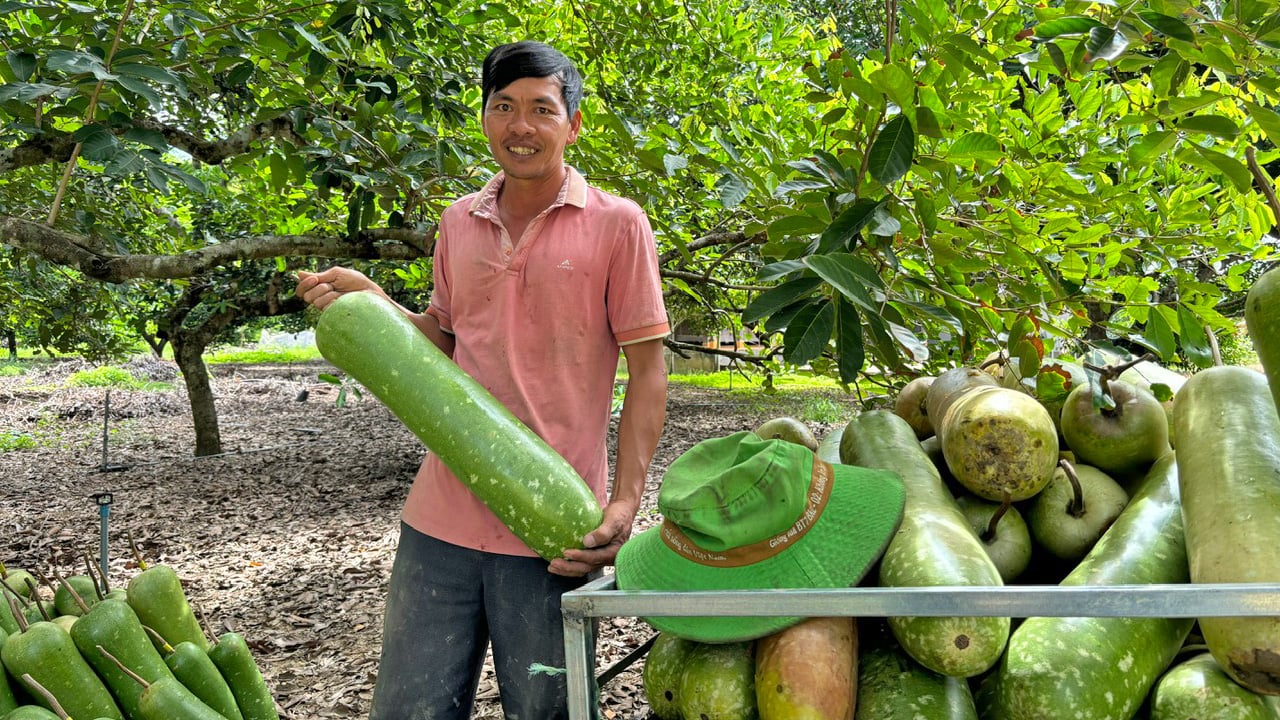
| Mr. Tran Van Thang is letting the gourd "sleep" under the rambutan tree. |
The family of Mr. Tran Van Thang, in Hamlet 3, Duc Pho Commune, Da Huoai District, has been specializing in growing gourds for seed production for many years. He said that the "Sao" gourd is a large variety with little pulp and thick flesh, widely grown to supply green vegetables to the market. However, he himself doesn't grow "Sao" gourds commercially; he specializes in growing them for seeds.
While arranging the large gourds under the rambutan tree to let them "rest," Mr. Tran Van Thang explained that these are "first-generation" gourd plants, pollinated by parent plants. He said, "My family specializes in growing Star gourd seedlings, using very strict techniques to achieve the best quality, purest seeds, ensuring the company has seeds to supply to commercial vegetable growers. Growing seedling gourds requires special care, completely different from growing commercial vegetables." According to Mr. Thang, he grows Star gourd seedlings under contract with a company, with the company providing the seeds to farmers for propagation. The parent gourd plants are planted and marked very strictly, requiring attention from the moment the seeds are received. The first-generation seedlings are given to farmers to sow on disease-free land. His family usually rents land from farmers to grow rice, and in October of the winter-spring season, they start sowing gourd seeds. Gourd seedlings require very clean soil, not suitable for growing vegetables. Therefore, the family changes the soil once a year to ensure it is completely clean.
Mr. Thang explained that the gourd seeds are numbered after sowing for careful management. The parent gourd plants are very weak and need to be carefully supported with string to prevent them from falling, breaking branches, or damaging the tops. The seedling gourds require a very special fertilization regime, with a very abundant amount of organic fertilizer. “The parent gourd plants are actually very disease-resistant due to the clean soil, but they have very high nutritional and water requirements. Two months after planting, from the time the gourds begin to flower, the family must actively pollinate them. This is the most important step in growing seedling gourds, ensuring pure seeds that are not crossbred,” Mr. Thang explained. According to Mr. Thang, when pollinating gourds, pollen from the male parent plant must be transferred to the female parent plant. After pollination, farmers must use plastic clips to tightly seal the flower openings to prevent other insects from continuing to pollinate and crossbreed the seeds. "The pollination process is the most important step, ensuring the purity of the gourd seeds. If not done carefully, the seed yield and quantity will be mixed, failing to meet the company's requirements," Thang assessed.
After pollination, the care regimen for the gourd seedlings includes adequate watering and abundant fertilization. Mr. Thang shared that during the rapid growth stages of the gourds, each fruit can increase in weight by 0.2 - 0.3 kg per day. If not adequately fertilized, the gourds will not grow large enough, and the seeds will not be of good quality. From planting to harvesting takes 5 months, much longer than growing commercial gourds. By the time they are ready for harvest, each seedling gourd weighs an average of 4.5 - 5 kg. The seeds of a properly ripened gourd should be dark black, uniform in color, and free of immature or shriveled seeds. If harvested too green, the seeds will not germinate properly.
"After harvesting the gourds, Mr. Thang has to put them in cool areas such as on the porch or under the shade of trees so that they 'rest' for 15-20 days. Only then can he bring them home to continue the process such as extracting the seeds, rubbing off the mucilage, and drying them in weak sunlight so that the gourd seeds dry naturally. 'Growing gourd seedlings is very difficult; not everyone can succeed because the company sets many strict standards. For example, the purity of the seeds must be above 98%, the germination rate above 90%, and all indicators are measured precisely with machinery and tools that farmers must adhere to.'" However, having grown gourd seedlings under contract with the company for many years, my family is still able to meet the company's requirements," Mr. Thang said. It is known that growing gourd seedlings is only done once a year, from October to March of the following year. Because he is familiar with the process and strictly adheres to the planting procedures, he achieves a yield of approximately 1 ton of seeds per hectare of land. Currently, the price of seeds paid by the company is 450,000 VND/kg. After deducting costs for fertilizers, pesticides, and labor, Mr. Thang has a fairly stable income from cultivating gourd seedlings.
Mr. Le Doan Loi, Vice Chairman of the People's Committee of Duc Pho commune, Da Huoai district, said that Mr. Tran Van Thang's household growing Star gourd seedlings in partnership with a business is a policy of the commune government. Through Duc Pho commune, the business signs contracts with farmers to grow seedlings in a sustainable way, bringing long-term benefits to both sides, and is a stable direction for agriculture in remote areas. Not only farmer Tran Van Thang, but through the People's Committee of the commune acting as a bridge, many farming households in Duc Pho are also actively linking with businesses to grow seedlings of various vegetables, bringing in income and diversifying crops on rice fields.
Source: https://baolamdong.vn/kinh-te/202504/nong-dan-trong-bau-sao-lay-hat-0ec3993/


![[Photo] Nhan Dan Newspaper celebrates the 96th anniversary of the founding of the Party.](/_next/image?url=https%3A%2F%2Fvphoto.vietnam.vn%2Fthumb%2F1200x675%2Fvietnam%2Fresource%2FIMAGE%2F2026%2F02%2F03%2F1770093917726_z7495755471262-66d965cdf06fce4e837f306802ae37b1-7408-jpg.webp&w=3840&q=75)


![[Photo] President Luong Cuong receives Special Envoy of the Cuban Party and State Rodriguez Parrilla](/_next/image?url=https%3A%2F%2Fvphoto.vietnam.vn%2Fthumb%2F402x226%2Fvietnam%2Fresource%2FIMAGE%2F2026%2F02%2F03%2F1770103749566_anh-man-hinh-2026-02-03-luc-14-28-47.png&w=3840&q=75)


Comment (0)