

Heavy rains over the past few days have caused widespread flooding of vegetable crops in Ha Tinh province . Farmers are rushing to the fields to take timely measures to care for their plants.
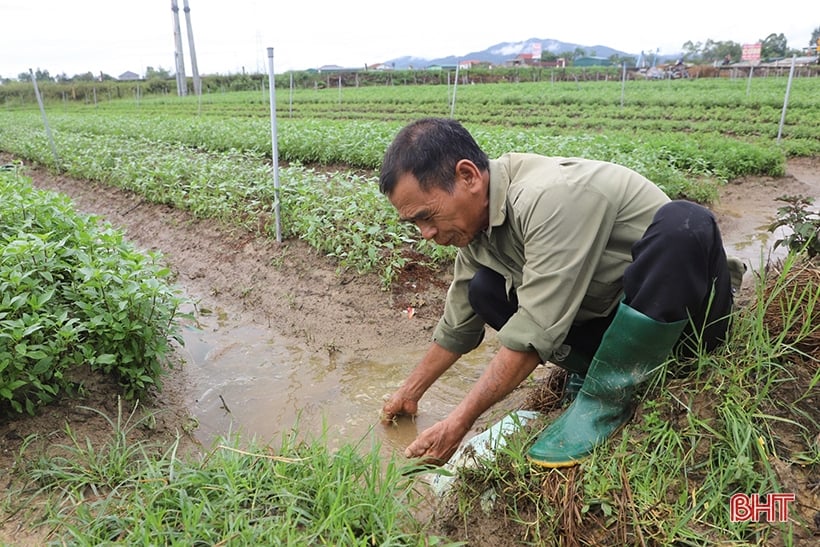
Mr. Pham Van De is trying to drain the water to protect his 5 acres of herbs that are currently in harvest season.
Taking advantage of a lull in the rain, Mr. Pham Van De (La Xa village, Tan Lam Huong commune, Thach Ha district) hurried to the field to check on his 5 sao (approximately 0.5 hectares) of herbs that are ready for harvest.
Mr. De said: "The heavy rains in recent days have caused waterlogging in the vegetable fields, so I had to quickly drain the water and mound the soil higher. Herbs, especially basil, are susceptible to fungal diseases and root rot if submerged in water, and they easily die when the sun comes out. Therefore, after draining the water and drying the fields, I have to use pesticides recommended by the experts to eliminate pests and diseases and increase the resistance of the vegetables."
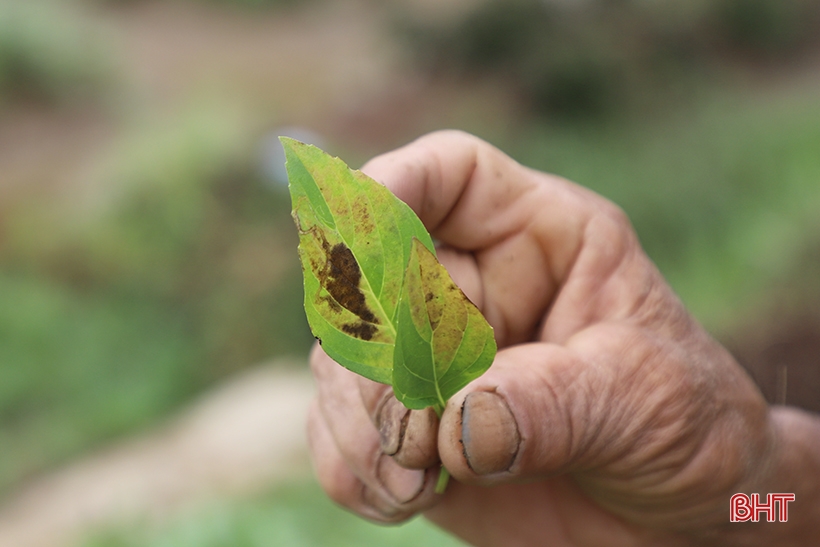
Basil is a vegetable that is susceptible to fungal diseases, yellowing leaves, and root rot when exposed to heavy rain.
According to Mr. Đệ, this is the beginning of the rainy season, which affects the growth and development of crops, so for the upcoming planting seasons, his family will make the raised beds higher and cover them with dry straw for protection.
Not far from Mr. De's vegetable patch, Ms. Le Thi Thuy (La Xa hamlet, Tan Lam Huong commune) is also dredging the furrows to clear the flow and drain water as quickly as possible for her 3 sao (approximately 0.3 hectares) of herbs and to treat damaged plants.
Ms. Thuy said: “First, we have to drain the water to ‘save’ as much of the vegetable crop as possible. For the plants that survived the rain, we will have to take better care of them and fertilize them more carefully to prevent pests and diseases. After heavy rain, not only does crop yield decrease, but harvesting is also more difficult because we have to pick out and separate the yellowed leaves.”
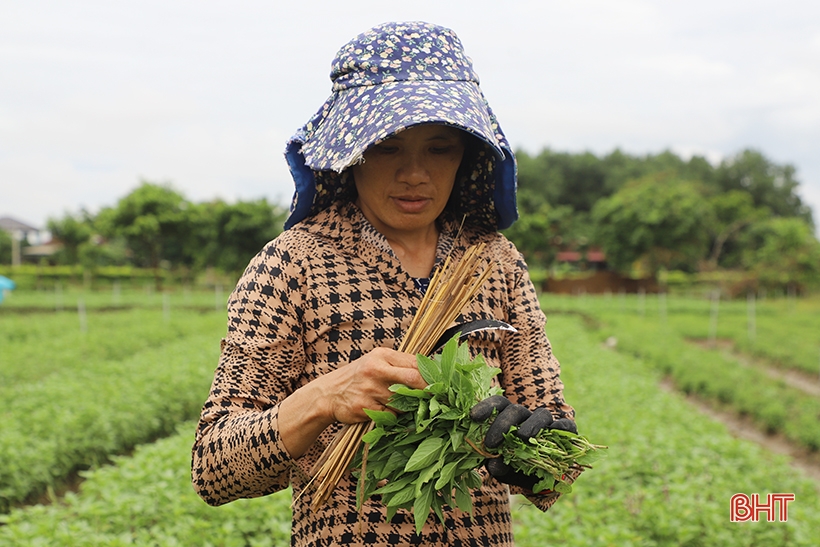
Ms. Le Thi Thuy removes damaged and yellowed leaves caused by the rain while harvesting vegetables.
In the vegetable fields of Bac Binh village, Tuong Son commune (Thach Ha district), farmers are also working quickly to drain water to ensure the plants grow.
Ms. Nguyen Thi Van (Bac Binh village) said: “My family has two rows of cabbage that were ready for harvest and two rows of cucumber seedlings that were completely flooded and damaged. As for the area planted with eggplant and gourds, I am trying to drain the water in the hope that the roots will not be waterlogged and the plants will die. I plan to fertilize and loosen the soil after this heavy rain ends to boost the growth of the plants.”
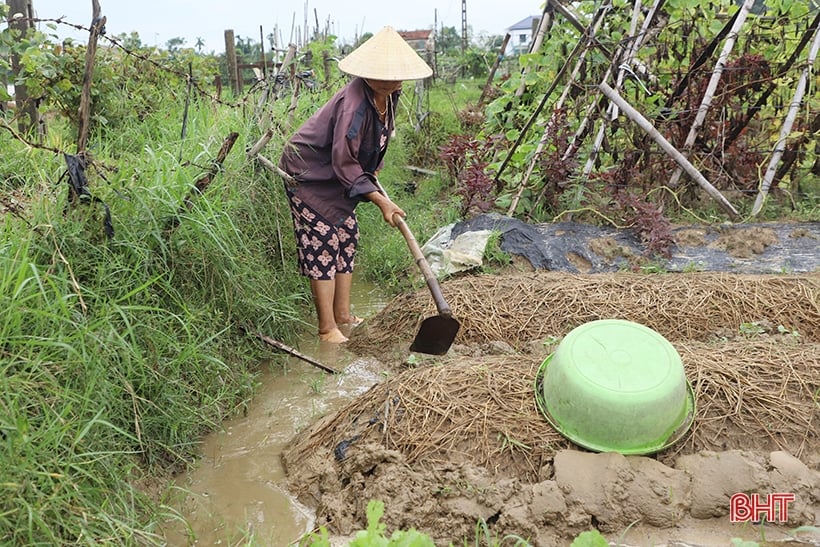
Ms. Nguyen Thi Van cleared the waterway for her rice fields.
In other vegetable-growing areas throughout the province, people are also promptly implementing measures to care for their vegetables after the rain.
For this year's winter crop season, Hoang Chu Cooperative (Yen Hoa commune, Cam Xuyen district) is cultivating 1 hectare of radishes. Mr. Tran Viet Chu, the cooperative's director, reported: “The heavy rains in recent days have damaged 7 sao (approximately 0.7 hectares) of newly sprouted radishes. The remaining area is nearing harvest time, so the cooperative has had to hire additional laborers to drain the water from the fields, mound the soil to create raised beds, and apply fertilizer to strengthen the plants' resistance.”
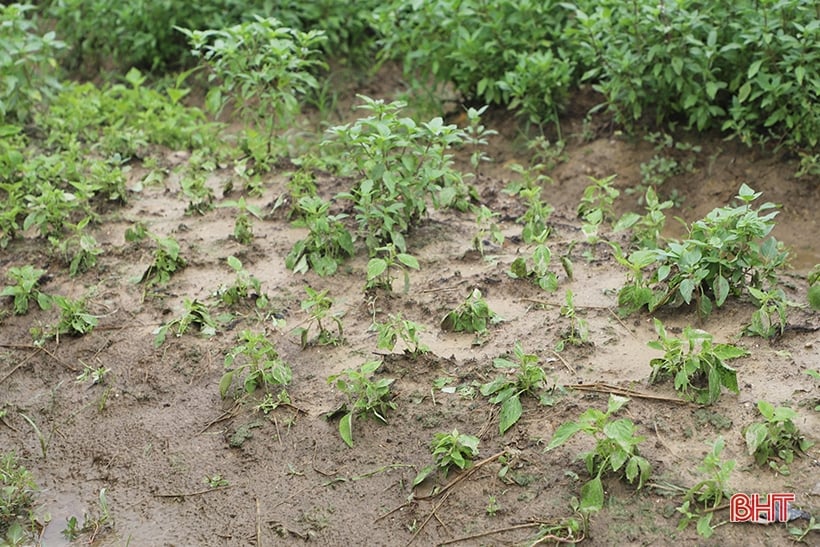
Newly planted vegetables are vulnerable to heavy rains because their root systems are not yet fully developed.
According to the Department of Crop Production and Plant Protection of Ha Tinh province, the entire province has currently planted 160 hectares of various vegetables, mainly distributed in Thach Ha, Duc Tho, Cam Xuyen districts, and Ha Tinh City... The heavy rains in recent days have negatively impacted the growth and development of vegetable crops. People need to immediately implement measures to care for crops after the floods as directed by the specialized agency.
Accordingly, people need to proactively widen drainage ditches, loosen the soil surface to remove the crust when flooded to aerate the soil and provide oxygen to the plant roots; create raised beds, mound the soil, and apply fertilizer (prioritizing organic fertilizer) to enhance nutrition and resistance for the plants. In case the plants are affected by pests and diseases after the rain, they should use pesticides according to regulations...
Mr. Phan Van Huan, Head of the Crop Production Department of the Ha Tinh Provincial Department of Crop Production and Plant Protection, stated: Vegetable production is highly dependent on weather conditions and carries high risks, especially during the winter season when it is often affected by early-season floods and late-season severe cold. Therefore, localities need to closely monitor production practices and proactively plan production in anticipation of complex weather developments.
Furthermore, it is necessary to arrange planting seasons appropriately and diversify farming methods for vegetables such as staggered planting, monoculture, intercropping, etc., to avoid natural disasters and facilitate consumption according to market demand. In addition, to minimize damage from natural disasters, farmers should invest in vegetable production in greenhouses and polytunnels.
Phuong - Loan
Source

![[Image] Hanoi's urban life under the challenge of a "scorching hot" environment](https://vphoto.vietnam.vn/thumb/1200x675/vietnam/resource/IMAGE/2026/05/25/1779706979265_nang-nong-t5-2026-minh-duy-7-4636-jpg.webp)
![[Image] Close-up view of the interchange connecting the two expressways and Long Thanh Airport.](https://vphoto.vietnam.vn/thumb/1200x675/vietnam/resource/IMAGE/2026/05/25/1779703378210_ndo_br_z7863716673926-224453a31600126cce10622af6290afd-4549-jpg.webp)






















































































Comment (0)