

Thanh Hoa is a unique city, still bearing strong traces of the Stone Age and Bronze Age at sites such as Nui Do and the ancient Dong Son village, as noted by writer Le Ngoc Minh and researcher Ha Huy Tam: "A rare historical and cultural site, a land of peculiar origins that, the further time recedes, the more it shines with dazzling colors." This very fact inspired the idea of building a cultural space with a distinctive Vietnamese identity – a Vietnamese cultural space – to recreate landscapes bearing the strong imprint of the local nature within the city through authentic historical and cultural artifacts.
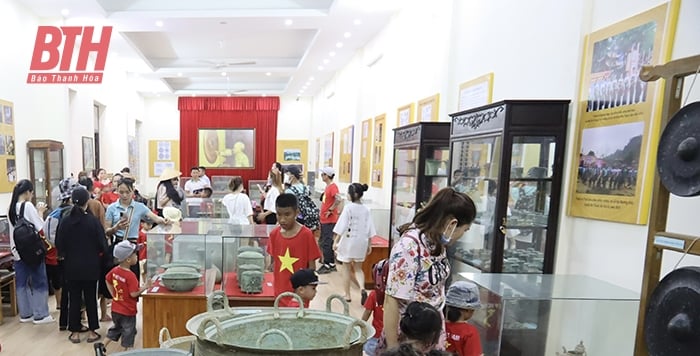
Located in Truong Thi Ward, Thanh Hoa City, the Vietnamese Cultural Space covers a total area of over 24,000 square meters. It is a complex of architectural structures and landscapes, housing a wealth of rich and valuable cultural artifacts and heritage. These are not only invaluable spiritual assets and material resources of a region deeply rooted in the Đại Việt culture, but also a comprehensive narrative with captivating documentation through vivid artifacts and heritage. From this, it introduces those who love Thanh Hoa province and its history and culture to it; and promotes it to tourists from all over, those who wish to visit Thanh Hoa to learn, research, experience, and discover the fascinating aspects of a land renowned for generations as a place of "spiritual and talented people."
Right at the main entrance, visitors will be delighted by the presence of a thatched-roof, mud-walled house, a recreation of traditional Vietnamese life. The house is made entirely from natural materials. The roof is made of straw. The mud walls are constructed from a mixture of straw and mud plastered onto bamboo slats. The front porch and sides of the house are used to store farming tools such as rice winnowing machines, rice pounding mortars, and rice mills. Inside, the house contains furniture (tables, chairs, beds) made of bamboo. To the right is a small kitchen, next to which are haystacks, a buffalo, a jackfruit tree... familiar images of Vietnamese farmers.
The exhibition area showcases wood sculptures crafted with skillful hands, meticulous attention to detail, and the creative minds and ideas of their owners, resulting in magnificent and invaluable works of art that will be passed down through generations. The artworks are captivating from their very names: Nine Dragons Competing for the Pearl; Four Immortals; Four Sacred Animals: Dragon,麒麟 (Kirin), Turtle, and Phoenix; and Adorable Green Unicorn...
Besides the wood sculptures, the exhibition of stone handicrafts also showcases the appeal, scale, and meticulous effort, investment, and dedication of the creator of this Vietnamese Cultural Space. Many exquisite products with high aesthetic and collectible value are crafted from natural stones such as green stone, ruby, agate, quartz, and topaz; some products are crafted from solid blocks of stone, which are very impressive.
The most prominent, impressive, and historically and culturally significant feature is the Dong Son Museum of Antiquities. As its name suggests, it houses, displays, and introduces over 1,000 artifacts belonging to the Dong Son culture – a brilliant culture of the Metal Age dating back 2,000-3,000 years, the first period of civilization of the ancient Vietnamese people – the time when the Van Lang State of the Hung Kings was established. It's worth remembering that understanding of the Dong Son culture originated from a villager living in the ancient Dong Son village on the Ma River (Thanh Hoa City) who accidentally discovered several bronze artifacts on the right bank of the river. These artifacts were later purchased by L. Pajot, a French customs officer specializing in antique hunting. In 1929, these artifacts were published worldwide by the French scholar V. Golubew. It can be said that, among the ancient cultures discovered in Vietnam, the Dong Son culture is one of the most representative, attracting widespread attention from archaeologists and cultural-historical researchers.
What could be more gratifying than building a fairly large, privately owned museum with a professional exhibition on the very land where the Dong Son culture was first discovered? The artifacts displayed at the museum are quite diverse, unique, and made of many different materials...
The pottery artifacts from the Dong Son culture preserved and displayed here include: cooking utensils (pots, pans, jars, vases, basins), and tableware (bowls, cups, mugs) with colors such as pale pink, reddish-brown, and dark gray... as unmistakably characteristic of Dong Son pottery from the Ma River region, laying the foundation for the development of pottery production in Thanh Hoa province for about 10 centuries afterward.
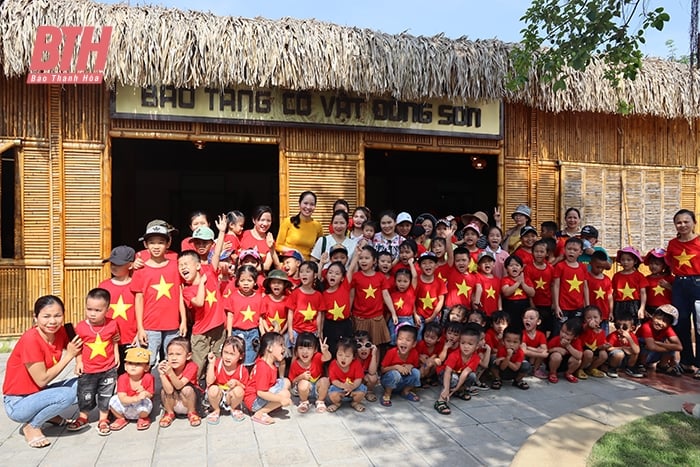
When discussing the Dong Son culture, it's impossible not to mention its collection of bronze artifacts. The museum houses a large number of bronze artifacts belonging to the Dong Son culture, such as: prehistoric and ancient people's production tools like crescent-shaped axes, plows, butterfly-shaped plowshares, etc.; various household and religious items such as bronze jars, vases, cauldrons, incense burners, etc. In addition, there are bronze weapons such as spears, daggers, short swords, and arrowheads.
With a collection of over 200 bronze drums – the “Dong Son sun” (to use the words of the late researcher Hoang Tuan Pho) – the Dong Son Museum of Antiquities demonstrates its immense scale and scientific value. This is a fairly large collection of bronze drums, diverse in type, size, and pattern. Bronze drums are considered a symbol of the Dong Son culture. In his book “The Quintessence of Thanh Hoa Culture,” the late researcher Hoang Tuan Pho, when writing “The Dong Son Sun,” described in detail: Each Dong Son bronze drum is “a work of art, harmoniously combining sculpture and painting, expressing the life and soul of Lac Viet with the symbol of the Lac bird, a large water bird capable of mastering the sky, dominating the world of the delta, the rhythm of the tides harmonizing with human life and the constantly flourishing rice plants, a symbol of the Ma River civilization.”
The exhibition area showcasing funerary artifacts of the Dong Son culture is also one of the highlights and an unmissable attraction when visiting the Dong Son Museum of Ancient Artifacts. Funeral artifacts are miniature models of familiar objects used in the daily lives of people at that time, used as burial goods. The funerary artifacts preserved and displayed at the Dong Son Museum of Ancient Artifacts include various types of bronze drums of different sizes and shapes, partly reflecting the spiritual life of the Vietnamese people, the organizational structure, and the class divisions in society at that time. “Visiting the Dong Son Museum of Ancient Artifacts in particular, and the Vietnamese Cultural Space in general, visitors are like embarking on a journey back in time, to the cultural roots of Thanh Hoa province. Just talking about the Dong Son Museum of Ancient Artifacts alone, you will see that from the dedication and investment of the owner to the unique artifacts, it affirms the historical and cultural depth, the role, and the position of Thanh Hoa province in the process of national history,” shared cultural researcher Ha Huy Tam.
With its historical, cultural, architectural, and landscape values reflected in the exhibited artifacts, the Vietnamese Cultural Space has been recognized as a tourist destination, contributing to the diversity and richness of the tourism and cultural landscape of Thanh Hoa City in particular and Thanh Hoa Province in general.
Text and photos: Thao Linh
Source
![[Photo] General Secretary and President visit the China-ASEAN AI Application Cooperation Center](https://vphoto.vietnam.vn/thumb/1200x675/vietnam/resource/IMAGE/2026/04/17/1776404277677_vna-potal-tong-bi-thu-chu-tich-nuoc-tham-trung-tam-hop-tac-ung-dung-ai-trung-quoc-asean-8706616-2286-jpg.webp)













![[Photo] National Assembly Chairman Tran Thanh Man attends the policy seminar to promote Vietnam-Türkiye cooperation.](https://vphoto.vietnam.vn/thumb/1200x675/vietnam/resource/IMAGE/2026/04/16/1776351415367_vna-potal-chu-tich-quoc-hoi-tran-thanh-man-du-toa-dam-chinh-sach-thuc-day-hop-tac-viet-nam-tho-nhi-ky-8705791-jpg.webp)








































Comment (0)