

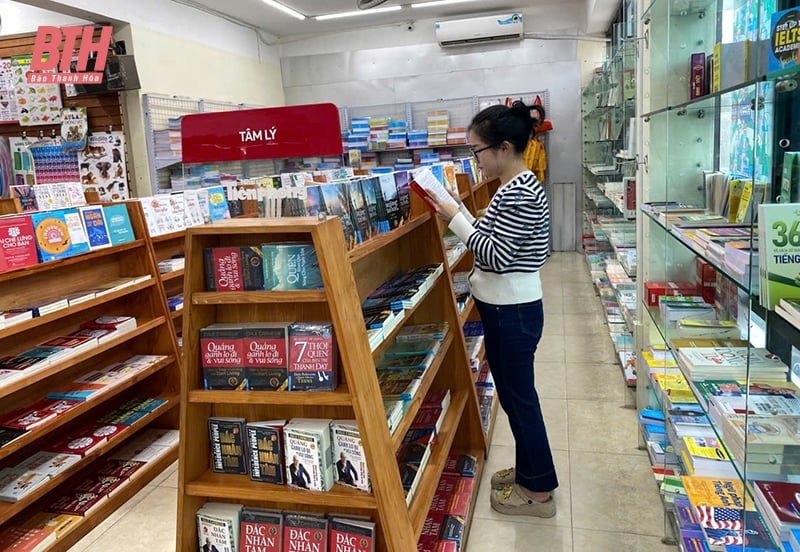
Although reading culture has shifted, there are still people who are passionate about printed books. Photo: Tang Thuy
Next to the People's Bookstore was the Ba Dinh Printing House. Opposite was an exhibition area and the headquarters of a newspaper editorial office. Therefore, even when the centrally planned economy transitioned to a market economy , this place remained full of books and newspapers, plus paintings, photographs, and cultural products... it was truly cheerful and warm. Then things changed, and a spacious bookstore was built here, but the atmosphere around it no longer had any resemblance to a book street.
It's not just a few bookstores that are missing. Even the former state-owned bookstores in the old district towns are no longer places to buy books. Private bookstores have sprung up, but they mainly display signs advertising textbooks. And only textbooks are considered practical books these days. Other types of books, especially literature and science and technology books, are no longer considered valuable or essential as they once were. Even in Hanoi, the once bustling and impressive Dinh Le book street has become deserted in recent years. Only a few bookstores remain. Sadly, when I went into one of the few remaining bookstores to ask about buying a novel, the owner replied that they no longer sell fiction or poetry, mainly comic books, pictures, calendars, and textbooks.
It's inevitable that as life progresses, digital technology enters every field and changes everything daily. But there's an indescribable feeling of longing. Now, even with money, it's hard to find a good book. Because publishers are no longer subsidized, they can't publish without a market. Bookstores, because they can't sell, don't dare accept orders either. It's a vicious cycle, and it's not anyone's fault. Perhaps it's only the fault of nostalgic people like myself. But we must also face the issue that needs serious consideration today: reading habits have changed drastically. The need to read stories and poetry has diminished in most social strata. If in the past, people could read books by the light of an oil lamp, during breaks between shifts, or while riding on the back of a buffalo, now people mainly look at their phones, scrolling through videos, articles, news, or short stories. Few people can devour books weighing several hundred grams or half a pound for hours. Even long novels, like "War and Peace," which have been uploaded online, have been browsed by very few people. The demand for reading literature and poetry is not what it used to be, which is one reason, but the main reason is that the means of transmitting literature, poetry, and cultural knowledge are more diverse, faster, and more convenient. Therefore, it's natural that literary books and bookstores have been downgraded.
In reality, for the human mind, reading on paper is still more effective. Memory and emotions are more deeply felt when assessed from the page. Paper printing technology has shaped the great minds of humankind for generations. Printed words remain very useful in human life. And there is still a segment of intellectuals, students, and scholars who are still avid readers, preserving this long-standing tool for transmitting cultural knowledge. Therefore, there are still large, thriving bookstores here and there. However, the owners must not only possess business acumen and significant capital, but also a passion for books and a wealth of knowledge.
Van Diep
Source: https://baothanhhoa.vn/noi-buon-pho-sach-243740.htm




![[Photo] General Secretary To Lam presides over a thematic session on strategic technology.](https://vphoto.vietnam.vn/thumb/1200x675/vietnam/resource/IMAGE/2026/03/18/1773838586650_anh-1-bnd-1822-7089-jpg.webp)
![[Photo] Prime Minister Pham Minh Chinh holds a phone call with Algerian Prime Minister Sifi Ghrieb](https://vphoto.vietnam.vn/thumb/1200x675/vietnam/resource/IMAGE/2026/03/18/1773849689752_ndo_br_dsc-9609-jpg.webp)























































































Comment (0)