

 |
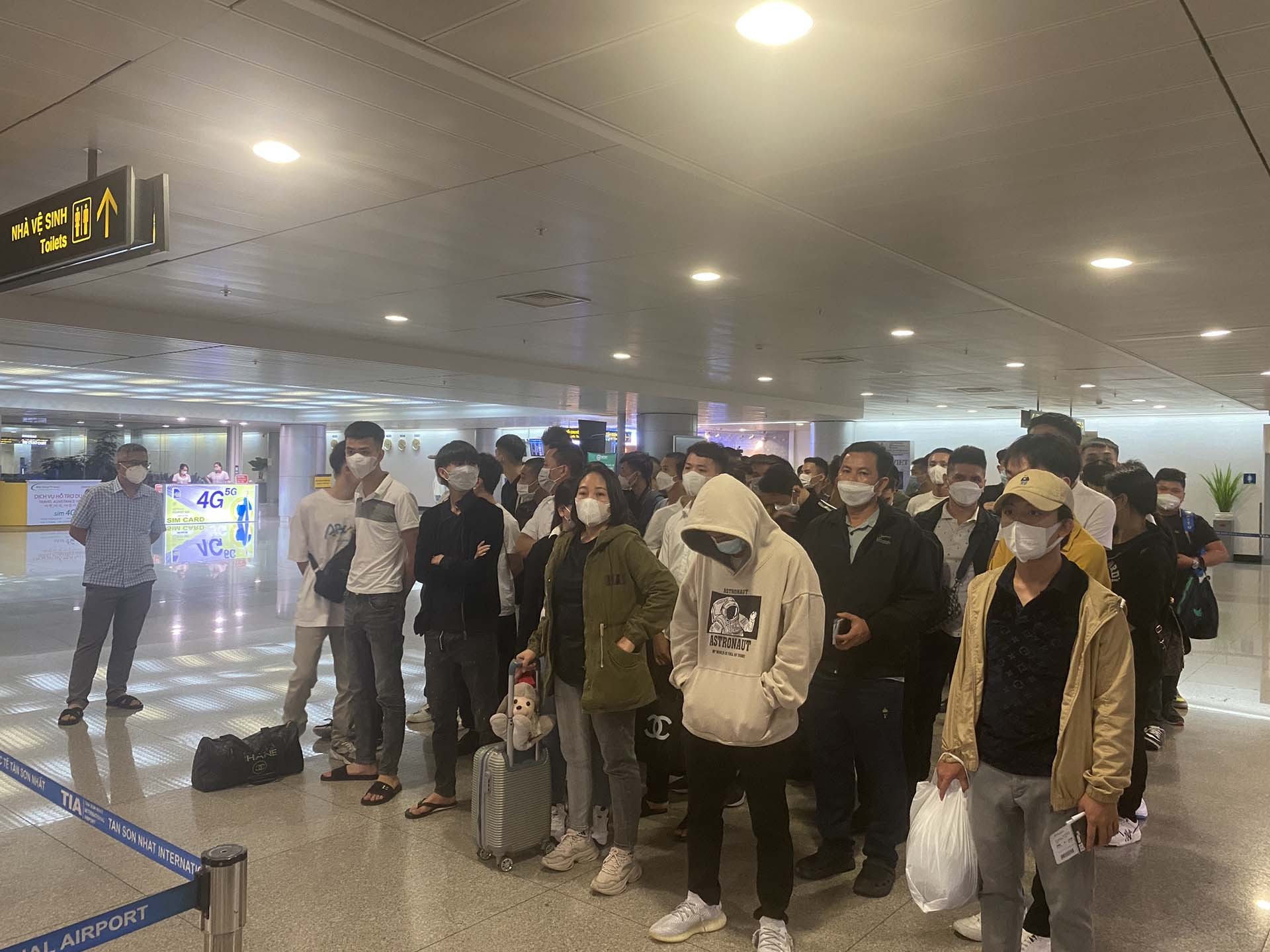
| On May 4th, Philippine authorities rescued over 1,000 people, including Vietnamese citizens, who were forced to work at a facility owned by Clark Sun Valley Hub in Pampanga, near Manila. On May 30th, 60 Vietnamese citizens rescued by Philippine authorities returned home. |
Human trafficking is ranked by the UN as one of the four most dangerous crimes today, generating high illicit income second only to drug trafficking and arms trafficking.
According to estimates by the ILO Global Estimates, 25 million people worldwide are trafficked each year, generating illicit profits of approximately $150 billion, and this figure continues to rise.
Human trafficking crimes directly violate the most fundamental human rights regarding life, health, honor, and dignity. Therefore, protecting the rights of victims of human trafficking is a central focus in preventing and combating this crime.
The reality of human trafficking in Vietnam
Over the years, the situation of human trafficking in Vietnam has become increasingly complex, occurring in all 63 provinces and cities. Of these, trafficking to foreign countries accounts for 85% (75% to China, 11% to Laos and Cambodia, and the remainder to Thailand, Malaysia, Russia, etc.), via land, sea, and air routes. With its favorable geographical location, Vietnam is not only a point of origin or destination but also a transit point for human trafficking to third countries.
From 2010 to 2021, there were over 7,500 victims of human trafficking in Vietnam. According to a random survey of 2,596 cases, women accounted for 97% and men 3%; 86% were under 30 years old (38% were under 18); 84% were from poor and disadvantaged backgrounds; 6.86% were students, 71.46% were farmers, and 20.76% were self-employed; 37% were illiterate, and 56.82% had completed primary or lower secondary education; 98.87% of cases occurred abroad (93.80% in China alone); forced labor (3.87%), sexual exploitation (35.37%), and forced marriage (42.43%); 40.39% of victims returned on their own, and 31.34% were rescued. 28.27% were repatriated by other countries. Thus, the majority of victims of human trafficking are women, often from disadvantaged economic backgrounds, and are frequently trafficked abroad for sexual exploitation or forced marriage.
According to information from the Police Investigation Agency, those involved in human trafficking are mainly professional criminals, often with prior convictions. Foreigners can also be perpetrators of this crime by entering Vietnam through brokerage companies via legal channels.
Notably, some of those who committed human trafficking were previously victims themselves; after returning to their home countries, they then trafficked women and children, even deceiving their own family members.
Regarding their methods, they try to contact, get acquainted with, and befriend victims through phone calls and social media (Facebook, Zalo, etc.), luring and deceiving them with promises of high-paying, easy jobs, but in reality, selling the victims to online gambling establishments, illegal businesses, massage parlors, and disguised karaoke bars. Another sophisticated tactic is brokering the adoption of newborn babies without following legal procedures, in order to sell them abroad.
Some individuals even impersonate law enforcement officers to deceive and coerce victims; they exploit regulations on organ donation and transplantation for illicit profit. Furthermore, the open and lenient immigration procedures and visa exemption policies are thoroughly exploited by criminals to smuggle people abroad under the guise of tourism , visiting relatives, or employment, but then confiscate documents and passports to force them into labor or sexually abuse them.
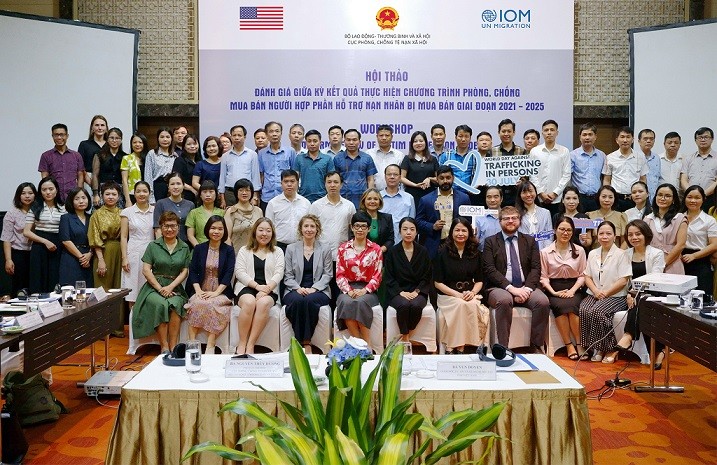 |
| On August 9th, the International Organization for Migration and the Department of Social Evils Prevention under the Ministry of Labour, Invalids and Social Affairs completed a series of workshops on the Mid-Term Review of the Implementation Results of the Program for the Prevention and Combat of Human Trafficking in the period 2021-2025 in the field of victim protection in Ho Chi Minh City. |
Efforts to protect victims of human trafficking
Over the years, Vietnam has made concerted efforts to implement a comprehensive range of measures to protect victims of human trafficking and to mitigate its consequences and combat human trafficking crimes.
Significant progress has been made in supporting and protecting victims of human trafficking. The Law on Prevention and Control of Human Trafficking of 2011 specifically stipulates the rights of victims. Government Decree No. 09/2013/ND-CP and Decree No. 20/2021/ND-CP dated March 15, 2021, create a legal framework to ensure the best possible protection for victims, specifically: support for essential needs and travel expenses; medical support; psychological support; legal assistance; cultural and vocational training support; initial hardship allowance; and loan assistance. From 2012 to the present, the Ministry of Public Security has received and supported 7,962 victims.
In particular, the results of Program 130/CP for the period 2016-2020 on "Combating human trafficking" have been recognized by the international community. During the period 2011-2018, Vietnam was ranked by the UN in Group 2 among countries with outstanding efforts in combating human trafficking.
Recently, Government Decree No. 20/2021/ND-CP dated March 15, 2021, adjusted and increased the support level for victims of human trafficking receiving temporary care and support in the community, further demonstrating concern for victims of human trafficking.
Vietnam has always prioritized improving its legal system to enhance the effectiveness of preventing and combating human trafficking. The current Penal Code has specifically defined the acts of human trafficking to match the nature and severity of the crime, while also providing a legal basis for prosecuting authorities to prove the crime and differentiate criminal responsibility.
| From January 1, 2011 to February 2023, 1,744 cases involving 3,059 defendants were prosecuted for human trafficking (100% were supervised as per regulations); People's Courts at all levels handled 1,661 cases involving 3,209 defendants; 1,634 cases were resolved and tried (98.4%), involving 3,137 defendants (97.8%). According to data from the Ministry of Public Security, from 2012 to the present, 7,962 victims of human trafficking have been received and assisted. |
The Law on Prevention and Combatting Human Trafficking is also included in the amendment program to ensure compatibility with other legal documents and international treaties. In addition, the issuance of decrees and circulars, participation in conventions, and the signing of agreements and memoranda of understanding are being intensified, creating a legal framework for dismantling and prosecuting human trafficking rings.
Communication efforts and the fight against human trafficking have been intensified; the repatriation and support of trafficking victims, along with international cooperation, have been implemented comprehensively and decisively. The strength of the community and social resources have been mobilized, creating a combined force.
International cooperation in combating human trafficking has been particularly effective, with the strengthening of bilateral and multilateral cooperation agreements on combating human trafficking, such as the Joint Ministerial Conference of the Greater Mekong Subregion on Combating Human Trafficking (COMMIT); and coordination with law enforcement agencies in neighboring countries to establish hotlines for information exchange, joint investigation, apprehension of perpetrators, and rescue, reception, and support of victims of human trafficking.
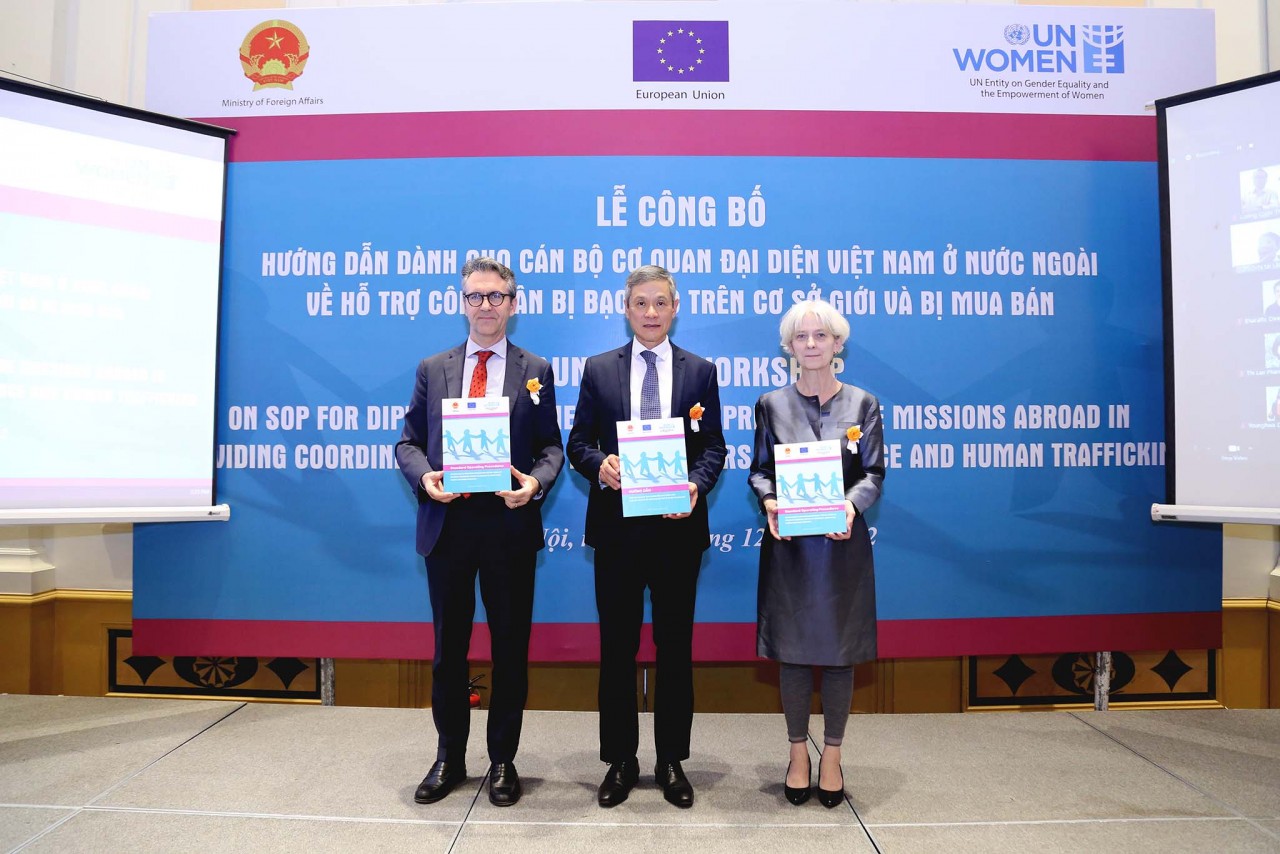 |
Assistant Minister of Foreign Affairs Nguyen Minh Vu, Ambassador Giorgio Aliberti, Head of the European Union Delegation to Vietnam, and Ingrid Christensen, Country Director of the ILO Office in Vietnam, at the ceremony announcing the Guidelines for Vietnamese diplomatic staff abroad on supporting Vietnamese citizens experiencing gender-based violence and trafficking, December 12, 2022. (Photo: Quang Hoa) |
Some difficulties, causes, and solutions.
Although certain results have been achieved in preventing and combating human trafficking and supporting and protecting victims, many difficulties and obstacles remain.
Firstly , economic conditions in some areas are still difficult, with a lack of jobs; and a segment of the population lacks knowledge, is lazy but still wants high wages, and has a desire to marry a foreigner or go abroad, making them easily susceptible to deception and becoming victims.
Secondly , Vietnam has a border stretching over 4,000 km with numerous trails, openings, and coastlines, making it an ideal area for human trafficking activities and posing difficulties for territorial management, patrolling, and control. Furthermore, the management of foreigners, population, household registration, borders, checkpoints, immigration, and marriage is still lax. Many localities lack specific solutions to combat human trafficking and remain dependent on directives from higher levels.
Thirdly , the functional forces (Police, Border Guard, Coast Guard, etc.) are still insufficient; often they only perform advisory functions, and coordination, supervision, inspection, implementation, and guidance work still have many limitations and shortcomings. In some localities, people are not yet concerned about the prevention and combating of human trafficking.
Fourth , some provisions of Vietnamese law are inconsistent with international law. According to the Palermo Protocol, any one of the acts of transporting, harboring, transferring, or receiving a person for the purpose of exploitation constitutes the crime of human trafficking.
According to Vietnamese law, it must be proven that the purpose of the above acts was "to give or receive money, property, or other material benefits," or "to sexually exploit, force labor to obtain body parts of the victim, or for other inhumane purposes" (Article 150 of the current Penal Code) in order to constitute a crime.
Furthermore, in practice, victim support efforts face many limitations in terms of both material and human resources, as well as the resources available to operating facilities; the procedures for supporting victims are complex and impractical in many localities; and the police force still faces many difficulties due to the lack of criteria for identifying victims of human trafficking in existing regulations…
Given the aforementioned shortcomings and limitations, the following solutions should be implemented in the future:
Firstly, it is necessary to improve the legal framework for preventing and combating human trafficking. This includes clarifying criminal offenses in the Penal Code, particularly those targeting victims aged 16 to 18. Furthermore, the definition of human trafficking offenses should be reviewed based on the Palermo Protocol.
Accordingly, it is not necessary to prove the purpose "to give or receive money, property or other material benefits," "to sexually exploit, force labor to obtain body parts of the victim or for other inhumane purposes" as stipulated in the Penal Code to avoid letting criminals escape punishment.
To improve the legal system related to human trafficking crimes, the Council of Judges of the Supreme People's Court needs to issue a Resolution and guidelines on prosecuting acts of human trafficking under the Penal Code. A review of the past five years of implementing the Law on Prevention and Combat of Human Trafficking and the past ten years of implementing the Law on Sending Vietnamese Workers Abroad is necessary to develop solutions appropriate to the current situation.
On July 7, 2021, the Government Office issued Notice No. 4493/VPCP-NC, assigning the Ministry of Public Security to lead and coordinate with relevant agencies to research and propose the amendment of the 2011 Law on Prevention and Combat of Human Trafficking. Accordingly, the Ministry of Public Security published the draft amended Law on Prevention and Combat of Human Trafficking, based on the principle of putting the victims of human trafficking at the center, to solicit opinions from agencies, organizations, and individuals nationwide. Full text of the draft |
Secondly, improve regulations and support for victims of human trafficking. Review, amend, and supplement relevant legal provisions such as the Law on Prevention and Control of Human Trafficking, the 2017 Law on Legal Aid, etc., to ensure consistency and uniformity.
Thirdly, link the task of preventing and combating human trafficking with economic development, job placement, poverty alleviation, etc., to minimize the conditions for exploiting and luring victims; strengthen organizations for preventing and combating human trafficking, mobilize the participation of the people in the movement to protect national security, and mobilize the combined strength of the entire political system and the whole population in the work of preventing and combating human trafficking...
Fourth, improve the management and supervision of enterprises with the function of exporting labor, preventing them from exploiting illegal fee collection and using the pretext of labor export to send people abroad; and improve the work of gathering information, monitoring the situation, and managing laborers while they are working abroad.
Fifth, regularly conduct comprehensive assessments of human trafficking to devise more effective measures to prevent and combat human trafficking; ensure that the rights of victims are closely linked to anti-human trafficking activities; and mobilize the strength of the entire political system, the entire Party, and the entire people, with the police force as the core, in preventing and combating human trafficking.
Source


![[Photo] General Secretary To Lam receives the Special Envoy of General Secretary and President of China Xi Jinping](/_next/image?url=https%3A%2F%2Fvphoto.vietnam.vn%2Fthumb%2F1200x675%2Fvietnam%2Fresource%2FIMAGE%2F2026%2F01%2F30%2F1769759383835_a1-bnd-5347-7855-jpg.webp&w=3840&q=75)


![OCOP during Tet season: [Part 3] Ultra-thin rice paper takes off.](/_next/image?url=https%3A%2F%2Fvphoto.vietnam.vn%2Fthumb%2F402x226%2Fvietnam%2Fresource%2FIMAGE%2F2026%2F01%2F28%2F1769562783429_004-194121_651-081010.jpeg&w=3840&q=75)

![OCOP during Tet season: [Part 2] Hoa Thanh incense village glows red.](/_next/image?url=https%3A%2F%2Fvphoto.vietnam.vn%2Fthumb%2F402x226%2Fvietnam%2Fresource%2FIMAGE%2F2026%2F01%2F27%2F1769480573807_505139049_683408031333867_2820052735775418136_n-180643_808-092229.jpeg&w=3840&q=75)


Comment (0)