

Selling cheap... still a good deal.
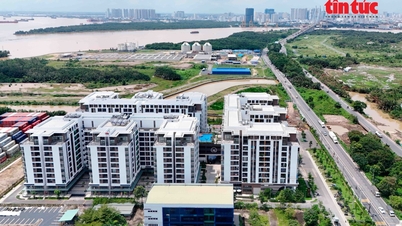
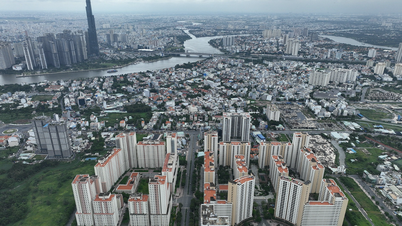
Along Nguyen Huu Tho Street (Nha Be District, Ho Chi Minh City), the names of project owners such as Hoang Anh Gia Lai, Phu Hoang Anh, Phu Long, Tai Nguyen, Novaland , etc., used to be numerous, but now they are gradually disappearing. Instead, there are more foreign companies such as Phu My Hung (Taiwan), GS (Korea), and Keppel Land (Singapore). A quiet but rapid change of ownership is taking place between domestic and foreign companies. Many projects are being resold at unprecedentedly low prices.
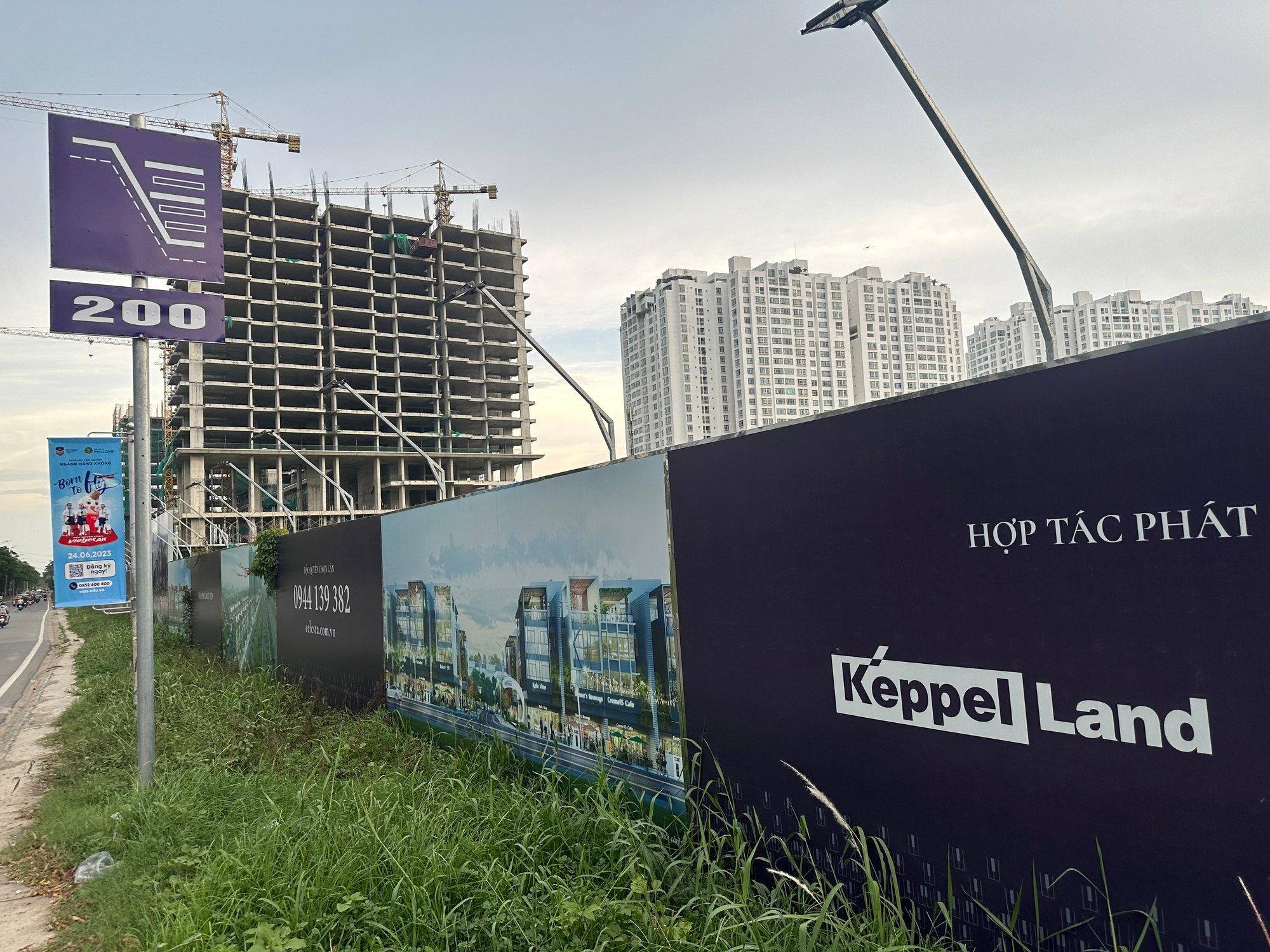
Many projects have been acquired by Keppel Land.
The leader of a real estate group in Ho Chi Minh City said he had to sell some of his most desirable projects to Keppel Land to pay off principal and interest on bank loans. When asked about the selling price, he sadly stated that if the market price was 10 dong, he would only be selling them to the foreign partner for 6 dong.
"Currently, domestic businesses no longer have the money to implement projects. Even if they had the money, they wouldn't dare to do it because no one can be sure they'll be able to sell their products in the current climate. They can't move forward, and they can't move backward. It's better to just sell everything to ease the mind," he sighed, unable to hide his sadness.
This person also admitted that there was regret, but given the ongoing payments without revenue, if they just "held onto" the project, the bank interest would eat it all up within a year or two, so selling it cheaply was a relief. According to this person, foreign companies don't invest in every project. They only prioritize projects with complete legal documentation. Notably, because they know that domestic companies are "starved for cash," foreign companies are putting pressure on them to buy projects at low prices.
"My family only has one jar of rice. When we run out, we have to borrow from our neighbors. But we can only borrow once or twice before they run out of rice, and so do we, because we have nowhere else to turn. That's why some businesses die in 6 months, some in 9 months, and some in a year. So right now, even with low prices, we have to sell everything we own to buy rice and survive," this person said bitterly, using a metaphor.
In fact, simply observing the reality is not difficult to see that many prominent projects have changed names, meaning a change of ownership. It's just that the businesses don't announce it. Even Novaland Group, a major brand in the real estate market, has had to sell many of its projects to Gamuda Land Group from Malaysia.
The prolonged difficulties and lack of optimistic outlook have led many businesses to scramble for partners to "sell themselves." The leader of a large real estate group in Ho Chi Minh City lamented that he offered his projects to foreign partners at low prices, but no one bought them, nor did anyone agree to invest because the projects lacked complete legal documentation and land use fees. Similarly, the DK Group, after nearly a year of working with a Japanese partner, was offered investment or outright sale of a project; DK would be responsible for all sales, even with profit sharing based on the contribution ratio. However, they haven't finalized the deal and are currently waiting to see what happens. The inability to sell, generate revenue, and attract partners has plunged the group into unprecedented hardship. "Almost all the staff have left, projects are stalled, and the risk of bankruptcy is very high despite having significant assets," the group's leader lamented.
Supporting leading enterprises
Mr. Huynh Phuoc Nghia, Director of the Center for Economics , Law and Management (Ho Chi Minh City University of Economics), argues that domestic businesses having to sell assets to foreign businesses leaves many negative consequences for society and the economy as their contributions decrease, or may even disappear. Furthermore, it will take 5, or even 10 years to recover to pre-crisis levels because the asset loss is so significant. Although no studies have clearly indicated the exact amount of losses, it can be estimated that asset losses could range from 20-30%, or even up to 50%.
"On the surface, many people think that foreign companies acquiring shares will provide domestic businesses with additional funds for continued investment, potentially helping the market recover. After the crisis, it might lead to greater market transparency and improved legislation. However, in reality, domestic businesses spend many years building a brand strong enough to compete with foreign partners. Now, being taken over and forced to sell assets cheaply is very painful. Therefore, the government needs to consider removing obstacles for each business and each project to minimize this situation," Mr. Nghia said.
Obstacles in approving investment policies for commercial and social housing projects, and issues related to corporate bonds, fall under the authority of the Government. However, issues concerning interspersed public land, land use fees, and the issuance of land ownership certificates fall under the authority of local governments. As for projects that are temporarily suspended for review, access to credit, interest rate reductions, and tax cuts, resolving these issues and injecting seed capital will create liquidity in the market and alleviate difficulties for businesses.
Mr. Le Hoang Chau
Mr. Pham Lam, Vice Chairman of the Vietnam Real Estate Brokers Association, also agreed that it took many years for Vietnam to have large real estate companies like Vingroup, Sun Group, Him Lam, Masterise Homes, Novaland, Hung Thinh… These are leading companies in the market, so they not only impact real estate but also many other industries, from credit, construction, building materials, labor, interior design, furniture… Therefore, when businesses face difficulties, there needs to be a breakthrough approach and mechanism to support them, especially the leading companies, to recover. Because their recovery will pull other businesses, industries, and the entire economy back up. At the same time, it will help revive projects that are clinically dead, limiting waste. In particular, it will prevent the resources that domestic businesses have spent many years building from falling into the hands of foreign companies at cheap prices.
Recalling the painful experience of seeing projects acquired by foreign companies at low prices, the Chairman of the Ho Chi Minh City Real Estate Association (HoREA), Le Hoang Chau, remembered 2007, when Vietnam joined the WTO, a time when foreign companies "flooded" into Vietnam. However, at that time, he wasn't concerned about domestic real estate companies or projects being taken over by foreign entities. In fact, in many sectors, domestic companies not only maintained their market share but also outpaced foreign companies. But in the third quarter of 2022, HoREA issued its first warning about the risk of some large, well-known real estate companies and high-value projects being acquired by foreign entities. A prime example is the transfer of a $1.5 billion project to a foreign partner at a very low price by one of Vietnam's largest real estate groups. Currently, many large real estate projects and groups in Vietnam have been "taken over" by foreign companies, with up to 49% of their shares acquired.
"Foreign businesses are 'shopping around' in the Vietnamese real estate market, seeking and acquiring the best projects at prices below cost. Some foreign corporations have told me that if any businesses are selling projects, they should be introduced to them. We have to accept this reality because businesses and the market are very weak and desperately need capital. To control this, a fundamental solution is to increase the resilience and strength of domestic businesses in general, including real estate businesses. In particular, immediate actions need to be taken to remove obstacles within the authority of each level – at the government, ministerial, and local levels – so that businesses can implement projects, build trust with customers, boost liquidity, and recover," Mr. Chau emphasized.
Source link
![[Photo] Prime Minister Pham Minh Chinh attends the Conference on the Implementation of Tasks for 2026 of Vietnam Television.](/_next/image?url=https%3A%2F%2Fvphoto.vietnam.vn%2Fthumb%2F1200x675%2Fvietnam%2Fresource%2FIMAGE%2F2026%2F01%2F10%2F1768047311329_ndo_br_dsc-3214-jpg.webp&w=3840&q=75)







































![[Infographics] Resolution No. 79-NQ/TW of the Politburo on the development of the state-owned economy](https://vphoto.vietnam.vn/thumb/402x226/vietnam/resource/IMAGE/2026/01/10/1768038914679_chp_3-11-23.jpeg)
































Comment (0)