

The simple, folk-inspired themes found in Dong Ho, Hang Trong, and Kim Hoang paintings, through the skillful hands of lacquer artist and painter Luong Minh Hoa, have taken on a new dimension. Using techniques such as carving, gold leafing, and silver leafing, these folk paintings are transformed into luxurious and highly valuable works of art.
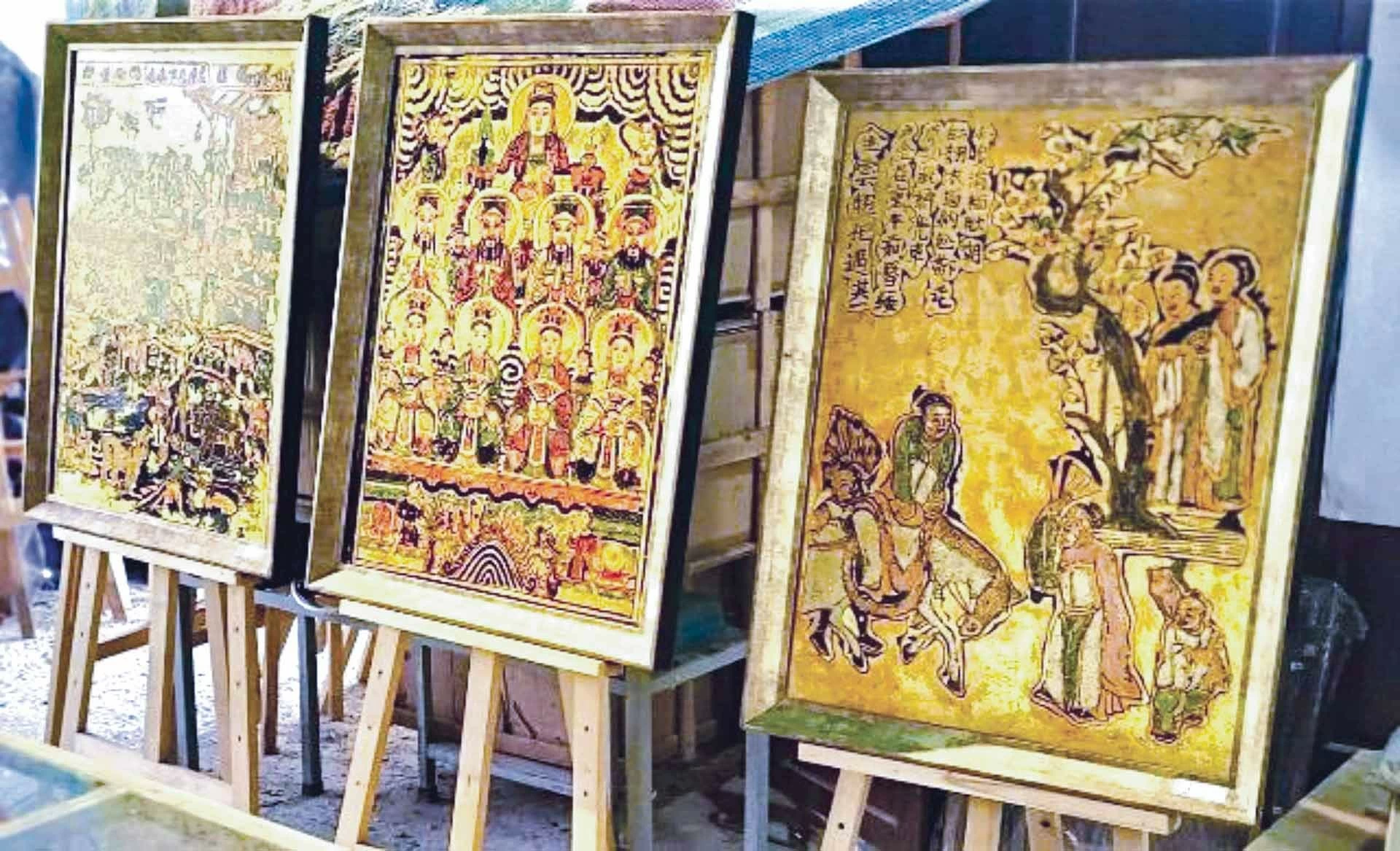 |
| A display area for paintings in the studio. (Photo: George Newman) |
In the early autumn hues of winter, while chatting with friends in the art community, I asked, "Is there anything new in folk art these days?" Expecting no answer, I was fortunate enough to receive a response from architect Tran Vinh: "Yes, there is. There's the lacquer-carving artist Luong Minh Hoa in the Latoa Indochine group (short for 'Lan Toa' - meaning 'to spread') with his carved lacquer paintings. This can be considered a new style, not traditional lacquer painting."
Researcher and artist Phan Ngoc Khue stated: “The lacquer paintings by artist Luong Minh Hoa and his colleagues in the Latoa Indochine group are lacquer paintings that retain the essence and spirit of folk paintings but create new nuances through carving techniques, gold leafing, silver leafing… creating contrasting colors and light reflections, giving the paintings a new, more luxurious image. This is truly a meaningful way to preserve and promote folk paintings, and it needs to be widely replicated and developed.”
This made it impossible for me to delay my visit to the workshop of lacquer artist Luong Minh Hoa, located below the Nguyen Khoai dike on the banks of the Red River.
New series of paintings
Artists not only bring a significant difference to their works, but also imbue them with invaluable humanistic values. Painter Luong Minh Hoa is among them. Hoa's living and working space, one could say, is "densely" brimming with art. Once you enter this place – an art space arranged like turning pages of history with dazzling lacquer paintings, profoundly reflecting the spiritual and material life, depicting the age-old dreams of working people for a harmonious, prosperous, and happy family life, and for a just and good society… you simply can't leave! That was my feeling when I stepped into the art space of Luong Minh Hoa and his collaborators on a peaceful autumn afternoon.
| Lacquer painting requires eggshells, gold and silver leaf, and gilded pigments that are then polished. Lacquer paintings are magnificent under light, revealing changing color angles upon observation, but are limited in their ability to create smooth lines, requiring considerable time and experience to achieve a flawless finish. Lacquer carving, on the other hand, is beautiful due to its fluid lines and the layered texture it creates. |
I was engrossed in watching, while Hoa continued with her work. I was captivated by everything from Dong Ho paintings like "The Mouse Wedding" and "The Child Hugging a Chicken," to Hang Trong Tet paintings, solemn altar paintings, and then Kim Hoang paintings like "The Tiger - Ông 30," with their rich red and yellow hues that were both familiar and novel, vibrant and sharp...
The sunlight streamed through the workshop, illuminating everything. I looked up and asked, as Hoa had just finished carving a cute little boy hugging a chicken: "So you've combined three traditional painting styles: lacquer painting, woodblock printing, and folk painting?"
Hòa calmly replied, "Why not?! Our ancestors created and perfected the techniques of masterful painting, so why don't we take advantage of and combine the strengths of those different painting styles?"
I wondered, "Could this be misinterpreted as mere copying or integration?"
Hòa calmly said, "The important thing is to fully convey the spirit of traditional painting, giving it new life and new appeal. Why does it have to be a completely new work, a one-of-a-kind creation? Why don't we look to tradition, learn from the talent of our ancestors, and cherish, nurture, and preserve it, just as we drink our mother's milk to grow and mature?"
Then Hoa showed me the shadow of the picture frame reflected on the floor. He said, "The past is gone, but it remains the foundation for us to create at a higher level. As the Austrian composer Gustav Mahler said: 'Tradition does not mean worshipping the ashes, but keeping the flame alive.' Society changes, people's needs change, perspectives change, so we must create in a way that adapts tradition to the times without changing its essence."
He confided, "It's easy to say, but in reality, once you start working on it, you realize that combining those elements isn't simple. If you're too meticulous, it becomes mere craftsmanship, but if you're too free, it's no different from printing graphics on wood, lacking sophistication and fresh emotion. Here, we practice art."
Hoa explained that lacquer painting requires eggs, gold and silver leaf, and then polishing. Lacquer paintings are magnificent under light, revealing changing color angles upon observation, but are limited in terms of fine lines because they require considerable time and experience to achieve smoothness. Lacquer carving, on the other hand, is beautiful due to the blending of layers and shapes. The drawback of lacquer carving is that the colors dry out, and the lines are stiff because they leave the original background and use black or red (traditional) colors. Therefore, combining these two methods enhances the value of each art form, maximizing the strengths of both techniques and adding to the captivating impact of light on the lines.
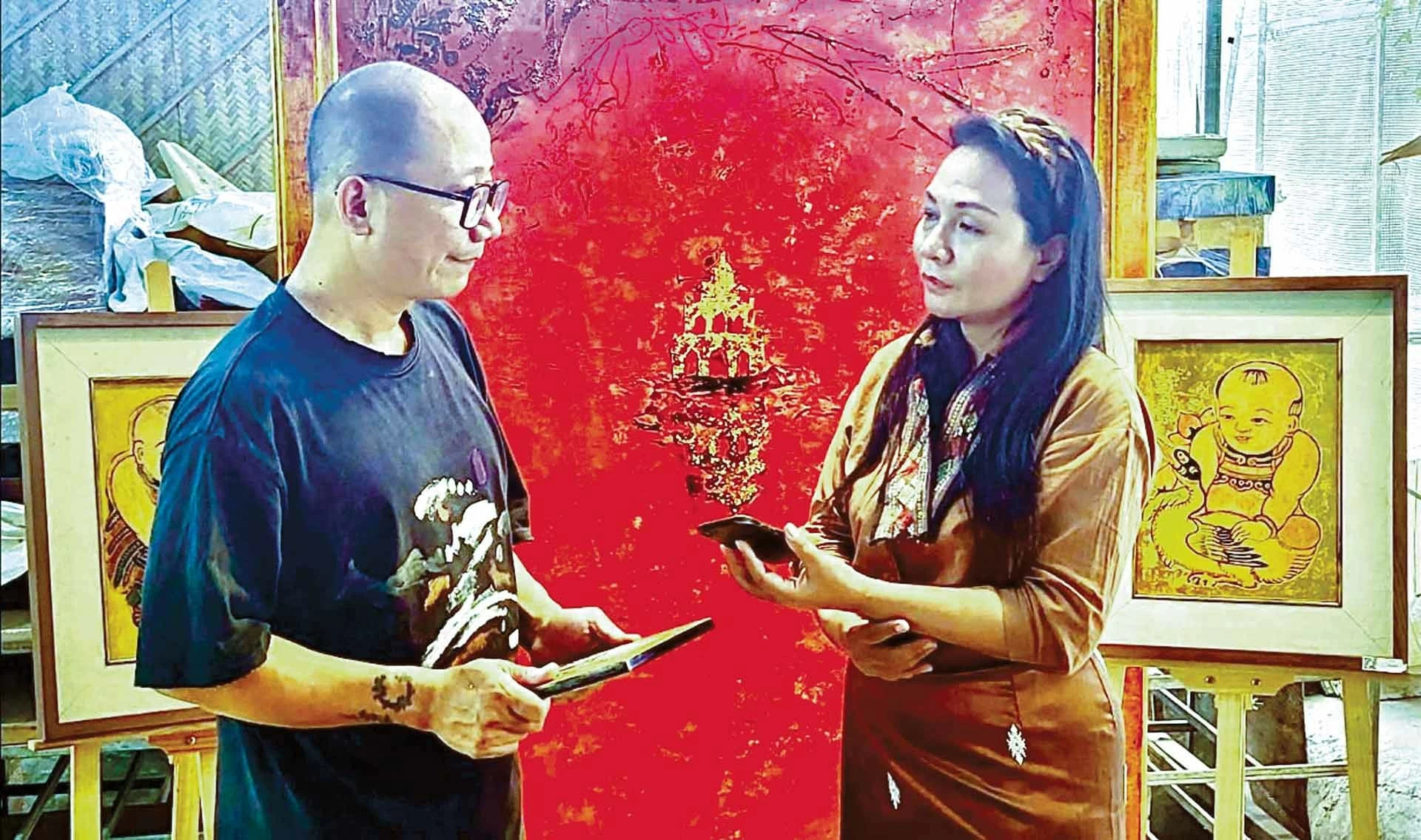 |
| Author and lacquer artist Luong Minh Hoa converses at the Latoa Nguyen Khoai art studio in Hanoi . (Photo: George Newman) |
Starting a business in your late 30s
After chatting for a while, Hoa got up to boil water for tea. At the workshop, he personally does all the kitchen chores. Hoa confided: “My passion probably took flight when I passed the entrance exam to the Hanoi University of Industrial Fine Arts in 1999. I came to the lacquer painting profession and it became a part of me. I started painting lacquer at the KIMA workshop for about two years before switching to design and working in this field for about 20 years. This field has a very broad range of aesthetics (architecture, fine arts, graphic design, performance, etc.), which gave me the opportunity to gain more understanding of painting.”
He added that while working as a designer, he had seen many beautiful applications of folk art in product packaging. His graduation thesis in carpet design was about a mouse wedding, so he understood the appeal of the line system in folk art. And perhaps the decisive factor was the outbreak of the Covid-19 pandemic, when Hoa found himself with lacquer painting. He and the Latoa Indochine group had been developing and practicing for about five years, but only officially started in 2020. However, success only began in 2022 when the group held the "The Path" exhibition at the Hanoi Museum.
| “The paintings by artist Luong Minh Hoa and his colleagues in the Latoa Indochine group are lacquer paintings that retain the essence and spirit of folk art but create new nuances through carving, gold leafing, silver leafing… creating contrasting colors and light reflections, making the folk paintings look more luxurious. This is truly a meaningful way to maintain and promote folk art, and it needs to be replicated and developed.” - Researcher and artist Phan Ngoc Khue |
Keep the flame alive and spread it to international friends.
After years of observation, Hoa's group realized that many people were interested in folk paintings, but there was no way to make them more valuable and elegant. The difficulty with lacquer painting lies in the lines created with lacquer paint. If the details are smooth and precise, it creates an artistic quality, but if they are too flamboyant, it becomes messy and loses the spirit of folk painting. From there, Hoa tried combining the lines of carved lacquer with the materials of lacquer painting, and the results were surprisingly good. From then on, he called this style "carved lacquer painting."
Lacquer paintings have been exhibited in many countries such as Japan, South Korea, China, France, India, etc., and have been selected as diplomatic gifts to promote culture. The group's products and works have been chosen as gifts for international friends, contributing to the spread of folk culture and traditional materials to the world.
Currently, Hoa's group is nurturing the idea of building a traditional craft village space to create a larger-scale development environment where people can come and experience it. The group hopes to create a long picture of Vietnam's landmarks, culture, and people, stretching across history to match the name Latoa, which means spreading the love of culture to many people.
Artist Luong Minh Hoa shared that he wants to contribute to creating works that can help people love art, love culture, and love the values that our ancestors painstakingly preserved. The Latoa group was very pleased to name the exhibition "The Path," with the desire to "go to the very end of tradition," preserving the essence of traditional culture to live in the modern era.
Source: https://baoquocte.vn/nguoi-thap-lua-cho-tranh-truyen-thong-292067.html


![OCOP during Tet season: [Part 1] Ba Den custard apples in their 'golden season'](/_next/image?url=https%3A%2F%2Fvphoto.vietnam.vn%2Fthumb%2F402x226%2Fvietnam%2Fresource%2FIMAGE%2F2026%2F01%2F26%2F1769417540049_03-174213_554-154843.jpeg&w=3840&q=75)


Comment (0)