

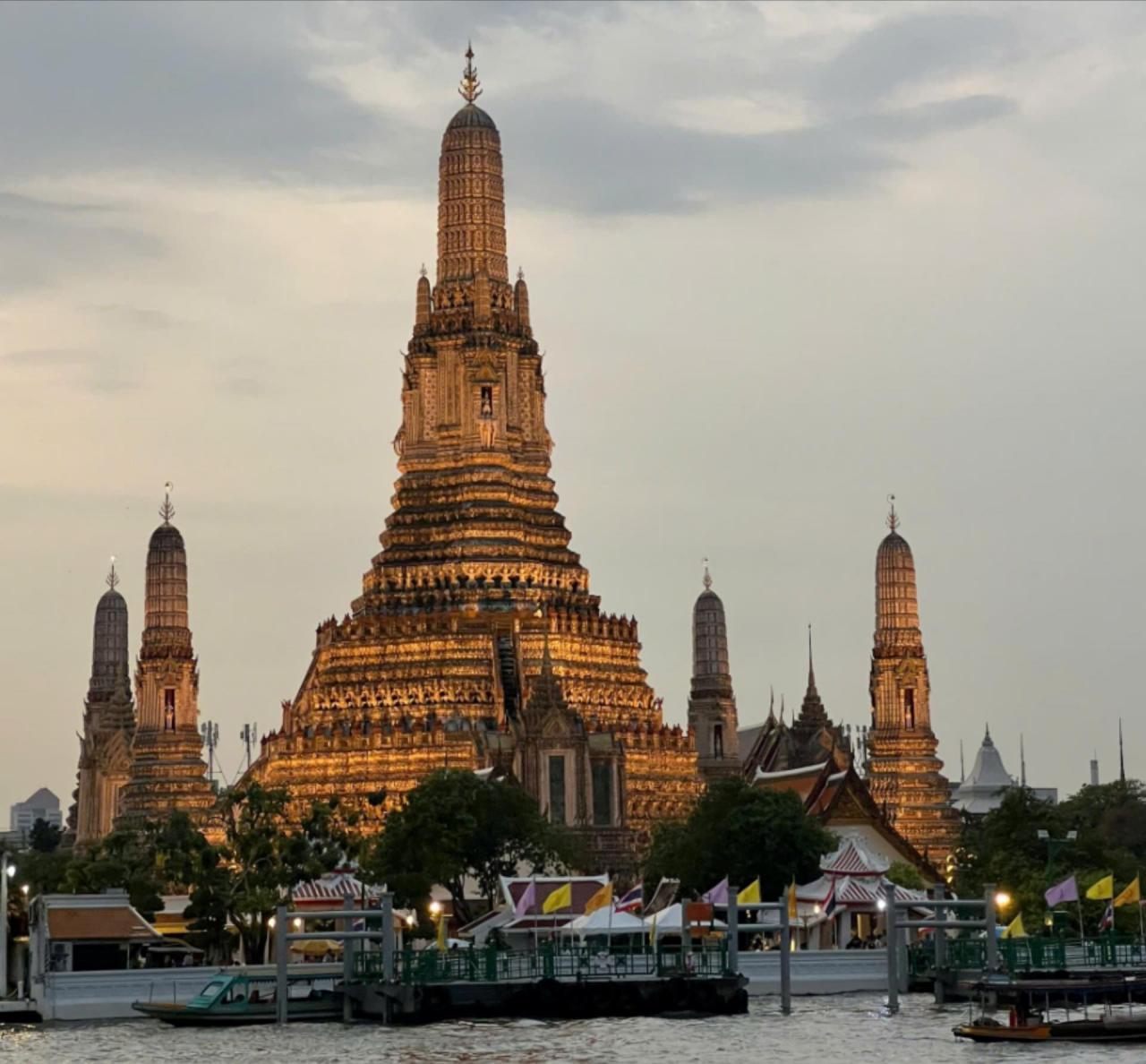
1. Saying that doesn't mean I'm equating Thai culture with Champa culture in Quang Nam , Central Vietnam. History has proven that the similarities between these two cultures are not coincidental, as ancient Champa was once part of the ancient Khmer empire.
The Khmer Empire's power dominated the territories of Cambodia and Thailand. Furthermore, Thailand in general, and Bangkok in particular, had a large influx of immigrants from China, adding to the similarities as Champa gradually merged with Dai Viet after the death of King Che Man.
When I first set foot in Thailand, I didn't realize how multi-ethnic the country is. I was fascinated by Thai architecture, but I was even more captivated by the country's diverse communities. Because Thailand is not just made up of Thai people.
Stepping into Pattaya, I saw Chinese tourists , Indian restaurants, street vendors selling Turkish kebabs, Middle Eastern silk shops, and Russian prostitutes.
Pattaya's red-light district attracts many tourists, and they bring in blonde, blue-eyed, white-lipped Russian girls to dance and entice visitors seeking one-night stands. Multi-ethnicity is real, but Thailand's multi-ethnicity suffers from profound humanistic values when a segment of the population is bought and sold like commodities.
Looking at Thai society, I can't help but think of ancient Champa, a culture now a thing of the past that once had a golden age of multi-ethnicity and human rights. Champa taught us to cherish women. A matriarchal society like Champa empowered women to inherit property, especially land and houses, and children would also take their mother's surname. The Cham people also worshipped the goddess Po Nagar, considered the mother of the land, the creator of nature, and the protector of the community.
Cultural exchange bestowed upon Champa a diverse ethnic population, comprising not only Chams but also people of Indian, Malay, and Middle Eastern descent. And regardless of ethnicity, the role of women remained paramount in Champa. Although both were once part of the Khmer empire, Champa was thousands of years ahead of Thailand in respecting women.
2. Although Thailand has a Buddhist population of 94%, the most revered deity is not the Buddha, but rather Brahman, a Hindu god. Brahman, with his four faces pointing in the four cardinal directions (East, West, South, and North), is believed to bring good fortune, protection, and prosperity. The Erawan Shrine in Bangkok is bustling with people offering flowers and praying for their wishes to come true.
I understand that the Thai people believe that the god Brahman accompanied the Buddha, protecting and advising him throughout his years of asceticism. Therefore, the worship of Brahman does not conflict with, but rather diversifies the Buddhist monastic life of Thailand. Evidence of this is the Wat Yan Nawa temple, which places a statue of Brahman right at the entrance before people are allowed to visit the relics of the Buddha.
From Brahmanism to the Buddha Shakyamuni, I learned more about Theravada Buddhism, or orthodox Buddhism, which Thailand has been influenced by from its neighbor India. Buddhist teachings have permeated Thai thought, shaping high moral values, especially filial piety towards parents.
Thais believe that annual birthdays are an occasion to show gratitude to their parents, so they try to return home early, prepare a basin of water to wash their parents' feet. Afterwards, they will visit a temple together, praying for their parents' well-being and long life surrounded by their children and grandchildren.
Besides Buddhism and the influence of Hinduism, Thailand has many mosques that I wish I had more time to visit. Islam is the largest minority religion in Thailand, with the Muslim population being predominantly Malay, who have lived and practiced their faith for centuries.
The growth of the Muslim community has led not only to a blend of Islamic and Thai architecture, but also to a demand for halal food that meets Islamic standards right on the streets of Thailand.
It wasn't difficult to spot Muslim women wearing hijabs all over the streets of Bangkok. Even though Thailand has experienced religious conflict in the past, the people still live peacefully amidst religious differences along every path I traveled.
3. Most aspects of Thai culture brought me back to think of My Son. Because the ancient Champa land was a crossroads of Hinduism, Buddhism, and Islam, which the Cham people still maintain, practice, and pass on to future generations.
I remember seeing the statue of Brahman at the Cham Museum in Da Nang , where he stood majestically after enduring countless layers of dust, alongside Shiva, still embodying the powerful spirit of destruction and rebirth.
And when I encountered the Cham dancers, I realized that the graceful yet strong nature of the Cham people was similar to that of Thai dancers. Even the skirts wrapped around their bodies were sculpted identically, down to every detail of the fabric.
Hindu architecture, deeply rooted in Champa, still remains. Looking at the Thai temples, I kept thinking of My Son, of the land of Champa. The solemn stone blocks, the exquisite patterns, seem to tell stories of the golden age of a brilliant civilization.
My Son, with its majestic Cham towers, is a vivid testament to the intermingling of Indian art and the creative spirit of the Cham people. These towering Cham structures stand tall against the sky, like sentinels guarding a once-flourishing culture, whose remnants still remain in Thai culture.
On the day I boarded the plane to return home, I turned my head to look at the land of a thousand elephants and suddenly remembered a passage from Nguyen Trac's poem "Beside the Tra Kieu Dancer Statue": " ...The tenth century is too far away/the twentieth century is also old news/but even with many more strange things/you are still an endless wonder/you still live as you have lived for a thousand years/a pair of hands that are not real human hands/a body that seems to be completely transcendent/still incredibly close to humanity ."
Source: https://baoquangnam.vn/ngoanh-dau-tu-thai-de-thay-chiem-thanh-3148379.html













































Comment (0)