The country has unforgettable days. One of those unforgettable days is April 30, 1975.
I hadn't returned to Saigon on that historic day. It was only in early May 1975 that I was present in the "bright zone of Saigon" that the poet Le Anh Xuan wrote about, and which I later dreamed of.
But once I was in Saigon, I suddenly remembered the Truong Son Mountains, the Dong Thap Muoi plain, the Southern Highway 4 - Cai Lay battlefield, and the years I spent with my brothers and comrades:
"The day the nation gathered on Highway One"
My heart never ceases to yearn for these forests.
where tens of thousands of children lie buried at the bottom of the mountain pass.
along a path hidden beneath the trees.
(Excerpt from the epic poem "Those Who Go to the Sea" - Thanh Thảo)
For those who lived through the war, memories always come flooding back. As a journalist specializing in military affairs, focusing on the theme of national reconciliation and harmony, I can never forget the historic words of General Tran Van Tra, Chairman of the Saigon Military Administration Committee, in the early days of peace and reunification.
That's what Mr. Tra said to General Duong Van Minh, former President of the Republic of Vietnam, on May 2, 1975, verbatim: "For us, there are no losers or winners, only the Vietnamese people defeating America."
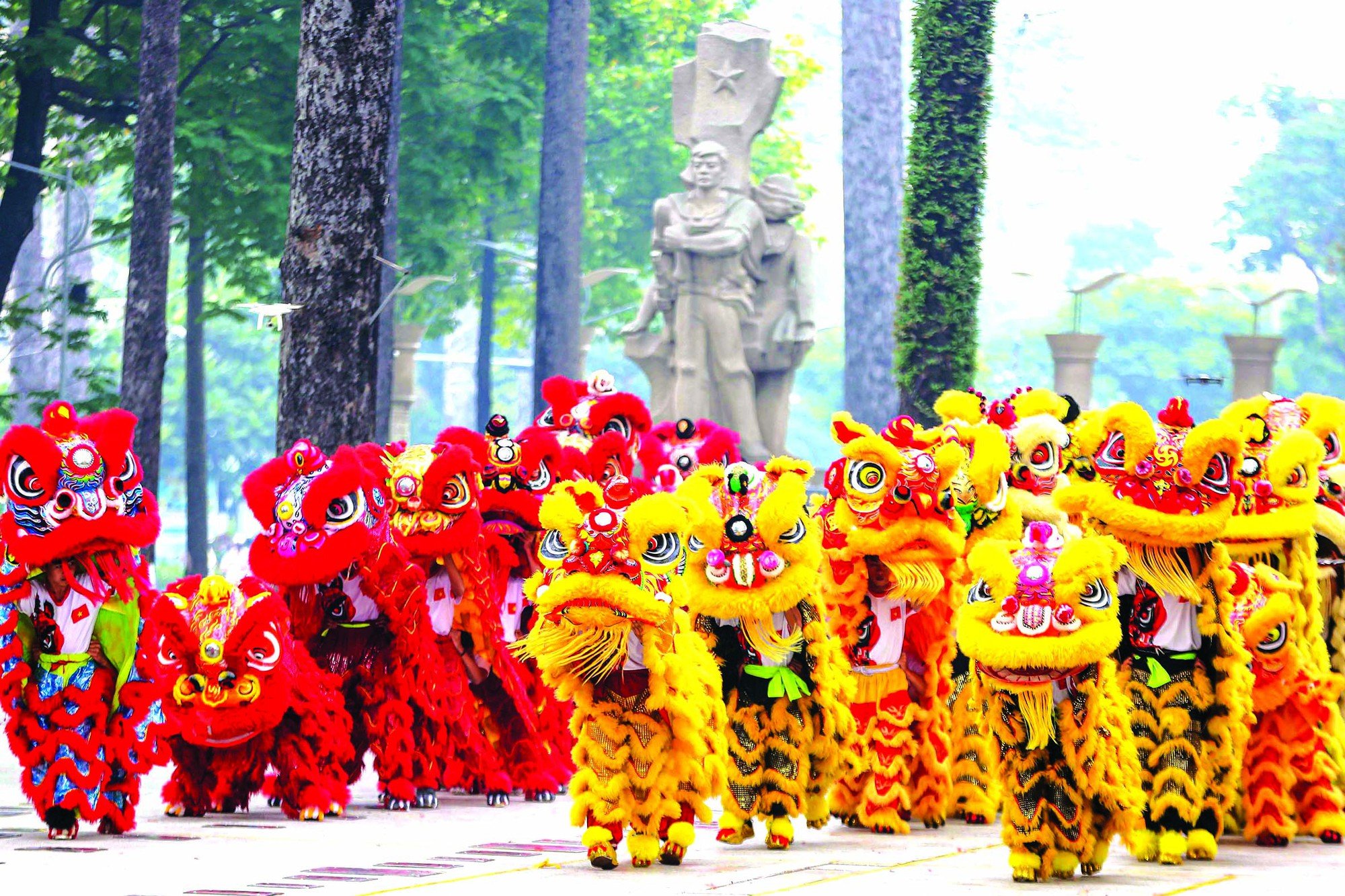
Lion and dragon dance performance in Ho Chi Minh City. Photo: Hoang Trieu
Fifty years have passed, but that historic statement shines ever brighter, for it exemplifies Vietnamese compassion and the fraternal love of the Vietnamese people. Only invaders would attempt to divide the Vietnamese nation; Vietnamese people, whether on one side or the other, are all Vietnamese.
Driven by love for our fellow countrymen, on that first day of peace, I and the poet Ngo The Oanh, guided by a younger brother studying at Van Hanh University, walked all over Saigon, always carrying a cassette tape with Trinh Cong Son's "yellow skin" songs, playing songs like "What Have We Seen Tonight?" and "Joining Hands in a Great Circle." During those days, Trinh Cong Son's music brought us much more joy, even though his songs contained sadness because of the suffering our nation had endured.



Wandering through Saigon, we visited many small streets in Cholon and saw, alongside the relatively affluent, countless poor working-class families, people who had fled from the countryside to Saigon during the war. They lived in narrow alleys, building "houses" out of cardboard, and all their family activities were confined within these cardboard homes.
Indeed, despite the hardships of life in the jungle, we never imagined that laborers could be in such dire straits. That's what deeply saddened us young soldiers.
In May 1975, Saigon was buzzing with student parades and lion dances, as if the entire city had taken to the streets to celebrate peace and reunification.
I was constantly participating in one event after another, and at mealtimes, people in Saigon would invite me to eat and drink. I met everyone as if they were my own family, and I never felt like a stranger. When I and the poet Ngo The Oanh, dressed in military uniforms, went to choose books from a street vendor on Le Loi Street, a group of intellectuals sitting and drinking coffee observed us with surprise.
They didn't know what books the two Liberation Army soldiers were buying, so they came out to help us wrap the books while also reading the titles of the books we bought. They were even more surprised because we were buying only classics and translated books. They invited us for coffee and conversation. Knowing that we had studied at a university in Hanoi , they were very pleased. The conversation was friendly and cheerful. They invited us to their house to celebrate our reunion with beer. We happily accepted.
May 1975 was truly unforgettable! Meeting the poor laborers in Saigon, like the cyclo drivers and the motorized tricycle drivers, they were all happy to invite us in, sharing whatever drinks and fun they had, chatting with us with such affection, as if we were their own relatives. That's what "the South accepting them" meant.
I vividly remember visiting the home of the older sister of a close friend from the R war zone. Their house was on Thi Nghe canal, a house – to sound impressive – but it was extremely simple. There, I met a little girl, just over two years old, the daughter of the older sister. She greeted me cheerfully, and when I asked her name, her mother said it was Hoa Binh (Peace). I was deeply moved; it truly was Hoa Binh.
"He hugged his nephew and kissed him affectionately."
From today onwards, I am forever at peace.
Forever is the child's name.
"On this land, the bomb craters and trenches are closing up" ("Written on Highway One" - poem by Thanh Thảo)
Surely no nation loves peace more than the Vietnamese people. That's not an exaggeration. Just remember how much our nation and our people sacrificed, suffered losses and pain for decades, enduring 21 years of division. Only then can we understand how high the price of peace and reunification was.
I was fortunate enough to travel with a group of writers from Central Vietnam at the end of May 1975, journeying from Saigon to Da Lat , then down Highway 1 through Central Vietnam, to Hue, and all the way to Hanoi. It was a trip I had dreamed of since setting foot in the Truong Son Mountains; I had vowed to myself to enter the Southern battlefield via the Truong Son route and return to Hanoi via Highway 1.
Five years on the battlefield in Southern Vietnam helped me mature, and I feel those were the most beautiful years of my youth.



My friends who came from Saigon and Hanoi to the battlefield, and whom I met in Zone R, all shared the same feeling as me, having survived the fierce war.
"We went without regretting our lives."
But how can one not have regrets at the age of twenty?
(But if everyone regrets losing their twenties, what will become of the homeland?)
"The grass is so colorful and warm, isn't it, my dear?"
(Excerpt from the epic poem "Those Who Go to the Sea")
Fifty years have passed, our generation has journeyed from the forests to the sea, and although we are now old, our love for our people and our country remains forever young.
Source: https://nld.com.vn/ngay-dan-toc-tu-ve-duong-so-mot-196250121133715729.htm