

To address the shortage of female labor, systemic changes are needed to encourage women to pursue careers in semiconductor technology at the university level and even earlier.
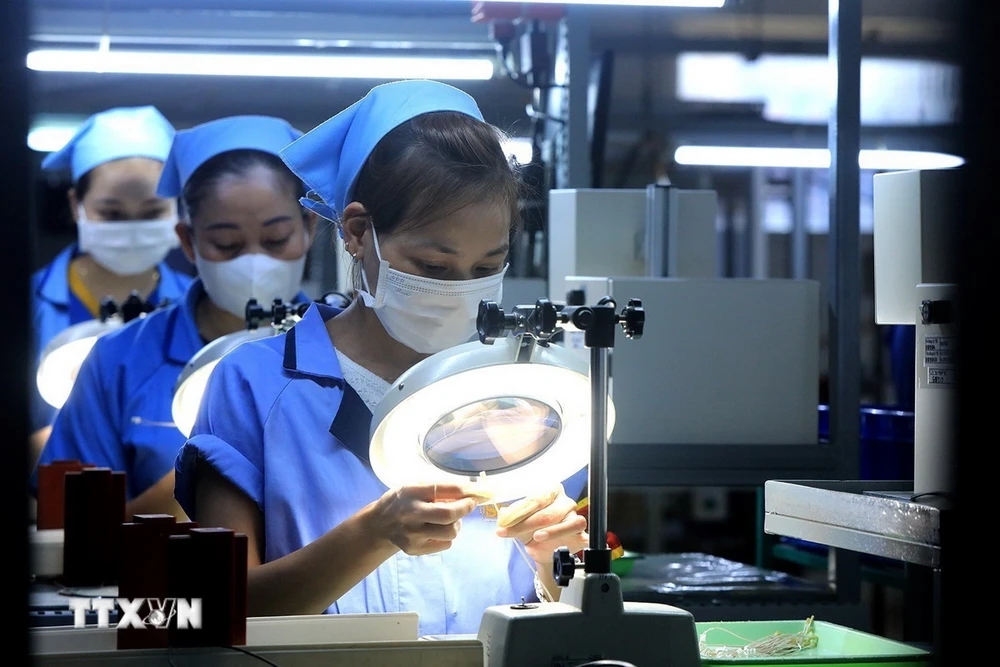
At a large-scale semiconductor trade show held in Tokyo last week, more than 1,000 companies, representing almost every aspect of the supply chain, were present to showcase their latest technologies to approximately 100,000 attendees.
However, Catherine Thorbecke, Bloomberg's Asia technology commentator, said that as she moved from the local train station amidst a crowd of men in suits, she wondered, "Where are the women?"
In reality, the semiconductor industry and the technology sector in general often feel like a "male world ." Therefore, the fact that around 12% of this year's speakers were women offered a glimmer of hope. While this number might sound bleak, it's actually better than some other conferences.
This imbalance is not solely due to the nature of the event or specific to Asia. The shortage of women in the chip industry is a global problem.
A 2023 report showed that the percentage of women in the workforce ranged from 20% to 29%, and the percentage of women in technical roles was only 10% to 19%. These numbers declined even more sharply in managerial positions.
Companies in the chip industry are in dire need of a overhaul in their recruitment and retention practices for female employees.
The global semiconductor industry is projected to become a trillion-dollar industry by the end of this decade. The Semiconductor Industry Association forecasts the need for an additional 1 million workers by 2030.
While governments worldwide are spending billions of dollars to gain an advantage, policymakers need to recognize that efforts to boost domestic production cannot ignore half the population.
For private sector leaders, there is ample data showing that businesses with more female leaders perform better and are more resilient.
In the technology sector, the importance of diversity is even greater. Diversity fosters innovation, while groupthink stemming from a lack of diversity can undermine companies attempting to solve challenging problems.
Japan's technology ecosystem has faced criticism for not innovating enough, as it increasingly lags behind America's Silicon Valley.
In addition, women have been left out of the country's technology sector.
Japan has the lowest percentage of women who aspire to work in science or technology by the age of 30, and the lowest percentage of female graduates in science, technology, engineering, and mathematics (STEM) among OECD countries.
At a workshop examining the barriers companies face in recruiting and retaining female employees, the limited number of STEM graduates emerged as a major issue.
To address this issue, more effort is needed from companies; it requires systemic changes, encouraging women to pursue careers in technology at the university level and even earlier.
Government requirements can help drive business change, but they are not enough to support the initial phase.
Meanwhile, promoting women to leadership positions is crucial to addressing the shortage of role models and mentors at higher levels within the semiconductor industry.
Last week, Time magazine named Lisa Su, CEO of Advanced Micro Devices Inc. (AMD), as CEO of the Year. This Taiwanese-born businesswoman, who immigrated to the U.S., has helped AMD's stock price increase 50-fold during her leadership.
Her tenure was the subject of a Harvard Business School case study, which showed that women are capable of leadership in this field when given the opportunity.
In a recent interview, Ms. Su stated that she is passionate about her work with the Global Semiconductor Alliance's women's leadership initiative, while emphasizing the importance of connecting women in the industry for support and mentorship.
Source: https://www.vietnamplus.vn/nganh-cong-nghiep-ban-dan-tren-toan-cau-dang-thieu-hut-lao-dong-nu-post1002363.vnp
![[Photo] Prime Minister Pham Minh Chinh receives the Governor of Tochigi Province (Japan)](/_next/image?url=https%3A%2F%2Fvphoto.vietnam.vn%2Fthumb%2F1200x675%2Fvietnam%2Fresource%2FIMAGE%2F2025%2F12%2F16%2F1765892133176_dsc-8082-6425-jpg.webp&w=3840&q=75)
![[Photo] Prime Minister Pham Minh Chinh receives Lao Minister of Education and Sports Thongsalith Mangnormek](/_next/image?url=https%3A%2F%2Fvphoto.vietnam.vn%2Fthumb%2F1200x675%2Fvietnam%2Fresource%2FIMAGE%2F2025%2F12%2F16%2F1765876834721_dsc-7519-jpg.webp&w=3840&q=75)


![[Image] Leaked images ahead of the 2025 Community Action Awards gala.](/_next/image?url=https%3A%2F%2Fvphoto.vietnam.vn%2Fthumb%2F1200x675%2Fvietnam%2Fresource%2FIMAGE%2F2025%2F12%2F16%2F1765882828720_ndo_br_thiet-ke-chua-co-ten-45-png.webp&w=3840&q=75)
![[Live] 2025 Community Action Awards Gala](/_next/image?url=https%3A%2F%2Fvphoto.vietnam.vn%2Fthumb%2F1200x675%2Fvietnam%2Fresource%2FIMAGE%2F2025%2F12%2F16%2F1765899631650_ndo_tr_z7334013144784-9f9fe10a6d63584c85aff40f2957c250-jpg.webp&w=3840&q=75)























































![[Photo] Prime Minister Pham Minh Chinh attends the Vietnam Economic Forum 2025](https://vphoto.vietnam.vn/thumb/402x226/vietnam/resource/IMAGE/2025/12/16/1765893035503_ndo_br_dsc-8043-jpg.webp)






























Comment (0)