

According to the medical history, the family reported that after the fall, baby P. cried, was conscious, did not vomit, and did not have seizures. The next day, the family discovered swelling in the neck and chest, and took the child to a local hospital for examination. There, the child was found to be lethargic, with cyanotic lips, difficulty breathing, and an SPO2 of 85%. The child was intubated and placed on a ventilator. A CT scan of the head, chest, and abdomen revealed subcutaneous emphysema in the abdomen, hips, back, chest, and neck on both sides, as well as collapse of the upper lobes and middle lobes of the lungs. The doctor concluded that a tracheal rupture, mediastinal emphysema, and rib fractures were suspected. The child was then transferred to the Children's Hospital of Ho Chi Minh City.
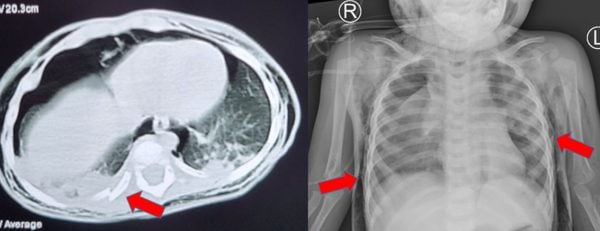
CT scans and chest X-rays revealed mediastinal emphysema, subcutaneous emphysema, and fractured ribs in the child.
PHOTO: BSCC
On March 7th, Dr. Nguyen Minh Tien (Deputy Director of the City Children's Hospital), a specialist in respiratory medicine, ENT, surgical intensive care, and anesthesia, stated that P. was diagnosed with tracheal rupture and rib fractures after consultation with specialists in respiratory medicine, ENT, surgical intensive care, and anesthesia. The doctors unanimously agreed on a treatment plan involving open chest surgery, tracheal reconstruction, and bronchoscopy during the operation. The doctors determined this to be a rare case of tracheal rupture in children.
During the surgery, the child was positioned lying on their left side at a 90-degree angle. The surgical team excised and sutured the perforation, inserted an endotracheal tube through the perforation site to irrigate the right pleural cavity, placed a pleural drain, and bandaged the surgical wound.
The child was then transferred to the surgical intensive care unit for treatment with respiratory support, antibiotics, intravenous fluids, pain relievers, sedatives, and electrolyte and acid-base balance correction.
After nearly two weeks of treatment, the child's condition improved, the mediastinal and subcutaneous emphysema gradually resolved, and the child was weaned off the ventilator and the pleural drainage tube was removed. The child was alert and breathing ambient air.
Through this case, Dr. Tien advises parents to always supervise children under 3 years old, because at this age, children often explore the world around them by crawling, touching strange objects, and putting strange objects in their mouths, leading to unfortunate accidents such as burns, electric shocks, poisoning from accidentally ingesting chemicals or medicine, and injuries from falls, etc.
Source: https://thanhnien.vn/nga-tu-giuong-xuong-dat-be-1-tuoi-bi-vo-khi-quan-185250307135607388.htm
![[Image] Leaked images ahead of the 2025 Community Action Awards gala.](/_next/image?url=https%3A%2F%2Fvphoto.vietnam.vn%2Fthumb%2F1200x675%2Fvietnam%2Fresource%2FIMAGE%2F2025%2F12%2F16%2F1765882828720_ndo_br_thiet-ke-chua-co-ten-45-png.webp&w=3840&q=75)
![[Photo] Prime Minister Pham Minh Chinh receives the Governor of Tochigi Province (Japan)](/_next/image?url=https%3A%2F%2Fvphoto.vietnam.vn%2Fthumb%2F1200x675%2Fvietnam%2Fresource%2FIMAGE%2F2025%2F12%2F16%2F1765892133176_dsc-8082-6425-jpg.webp&w=3840&q=75)
![[Photo] Prime Minister Pham Minh Chinh receives Lao Minister of Education and Sports Thongsalith Mangnormek](/_next/image?url=https%3A%2F%2Fvphoto.vietnam.vn%2Fthumb%2F1200x675%2Fvietnam%2Fresource%2FIMAGE%2F2025%2F12%2F16%2F1765876834721_dsc-7519-jpg.webp&w=3840&q=75)
![[Image] The tenacious fighting spirit of Vietnamese women's football](/_next/image?url=https%3A%2F%2Fvphoto.vietnam.vn%2Fthumb%2F1200x675%2Fvietnam%2Fresource%2FIMAGE%2F2025%2F12%2F17%2F1765990260956_ndo_br_4224760955870434771-copy-jpg.webp&w=3840&q=75)
![[Live] 2025 Community Action Awards Gala](/_next/image?url=https%3A%2F%2Fvphoto.vietnam.vn%2Fthumb%2F1200x675%2Fvietnam%2Fresource%2FIMAGE%2F2025%2F12%2F16%2F1765899631650_ndo_tr_z7334013144784-9f9fe10a6d63584c85aff40f2957c250-jpg.webp&w=3840&q=75)









































![[Live] Closing Ceremony and Award Presentation for the "Impressive Vietnam Tourism" Video/Clip Creation Contest 2025](https://vphoto.vietnam.vn/thumb/402x226/vietnam/resource/IMAGE/2025/12/17/1765974650260_z7273498850699-00d2fd6b0972cb39494cfa2559bf85ac-1765959338756946072104-627-0-1338-1138-crop-1765959347256801551121.jpeg)











Comment (0)