

Russia has recently increased the number of conscription orders issued to newly naturalized foreign workers, seemingly in an effort to bolster its forces on the Ukrainian battlefield.
Over the past few weeks, Russian police have intensified checks and searches of hundreds of migrant workers, mostly from Central Asia, in several cities. This operation appears to be primarily targeting men who have recently acquired Russian citizenship but have not yet completed their mandatory military service registration.
During inspections and searches, police officers issue conscription orders on the spot to migrant workers, or take them to recruitment offices to register.
According to Russian law, naturalized male immigrants are obligated to register with the military recruitment office, ready to enlist should Moscow conduct mobilization. However, these are not the only targets in the crackdown, according to Valentina Chupik, a lawyer who provides legal advice to immigrants in Russia.
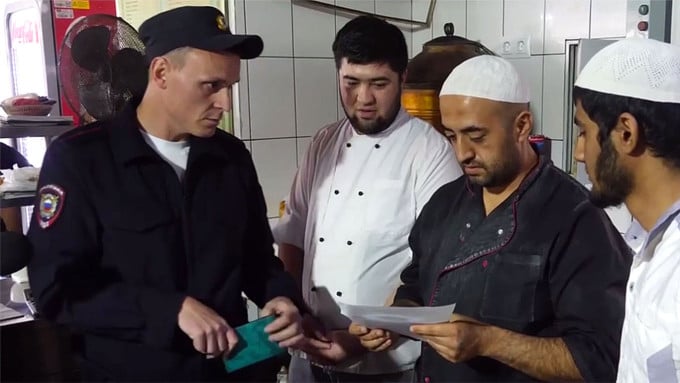
Russian officials issue conscription orders to migrant workers in Chelyabinsk. Photo: 31tv.ru
"It's not just those who are already Russian citizens who have to register for military service. They force everyone brought to the police station after each raid to sign a conscription contract," Chupik said, adding that many of her clients reported being pressured to sign contracts with the Russian Ministry of Defense when going through the required residency procedures.
According to an intelligence report released by the UK Ministry of Defence on September 5th, the Russian military is increasing its recruitment of immigrants from Central Asia and neighboring countries to bolster its military operations in Ukraine. "There are at least 6 million immigrants from Central Asia in Russia, and the Kremlin considers them potential recruits," the report stated.
Since launching its military campaign in Ukraine, Russia has enacted several laws aimed at encouraging immigrants to enlist. In May, President Vladimir Putin signed a decree simplifying the naturalization process for foreign citizens who agree to serve in the Russian military during the conflict in Ukraine.
The UK Ministry of Defence said Russia's goal was to avoid having to issue a mobilization order ahead of next year's elections. Last September, Moscow issued a partial mobilization order, deploying more than 300,000 troops from its reserves to supplement its military operation in Ukraine. This mobilization represents just over 1% of Russia's total mobilization potential of 25 million people.
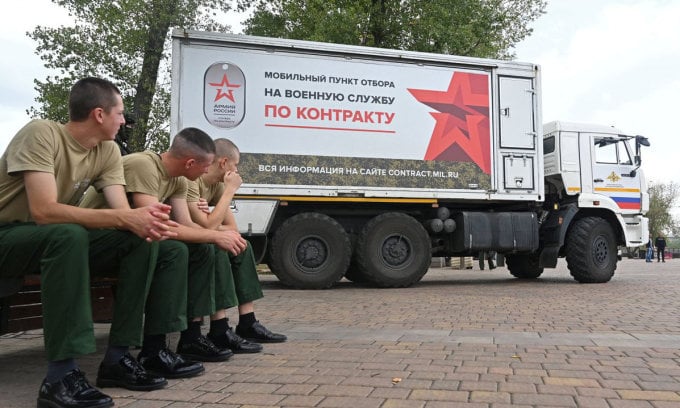
A Russian mobile recruitment center in the city of Rostov-on-Don on September 17, 2022. Photo: Reuters
In June, Putin said Russia had no plans to impose another round of military mobilization. Last week, Russian Security Council Deputy Chairman Dmitry Medvedev said that 280,000 people had signed contracts to join the Russian army since the beginning of the year, some of whom are reserves and volunteers.
"The mobilization of newly naturalized immigrant workers allows Russia to replenish its manpower in the face of increasing setbacks on the battlefield, without having to issue a mobilization order," the UK Ministry of Defence said.
On September 6, Russia confirmed a "tactical withdrawal" from Rabotino, a strategically important village on Russia's first line of defense in Zaporizhzhia, more than a week after Ukraine declared control of the village. This is considered a major victory for Kyiv, allowing Ukrainian troops to open a crucial route to advance further south, cutting off Russia's land corridor connecting the Crimean Peninsula with the Donbass region.
However, experts still assess Ukraine's counteroffensive progress as slow, due to Russia's preparation of a complex network of defensive lines and the deployment of well-trained forces to counter it. On September 5, President Putin declared that Ukraine's counteroffensive "had failed," while the Russian Ministry of Defense stated that Ukraine had lost more than 5,600 soldiers in the previous week alone.
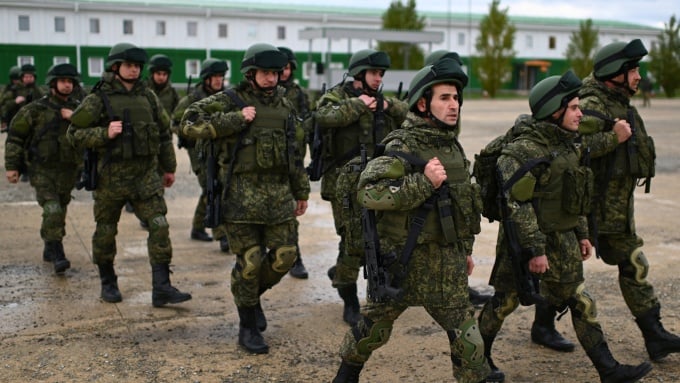
Russian reservists from Rostov departed for Ukraine in late 2022. Photo: Reuters
According to the UK Ministry of Defence, in addition to immigrants, Russia is also increasing its recruitment of mercenaries from neighboring countries such as Armenia and Kazakhstan, promising monthly salaries of 190,000 rubles (nearly $2,000) plus a "signing bonus" of 495,000 rubles (over $5,000), significantly higher than the average compensation.
Russia has not commented on the information, but has previously stated that British intelligence reports are false.
The Russian economy has long relied on immigrant labor, who are willing to take on low-paying jobs that locals rarely do, such as construction workers, fruit vendors, or street cleaners.
Russia experienced a "brain drain" of migrant workers during the Covid-19 pandemic, when more than 5 million people, equivalent to half of Russia's migrant population, left the country due to the impact of the disease.
The number of migrants leaving Russia continues to rise sharply after Moscow launched its campaign in Ukraine and was subjected to Western sanctions. Russian government statistics show that approximately 4 million migrants arrived in Russia for work in 2022.
However, the flow of immigrants to Russia is declining due to the sharp depreciation of the ruble. Experts believe that the Russian military's increased recruitment of immigrants, coupled with the weakening economy caused by sanctions, will lead to a continued decline in the number of foreign workers in Russia in the coming period.
"Sending money home is already difficult, and with incomes no longer what they used to be, a decrease in the number of immigrants is inevitable," said Temur Umarov, an expert at the Carnegie Endowment for International Peace.
Pham Giang (Based on Moscow Times, SCMP, Newsweek )
Source link
![[Photo] Prime Minister Pham Minh Chinh receives Lao Minister of Education and Sports Thongsalith Mangnormek](/_next/image?url=https%3A%2F%2Fvphoto.vietnam.vn%2Fthumb%2F1200x675%2Fvietnam%2Fresource%2FIMAGE%2F2025%2F12%2F16%2F1765876834721_dsc-7519-jpg.webp&w=3840&q=75)
![[Photo] Prime Minister Pham Minh Chinh receives the Governor of Tochigi Province (Japan)](/_next/image?url=https%3A%2F%2Fvphoto.vietnam.vn%2Fthumb%2F1200x675%2Fvietnam%2Fresource%2FIMAGE%2F2025%2F12%2F16%2F1765892133176_dsc-8082-6425-jpg.webp&w=3840&q=75)
![[Live] 2025 Community Action Awards Gala](/_next/image?url=https%3A%2F%2Fvphoto.vietnam.vn%2Fthumb%2F1200x675%2Fvietnam%2Fresource%2FIMAGE%2F2025%2F12%2F16%2F1765899631650_ndo_tr_z7334013144784-9f9fe10a6d63584c85aff40f2957c250-jpg.webp&w=3840&q=75)
![[Image] Leaked images ahead of the 2025 Community Action Awards gala.](/_next/image?url=https%3A%2F%2Fvphoto.vietnam.vn%2Fthumb%2F1200x675%2Fvietnam%2Fresource%2FIMAGE%2F2025%2F12%2F16%2F1765882828720_ndo_br_thiet-ke-chua-co-ten-45-png.webp&w=3840&q=75)































































Comment (0)