

Story number one
The story is taken from a conversation between writer Son Nam and Ms. Huong, the Vietnamese literature teacher, in the work "The Summer of Petrus" by writer Le Van Nghia.
In his presentation about the writer Son Nam, Dung, a 7th-grade student, included details not found in the textbook about the writer's biography, such as his debts for coffee and cigarettes, his unattractive appearance, and his sloppy clothing. His friends were surprised and thought Dung was making things up. She commented, "It's rare to meet a writer like Son Nam!", and remarked that the presentation had unintentionally offended the writer. As a result, Dung did not receive a high score for his presentation.
According to a friend's account, writer Son Nam went to see Ms. Huong to "clear Dung's name." From then on, she knew that the details her student mentioned were completely accurate because Dung met the writer almost every day while helping his father with typeset work at the printing house. Ms. Huong is truly admirable for frankly admitting her mistake to her student.
This is civilized behavior that helps students respect their teachers and builds greater trust with them.
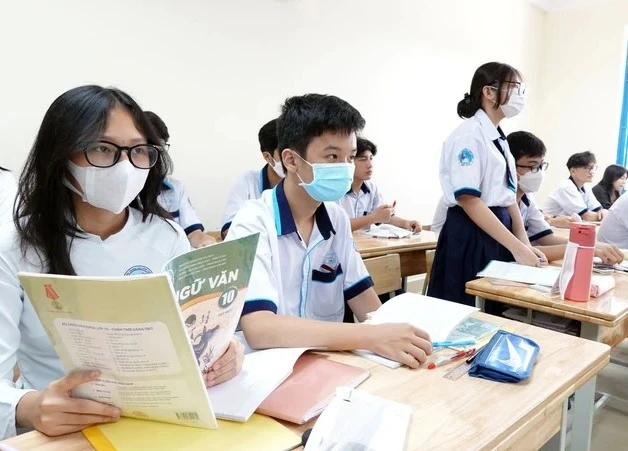
In civilized conduct, a teacher knows how to admit their mistakes if they are wrong.
ILLUSTRATIVE PHOTO: DAO NGOC THACH
Second story
"I was wrong not to give you a grade on this question. I apologize and thank you, because this incident has given me more knowledge and experience in my teaching." The literature teacher's apology to his student was met with applause from the students.
During a recent lesson, a question was posed asking students to find regional dialect words used to describe an object or event. One student answered that the word "bone" (xương) is synonymous with "carrying" (gánh), but the teacher deemed the answer incorrect. Being from Central Vietnam, the student explained to the teacher: "In Quang Tri , my maternal grandparents' hometown, people usually call 'carrying' 'bone' (xương)."
The student even cited lyrics from the song "Who Remembers Whom?" by composer Hoang Thi Tho: "My old mother's hair is as white as frost, burdened by life's debts, her shoulders hunched with pain in countless ways." After verifying the information, the teacher came up with a reasonable and appropriate solution as described above.
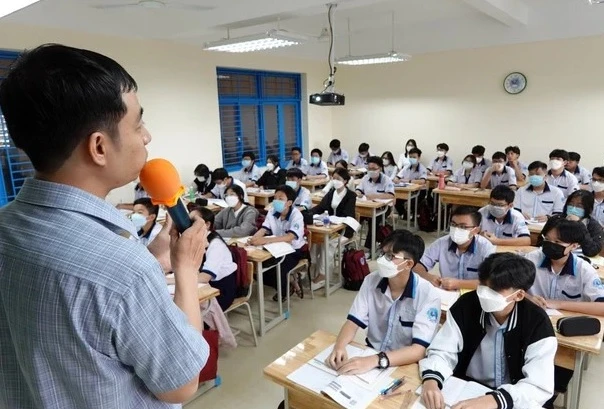
Teachers must constantly improve their knowledge to confidently stand in front of the class and build trust in the eyes of their students.
ILLUSTRATIVE PHOTO: DAO NGOC THACH
As a teacher, I appreciate the civilized way the teachers handled the two aforementioned pedagogical situations. Clearly, the explosion of information technology means that schools are no longer the only places where students receive knowledge.
For diligent and inquisitive students, knowledge can sometimes surpass even the teacher's understanding. This requires teachers to constantly improve their knowledge to confidently teach in the classroom and build trust in the eyes of their students.
If students have opinions or observations that differ from the textbook, teachers should consider this before giving feedback. If necessary, teachers can ask students to provide evidence to clarify their statements.
More importantly, it's crucial to help students identify authentic information from the data they gather. When trust is established between teacher and student, the process of receiving and transmitting knowledge becomes much smoother.
Students' learning activities are closely linked to their personality development. Teachers must be flexible in their pedagogical approach to help students learn to reason and solve problems logically in order to acquire and accumulate knowledge, while also knowing how to admit their mistakes to maintain a positive image in the eyes of their students and parents.
Whenever I have to deal with situations involving students or parents' questions, I always think of the two stories above to minimize impulsiveness and reduce negative ego in the teaching environment.
Forum "Civilized Behavior in Schools"
Following the controversial behavior of students and their teacher in class 7C at Van Phu Secondary School (Van Phu commune, Son Duong district, Tuyen Quang province), Thanh Nien Online is launching a forum titled "Civilized Behavior in Schools" with the hope of receiving shared experiences, recommendations, and opinions from readers to gain a complete and comprehensive understanding; helping teachers, students, and parents to behave in a civilized and appropriate manner in today's school environment.
Readers can submit articles and opinions to thanhniengiaoduc@thanhnien.vn. Selected articles will receive payment according to regulations. Thank you for participating in the forum "Civilized Behavior in Schools".
Source link


![[Photo] General Secretary To Lam receives the Special Envoy of General Secretary and President of China Xi Jinping](/_next/image?url=https%3A%2F%2Fvphoto.vietnam.vn%2Fthumb%2F1200x675%2Fvietnam%2Fresource%2FIMAGE%2F2026%2F01%2F30%2F1769759383835_a1-bnd-5347-7855-jpg.webp&w=3840&q=75)


![OCOP during Tet season: [Part 3] Ultra-thin rice paper takes off.](/_next/image?url=https%3A%2F%2Fvphoto.vietnam.vn%2Fthumb%2F402x226%2Fvietnam%2Fresource%2FIMAGE%2F2026%2F01%2F28%2F1769562783429_004-194121_651-081010.jpeg&w=3840&q=75)

![OCOP during Tet season: [Part 2] Hoa Thanh incense village glows red.](/_next/image?url=https%3A%2F%2Fvphoto.vietnam.vn%2Fthumb%2F402x226%2Fvietnam%2Fresource%2FIMAGE%2F2026%2F01%2F27%2F1769480573807_505139049_683408031333867_2820052735775418136_n-180643_808-092229.jpeg&w=3840&q=75)



Comment (0)