

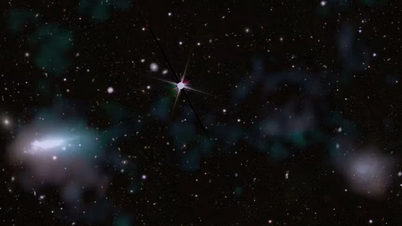
This groundbreaking discovery was made in SPT0418-47, a dust-shrouded galaxy that existed when the universe was only about 10% of its current age.
According to Sci-News , a research team led by Professor Joaquin Vieira from the University of Illinois at Urbana-Champaign (USA) analyzed data from James Webb (developed and primarily operated by NASA). They discovered the presence of polycyclic aromatic hydrocarbons (PAHs) within galactic dust particles that are glowing at infrared wavelengths.
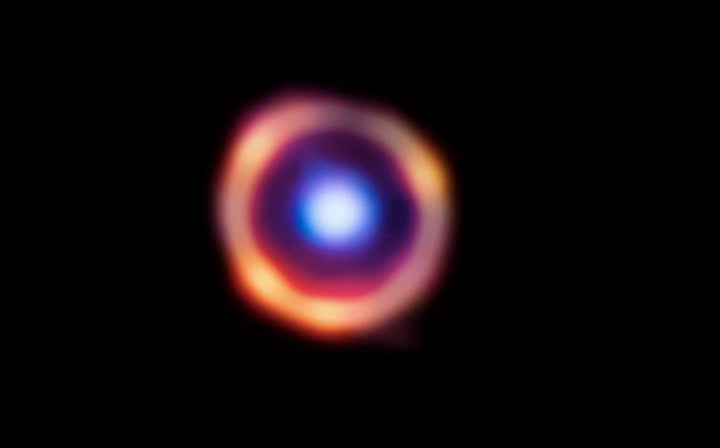
The red galaxy SPT0418-47, with its organic molecules glowing in orange light, is highlighted in blue in the foreground. (Image: NASA/ESA/CSA)
SPT0418-47 is located 12 billion light-years from Earth, meaning it would take 12 billion years for light to travel from it to Earth. This means we are looking at an image of this galaxy from 12 billion years ago, in a region of the universe from the distant past.
Therefore, the PAHs it possesses—complex organic molecules that form the basis of life today—are also the oldest organic molecules that humanity has ever found.
Spectroscopic data from the galaxy also shows that the interstellar gas within it is enriched with heavy elements. This means the galaxy has undergone a very long period of intense activity, with many generations of stars being born and dying, according to the paper published in the scientific journal Nature.
The principle of the universe's evolution—initially consisting of only a few meager elements—is that more and more elements are created by "reactors" in the nuclei of stars. When a star reaches the end of its life cycle and explodes, it adds new elements, making the chemical composition of the universe increasingly diverse.
Therefore, this study also adds to the growing evidence that the universe evolved very rapidly in its early stages, a horizon that scientists are always eager to explore further in order to explain our own existence.
At the same time, it also led to a new method for exploring the past, through dust particles around galaxies, which have absorbed half of the radiation emitted from nearby stars throughout history and glow under the lenses of infrared observatories.
(Source: Nguoi Lao Dong Newspaper)
Beneficial
Emotion
Creative
Unique
Source





























































































Comment (0)