

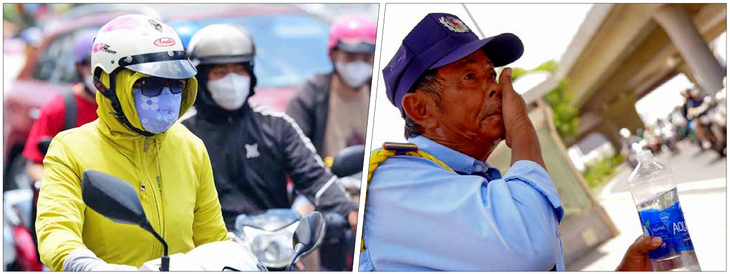
In recent days, Ho Chi Minh City has experienced a severe heatwave with very high UV index levels - Photo: DUYEN PHAN, AN VI
How to avoid getting sick? Secrets to avoiding ultraviolet rays.
Falling ill from being out in the midday sun.
Although summer hasn't officially arrived, the weather in Ho Chi Minh City and the Southern region has been quite unpleasant in recent days. During the day, the intense sunlight lasts from early morning until late afternoon, making outdoor activities a significant challenge.
The heat becomes more severe in urban areas due to heat absorption from tall buildings, roads, and vehicles. In recent days, the highest daily temperature recorded has reached 36.5°C, and in some outdoor areas, the temperature has nearly reached 40°C.
From 10 AM to 3 PM is when ultraviolet rays reach their highest intensity (level 8-10), causing a burning sensation when the skin is directly exposed to sunlight.
Besides the heat radiating from traffic and buildings, the stifling air makes people feel even more uncomfortable. Along the city center, many cafes and food shops have to use misting systems to reduce the heat.
Mr. Thanh Tu, an online book seller in Binh Thanh District, said that due to the nature of his work, he packs and ships books whenever customers can conveniently receive them (delivery radius within inner city districts). For two consecutive days, customers requested book deliveries during lunchtime, forcing him to travel over 15km round trip from Binh Thanh to Tan Binh, and on some days even to Thu Duc City under the scorching sun of Ho Chi Minh City, which caused him to fall ill.
"Even though I was wearing a hat and jacket like everyone else, the heat just kept penetrating my skin. Especially when I stopped at a red light, the heat from the road surface burned my legs. Following my habit of turning on the air conditioner to cool down after being out in the sun, I unexpectedly caught a cold and had a fever for a whole week," Mr. Tú shared.
Besides causing colds and fevers, skin diseases are also a consequence of heatwaves that anyone can experience.
Ms. Ngoc Lan (residing in Thu Duc City, Ho Chi Minh City) said that her skin is already sensitive due to a prolonged acne treatment before Tet (Lunar New Year). In recent days, even though the school is only a few kilometers from her home, when she takes her children to and from school at lunchtime, she feels a burning sensation and redness all over her face upon returning home. She had to visit dermatology clinics for a skin check-up after a week of sun exposure.
It is necessary to limit sun exposure during peak hours.
Dr. Vu Thi Phuong Thao, head of Clinical Department 1 at the Ho Chi Minh City Dermatology Hospital, said that according to the US Environmental Protection Agency (EPA), the ultraviolet (UV) index is divided into different levels, and each level poses different health risks.
Levels 8-10 (very high) indicate a high risk of severe skin damage and rapid burns. Levels 11+ (dangerous) cause rapid skin and eye damage and increase the risk of skin cancer .
According to the Ho Chi Minh City Center for Disease Control (HCDC), common health problems during hot weather include sunstroke, heatstroke, and stroke.
The main causes of these conditions are primarily prolonged exposure to hot weather without rest or adequate hydration, or sudden temperature changes from cool to intensely hot environments. Groups particularly vulnerable to heat stress include the elderly, children, pregnant women, outdoor workers, and those with chronic illnesses.
To prevent heat-related illnesses, the HCDC (Ho Chi Minh City Center for Disease Control) advises people to pay attention to getting adequate rest and maintaining a healthy diet. If you are in an air-conditioned environment, allow your body time to adapt to the outside temperature before going outdoors.
In addition, diet plays a very important role; people should increase their consumption of green vegetables, fruits, and soups in their daily meals. They should also drink enough water, at least 1.5-2 liters per day. Avoid excessive consumption of coffee or alcoholic beverages. Regular exercise and strengthening the immune system will help maintain good health.
Avoid sudden temperature changes.
The Ministry of Health advises limiting exposure to direct sunlight during peak hours. In particular, those who frequently stay in air-conditioned rooms with low temperatures should avoid sudden exposure to direct sunlight.
Before going outside, allow your body time to gradually adapt to the outdoor environment by increasing the air conditioning temperature in the room or resting in the shade.
First aid for heatstroke and heat exhaustion.
According to the Ministry of Health , heatstroke and heat exhaustion usually begin with symptoms such as dizziness, muscle cramps, heat exhaustion, and loss of the ability to exert oneself.
Without prompt medical attention, the condition can become serious, leading to heat stroke, with body temperature exceeding 40°C, along with symptoms such as headache, dizziness, blurred vision, mental disturbance, confusion, and disorientation.
For mild cases, have the victim lie down with their head lower than their body in the shade, remove some clothing, and cool their body. Fluid and electrolyte replacement is necessary.
For moderate cramps, stop all activity and allow the victim to rest. Gently massage the affected muscles and continue with fluid and electrolyte replacement.
In severe cases, move the victim to a cool, well-ventilated area, remove their clothing, and call for medical assistance. Immediately apply measures to lower body temperature, such as applying cool compresses, or if the temperature is above 40°C, remove clothing and immerse the body in cold water below 20°C for 20 minutes. If the condition does not improve, quickly transport the victim to the nearest medical facility.
The Ministry of Health advises limiting exposure to direct sunlight during peak hours. In particular, those who frequently stay in air-conditioned rooms with low temperatures should avoid sudden exposure to direct sunlight. Before going outside, allow your body time to gradually adapt to the outdoor environment by increasing the air conditioning temperature in the room or resting in the shade.
Source: https://archive.vietnam.vn/nang-nong-gay-gat-chu-y-dung-de-say-nang-say-nong-hay-dot-quy/



























































































Comment (0)