

According to doctors, the patient's wound was located close to the transverse venous sinus; if the injury had deviated by just a few millimeters, the patient's life could have been in danger.
Recently, the Central Military Hospital 108 received a male student with a traumatic brain injury caused by a key deeply embedded in his head, penetrating the skull and reaching approximately 3 cm into the brain tissue. The patient was brought to the hospital by his family in a conscious state, experiencing significant pain at the injured area, and the bleeding had stopped.
Upon receiving the patient, the doctors promptly conducted an examination, performed a CT scan, and carried out necessary tests to assess the damage. After consultation, the patient was scheduled for emergency surgery to remove the foreign object from the head.
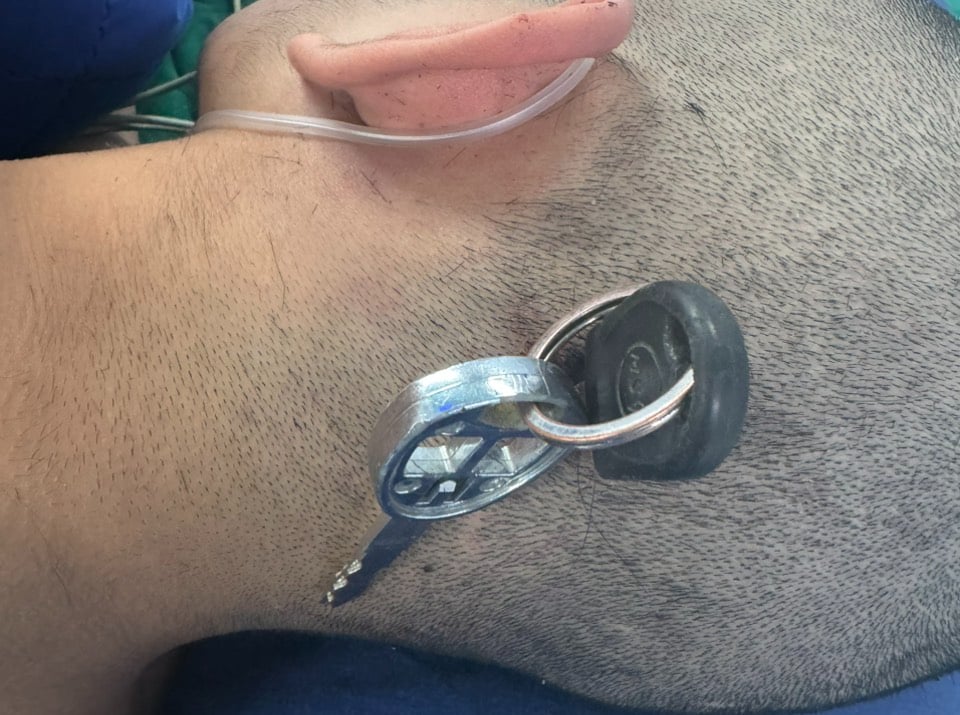
The patient was brought to the hospital with a key stuck deep in his head. Photo: Hospital provided.
Colonel Dr. Do Khac Hau – Deputy Head of the Neurosurgery Department, Central Military Hospital 108, said: The surgery was successful, completely removing the foreign object without causing further serious damage to the patient. In particular, the wound was located close to the transverse venous sinus; if the injury had been even a few millimeters further, the patient's life could have been in danger due to sinus damage causing bleeding. After intensive treatment, the patient recovered well and was discharged from the hospital.
Based on this case, experts advise that school-aged children are very active and sometimes not fully aware of the risks of injury in their daily lives. To minimize unfortunate accidents, parents, teachers, schools, and community health facilities need to regularly remind and equip children and students of all ages with safety knowledge.
Some important measures include: Educating children on accident prevention skills and providing basic first aid instruction so they can protect themselves. Increased supervision at home and on school grounds, especially in playgrounds, stairwells, and hallways.
In addition, remove sharp objects and potential hazards from daily living and play/learning environments. Guide children to avoid dangerous games that could cause injury to minimize the risk of accidents.
Source: https://giadinh.suckhoedoisong.vn/nam-sinh-di-cap-cuu-vi-bi-chia-khoa-cam-sau-vao-dau-172250312151554593.htm
































































































Comment (0)