

Satellite data analyzed by Brazil's National Institute for Space Research (Inpe) has recorded 346,112 wildfire hotspots this year across all 13 South American countries, surpassing the previous record of 345,322 in 2007.
This week, massive wildfires continued to rage along roads in the heart of Brazil's Amazon rainforest. Smoke rose and mingled with wildfire haze that stretched diagonally across the continent, from Colombia in the northwest to Uruguay in the southeast, darkening the skies above cities like Sao Paulo.
Brazil and Bolivia have deployed thousands of firefighters to try to control the blazes, but much remains dependent on the weather. Scientists say that while most of the fires are man-made, recent hot and dry conditions due to climate change are causing them to spread more rapidly.
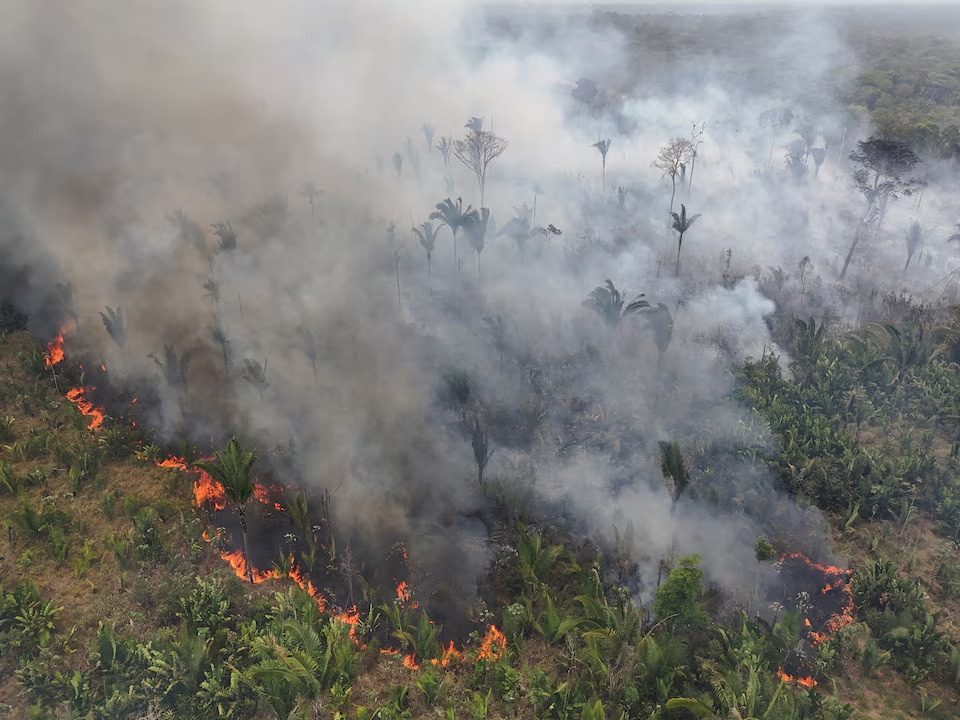
Smoke rises from a forest fire in the Amazon, Brazil, on September 4. Photo: Reuters
South America has been experiencing a series of heatwaves since last year. "We've never had a winter," Karla Longo, an air quality researcher at Inpe, described the weather in Sao Paulo in recent months. Although it is still winter in the Southern Hemisphere, temperatures in Sao Paulo have remained above 32 degrees Celsius since September 7th.
Ms. Longo stated that the Amazon wildfires also create extremely dense smoke due to the high density of burned vegetation. Approximately 9 million square kilometers of South America, equivalent to half the continent's area, are sometimes covered in smoke. Bolivia's capital, La Paz, is also shrouded in similar haze.
According to Inpe data, the largest number of fires this month were in Brazil and Bolivia, followed by Peru, Argentina, and Paraguay. Unusually intense fires in Venezuela, Guyana, and Colombia earlier in the year contributed to this record, but have largely subsided since then.
According to the national disaster monitoring agency Cemaden, the drought in Brazil that began last year has become the worst drought ever recorded.
Drought researcher Ana Paula Cunha in Cemaden said: "Overall, the 2023-2024 drought is the most severe, longest-lasting in some areas, and most widespread drought in recent history, at least according to data since 1950."
Hundreds of people marched in the highlands of La Paz, Bolivia's capital, demanding action to extinguish the wildfires. "Please realize the seriousness of what is happening in this country; we have lost millions of hectares," said Fernanda Negron, an animal rights activist at the protest. "Millions of animals have been burned to death."
Sao Paulo, the most populous city in the Western Hemisphere, had the worst air quality globally earlier this week, surpassing well-known pollution hotspots like China and India, according to IQAir.com.
Exposure to smoke increases the number of people hospitalized for respiratory problems and can cause thousands of premature deaths. According to a 2023 study, inhaling wildfire smoke contributes to an average of 12,000 premature deaths each year in South America.
Ngoc Anh (according to Reuters)
Source: https://www.congluan.vn/nam-my-vuot-qua-ky-luc-ve-chay-rung-post312170.html











































































































Comment (0)