

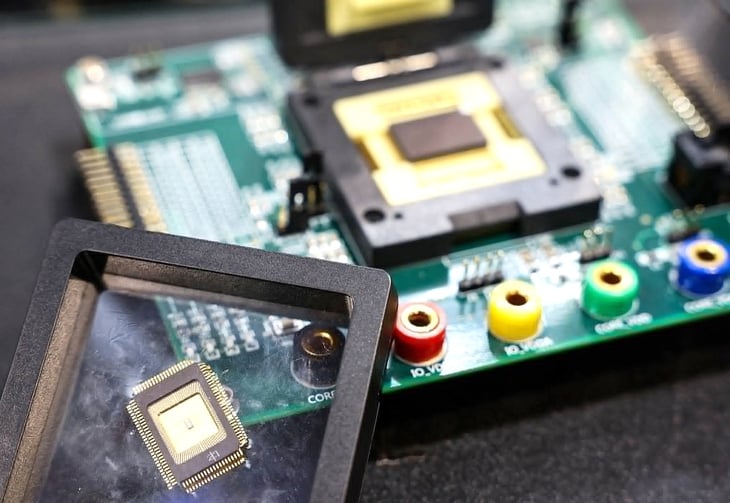
A semiconductor chip manufactured by TSMC is displayed at the Cybersec 2025 conference and exhibition in Taipei on April 15 - Photo: AFP
Washington's goal in further tightening the ban on chip exports to China is not only to curb Beijing's ambitions to lead in artificial intelligence (AI), but also to accept sacrificing the interests of American corporations in order to maintain its dominance.
A blow to Nvidia.
Considered one of the biggest victims of the US-China trade war, Nvidia announced on April 16 that it could incur losses of up to $5.5 billion in its first-quarter financial report, after the Washington administration imposed new restrictions on AI chip exports to China – one of the company's most important markets.
Accordingly, the H20 chip – designed by Nvidia specifically for the Chinese market and to comply with previous export controls – will require a special license if it is to continue being sold in the country. Reuters quoted Nvidia as saying the new regulation will be in effect "indefinitely".
Immediately after the news broke, Nvidia's stock fell nearly 7% by the close of trading that day, wiping out more than $148 billion in market value.
The wave of sell-offs in chip industry stocks quickly spread. In Asia, South Korean semiconductor companies such as Samsung Electronics and SK Hynix fell by as much as 3% overnight.
Meanwhile in Europe, shares of ASML, the Dutch semiconductor manufacturer, fell 5% in early morning trading after CEO Christophe Fouquet warned: "Recent tax announcements have increased uncertainty in the macroeconomic environment, and the situation will remain volatile for some time."
ASML also reported that orders in the first financial quarter totaled only €3.94 billion – about €1 billion less than investors' expectations.
Dan Ives, global technology research director at Wedbush Securities, led a group of analysts who noted that while the specific financial impact might not be severe given Nvidia's overall scale, the new controls represent a "strategic blow" that seriously complicates the company's efforts to maintain relationships with its Chinese customers.
"New information suggests Nvidia is facing significant hurdles in selling its products to China, as the Trump administration appears to have realized that one company – and one chip – is leading the AI revolution, and that company is Nvidia," the analysts wrote in a report published on April 15.
Michael Ashley Schulman, investment director at Running Point Capital, also agreed that the decision to restrict H2O chip exports reflects the increasing geopolitical instability engulfing the technology and semiconductor sectors.
"Especially under the kind of reversal policies seen during the Trump era, this uncertainty throws businesses and investment markets into disarray – as clearly demonstrated by the sharp drop in Nvidia shares and the widespread pressure on chip stocks on April 16," he said.
TSMC is an exception.
Amidst the semiconductor industry facing headwinds from geopolitical instability and protectionist policies, TSMC appears to be a notable exception.
According to financial reports released on April 16, the Taiwanese chip giant achieved a net profit of NT$361.56 billion (approximately US$11.1 billion) in the first quarter of 2025, a remarkable 60.3% increase compared to the same period last year.
TSMC is currently the main manufacturing partner for major names like Apple, AMD, and even Nvidia itself – meaning that while Nvidia worries about being blocked from selling its products, TSMC continues to manufacture chips for Nvidia on order from American companies or third parties.
TSMC's "neutral" position – neither an American company nor blacklisted in China – allows it to serve both sides of the tech war.
Of course, that position didn't come about by chance. According to the New York Times, TSMC is the central pillar of the global chip supply chain – an ecosystem built over more than 40 years with tens of billions of dollars in investment, thousands of highly skilled engineers, and a network of partners spanning continents.
In this cross-border collaboration model, American companies are responsible for chip design, TSMC handles manufacturing, Japan supplies silicon wafers, the Netherlands provides lithography machines, and China and Malaysia are responsible for testing and assembly. Each link is closely interconnected and not easily replaced.
Lita Shon-Roy, managing director at chip materials consulting firm Techcet, likens the chip supply chain to a multi-layered labyrinth, where materials can be refined in one country, blended in another, and manufactured in a third.
Given the high degree of interdependence and interconnectedness, each step of imposing tariffs or banning exports risks increasing costs, disrupting supply chains, and driving up the prices of consumer products—from smartphones and laptops to AI servers.
Therefore, although both the US and China are pushing forward with strategies to localize chip production, this process is by no means easy. Recreating the technical workforce, manufacturing management culture, and the ability to coordinate global supply chains cannot happen overnight.
For China, the problem is even more complex, as the country remains heavily reliant on Western technology. In the short term, Beijing's exemption of import tariffs on chips from Taiwan could be a way to buy time to prepare and maintain the flow of technology for strategic sectors such as AI, cloud computing, and defense.
As for the US, if it continues to tighten the ban, companies like Nvidia could lose one of their biggest growth markets. But if it loosens controls, the risk of technology falling into the hands of geopolitical rivals cannot be underestimated.
This tug-of-war has made semiconductor chips one of the most complex sticking points in current US-China relations, where every policy decision has global consequences.
Source: https://tuoitre.vn/my-trung-giang-co-ve-chip-ban-dan-20250419063932389.htm

![[Image] A night of light, many layers of message](https://vphoto.vietnam.vn/thumb/1200x675/vietnam/resource/IMAGE/2026/03/10/1773158812907_hoa-nhac9-jpg.webp)

























































































Comment (0)