

Amidst continued limitations on internet connectivity in many areas of the US, President Joe Biden has just announced a new investment of $42 billion to expand access to high-speed internet nationwide.
The Washington Post reported that the investment, announced by President Joe Biden at the White House on June 26 (local time), aims to provide broadband internet access to all 50 states and territories by 2030. The investment is part of the Broadband Access and Determination Program and is included in the $1 trillion infrastructure investment law that Biden signed in 2021. “This is the largest investment ever in high-speed internet. In today’s economy , everyone needs internet to work, and access to the internet is as important as electricity, water, or other basic services,” President Joe Biden told reporters at the White House.
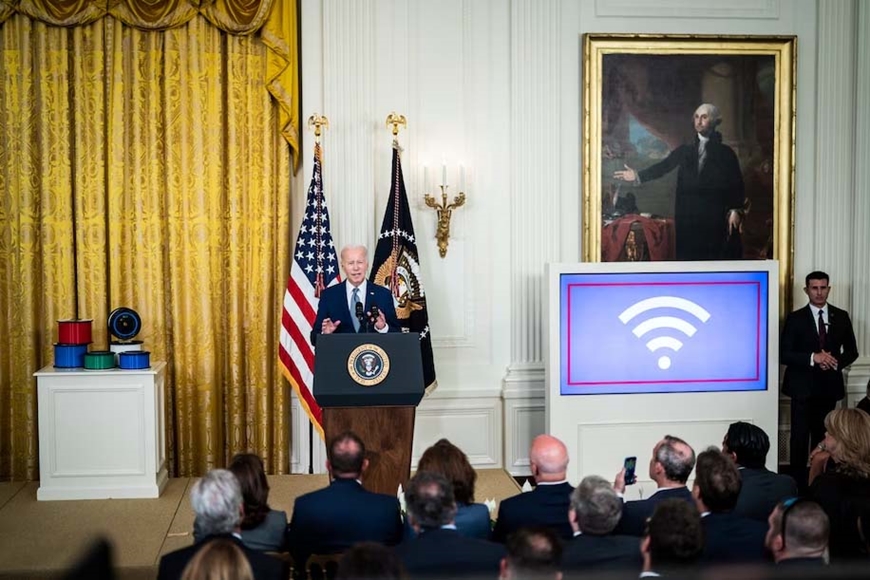 |
President Joe Biden announced the investment in high-speed internet on June 26. Photo: The Washington Post |
However, the aforementioned $42 billion will not be distributed evenly but will be allocated based on internet coverage maps, with each state receiving at least $107 million. The two most populous states in the US, Texas and California, will receive the largest investments, with $3.1 billion and $1.9 billion respectively. More sparsely populated states such as Virginia, Alabama, and Louisiana are also among the top 10 receiving funding due to their large rural areas and less internet connectivity compared to urban centers. It is expected that by the end of this year, states will submit their broadband infrastructure plans and receive approximately 20% of the funding upfront. The remaining funds will be disbursed by the US government later. “What’s really important is that we don’t leave any community behind in this project,” emphasized Brandy Reitter, CEO of the Colorado Office of Broadband Services.
To date, many locations in the United States still have limited broadband internet access. According to Reuters, telecommunications companies such as Verizon, Comcast, Charter Communications, and AT&T are hesitant to provide internet to rural and sparsely populated areas due to high investment costs and limited potential subscriber numbers. US Vice President Kamala Harris added that 24 million Americans still lack access to high-speed internet due to insufficient monthly funds or because they live in areas not fully connected to fiber optic networks. This issue has drawn public attention since the COVID-19 pandemic, which forced many American students to learn online.
The investment recently announced by President Joe Biden is expected to provide 8.5 million households and businesses in the United States with access to high-speed internet infrastructure.
The Washington Post noted that the internet is a safe solution that helps many Americans work, study, shop, and stay in touch with loved ones. A 2021 survey by the Pew Research Center showed that 60% of low-income customers said they frequently encountered problems using online services during the Covid-19 pandemic due to slow internet speeds. Additionally, nearly half of those surveyed complained of anxiety about whether they could afford their monthly internet bills.
ANH VU
Source
![[Photo] Conference announcing the Politburo's Decision on organizational and personnel matters](https://vphoto.vietnam.vn/thumb/1200x675/vietnam/resource/IMAGE/2026/04/01/1775017881825_bnd-2410-1472-jpg.webp)











![[Video] Viettel officially puts Vietnam's largest undersea fiber optic cable line into operation.](https://vphoto.vietnam.vn/thumb/402x226/vietnam/resource/IMAGE/2025/4/17/f19008c6010c4a538cc422cb791ca0a1)




























































































Comment (0)