


The renewed tensions between Wagner and Chechen forces exposed rifts within the Russian military ahead of the Ukrainian counteroffensive.
Earlier this week, forces from the Russian private security group Wagner began withdrawing from the city of Bakhmut in the Donetsk region to make way for Chechen forces under General Ramzan Kadyrov.
In a statement on Telegram, Wagner leader Yevgeny Prigozhin poured cold water on Chechen forces, suggesting they would find it difficult to control the entire Donetsk province. Moscow declared the annexation of the province, which it calls the Donetsk People's Republic (DPR), to Russia, but does not yet control the entire territory.
"I think they have enough forces to liberate many towns and villages in the DPR, but it will be difficult to liberate everything. They will only be able to control certain areas," Prigozhin said of the Chechen forces.
Wagner's comments immediately sparked outrage among those loyal to the Chechen leader, including longtime ally Adam Delimkhanov.
"You don't understand and don't need to understand, Yevgeny. You can contact me anytime and tell me where we can meet, so I can explain anything you don't know," Delimkhanov said in a video posted on Telegram.
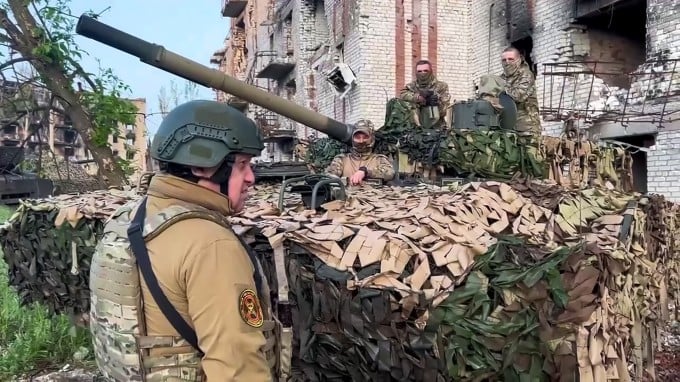
Wagner leader Yevgeny Prigozhin speaks with soldiers in Bakhmut in a photo released on May 25. Photo: AFP
Magomed Daudov, another loyalist of Kadyrov, sharply criticized Prigozhin. "He doesn't need to know the details of our mission. Our commander knows enough," he said.
Daudov also condemned Prigozhin's complaints to the Russian Ministry of Defense . "Our soldiers also have problems, but that doesn't mean they have to shout about it. He always implies in his statements that someone needs to be shot. Sometimes I don't understand what he wants to achieve with those daily comments," he said, accusing Prigozhin of sowing "a mood of panic among the population."
"Don't forget who you owe your private military company, planes, helicopters, and other things to," Daudov said. "Send me your location. Anytime, anywhere, we'll meet and talk frankly like men."
Kadyrov became the leader of the Chechen Republic within Russia in 2007. Like Prigozhin, he often described himself as fiercely loyal to Putin.
In the early months of Russia's campaign in Ukraine, Kadyrov worked to promote Chechen forces as the core of the Russian operation. Two days after the campaign began, he announced that his forces had reached the front lines.
Since then, Kadyrov has consistently posted updates and videos on social media about Chechen soldiers participating in various combat and humanitarian relief operations in Ukraine, as well as the combat achievements of Russian forces.
This is not the first time Chechen forces have been deployed to conflicts in which the Russian military is involved. They previously participated in the 2008 conflict in Georgia and the war in Syria. Observers believe that the deployment of Chechen fighters to Ukraine is an act demonstrating Kadyrov's loyalty to the Kremlin.
However, the image of the Chechen forces has become less prominent since Wagner's role gained more attention last September, when Russian troops were forced to retreat in the face of a Ukrainian counteroffensive. Wagner achieved several widely praised advances, bringing the forces into the spotlight on Russian television. This also helped Prigozhin increase his influence within the country's political circles.
Wagner subsequently played an increasingly prominent role in the offensive against Bakhmut. However, his criticisms of the Russian military leadership strained relations between the two sides.
Prigozhin criticized the Russian Ministry of Defense for "stealing Wagner's victory," calling Russian commanding officers "incompetent" and criticizing them for not supplying his forces with ammunition. In response to Prigozhin's escalating attacks, the Russian military appeared to seek to diminish Wagner's influence.
The deployment of Chechen troops, who are part of the National Guard but operate under Kadyrov's direct command, could weaken Prigozhin's position both on the battlefield and in Russian society, according to observers.
The use of Kadyrov's forces to replace Wagner's troops could escalate the rivalry between the two military leaders, who last year joined forces to criticize the Russian Defense Ministry as regular forces repeatedly failed to reinforce the front lines and allowed Ukrainian forces to gain a significant advantage.
"The Kremlin may be trying to sever ties between Kadyrov and Prigozhin, as well as reassert Russian authority through Chechen forces," an article by the Institute for the Study of War (ISW) earlier this week stated.
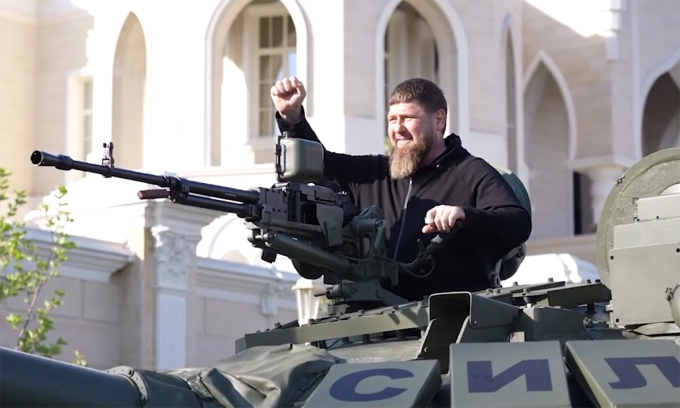
General Ramzan Kadyrov, leader of the Chechen Republic of Russia, on a T-72 tank on May 16. Photo: Telegram/RKadyrov_95
Chechen leader Ramzan Kadyrov said in February that he wanted to "compete" with Wagner founder and establish his own private security company. "When my duty to the country is fulfilled, I seriously plan to compete with my brother Yevgeny Prigozhin and establish a private security company. I think everything will go smoothly," he said.
In the newly erupted tensions, a senior member of Wagner even recalled history to warn Chechen forces. Following the collapse of the Soviet Union, the First Chechen War took place between the Russian Federation and the Chechen Republic in 1994-1996, when the Chechen autonomous government declared independence, seceding the region from Russia.
Akhmad Kadyrov, Ramzan's father, fought against Moscow in this war. However, during the Second Chechen War (2000-2009), Akhmad switched sides, siding with the Russian Federation and leading to the establishment of a pro-Moscow government in Chechnya.
Dmitry Utkin, a Wagner commander who fought against Chechen forces in the First Chechen War, referred to the conflict in response to comments from supporters of the Chechen leader.
"We are always ready to meet in person because we have known each other since the first and second Chechen wars," he wrote on Telegram.
A rift has emerged within the Russian military as Ukraine prepares to launch a major counteroffensive to regain Russian-controlled territories in the east and south of the country. The deployment of Chechen forces would mark their return to the front lines in almost a year.
According to General Kadyrov, Western and Ukrainian media "have been trying to intimidate us for the past few months by mentioning a terrifying counterattack." "I want to inform you that we will not wait for a NATO and Ukrainian counterattack; instead, the offensive by Akhmat units will begin. We are tired of waiting," General Kadyrov declared.
Thanh Tam (According to WSJ, Insider, Daily Beast )
Source link


















































Comment (0)